


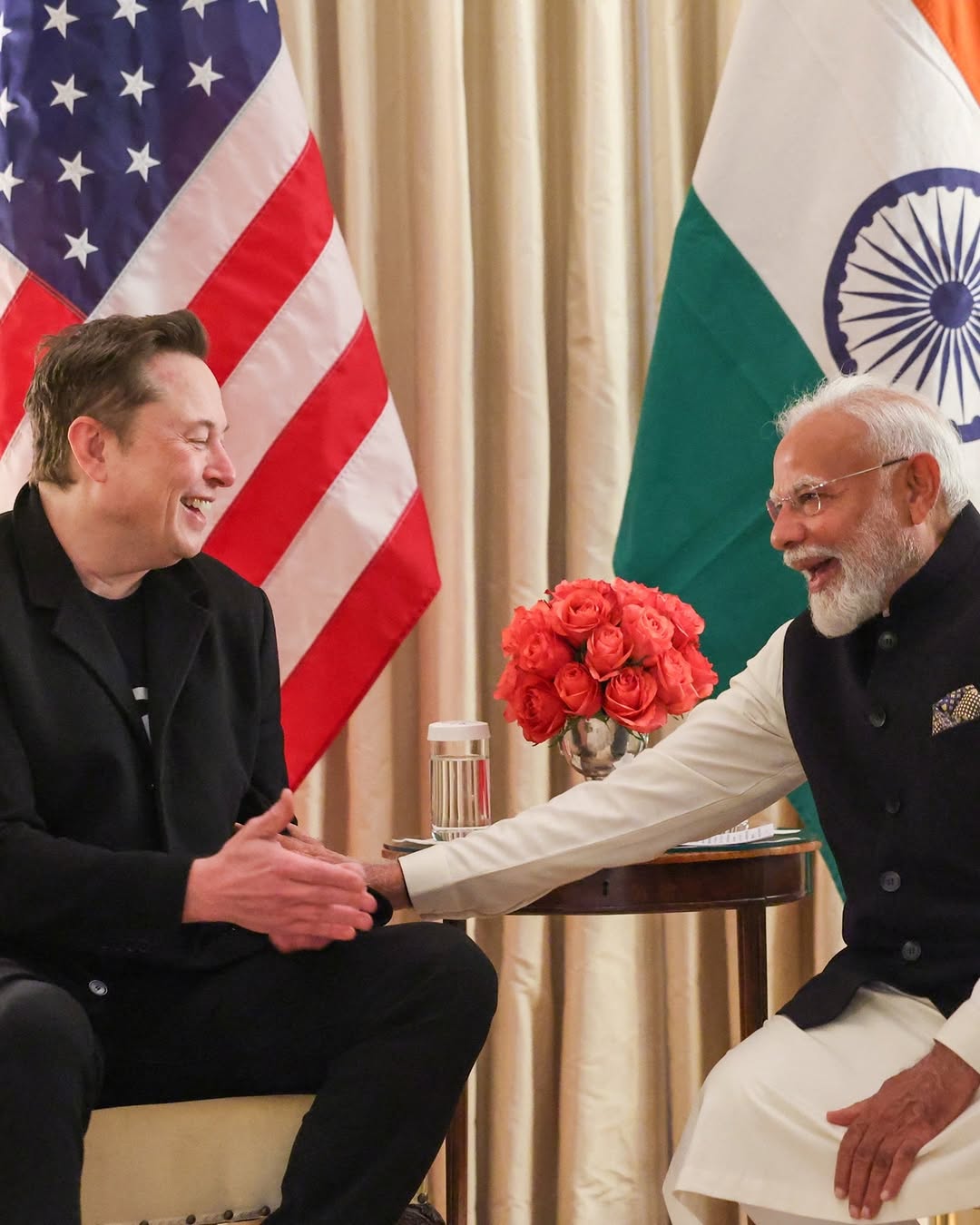
The push to bring Elon Musk’s Starlink into India appears to be gaining momentum following a Friday meeting between Prime Minister Narendra Modi and the US tech billionaire. The discussion included how Musk’s satellite internet provider can launch in the South Asian nation soon.
While announcing the discussion via an X post, the Prime Minister explained that India remains committed to advancing its partnerships with the US in the tech and innovation fields.
“Spoke to Elon Musk and talked about various issues, including the topics we covered during our meeting in Washington, DC, earlier this year. We discussed the immense potential for collaboration in the areas of technology and innovation,” Narendra Modi said.
Reacting to the meeting, Starlink’s Elon Musk noted that the business discussions will offer a new opening to the people of India. “In a nutshell, it was a fantastic meeting with the Prime Minister and I like him a lot and we’ve known each other for a while,” he added.
On how he views Modi’s leadership in technology, solar, and other inventions, Elon Musk said that “he (Modi) really wants to do the right thing for India & be open to new companies and to make sure it accrues to India’s advantage,e which is fantastic.”
In February, during a US visit, Modi met Musk in Washington. The PM later described the meeting as “good” and said they had discussed space, mobility, technology, and innovation.
Also Read: Starlink secures 10-year license to operate in Lesotho less than 24 hours after Somalia approval.
Friday’s meeting comes after Indian Commerce Minister Piyush Goyal hosted a delegation from Starlink this week. The discussion focused on exploring Starlink’s potential in the country and future investment plans.
“Discussions covered Starlink’s cutting-edge technology platform, their existing partnerships & future investment plans in India,” Goyal said on X.
Experts have suggested that Starlink’s launch in the country would be a great benefit considering its immense population of over 1.438 billion, where close to half of the population are rural area residents.
Data from Statista revealed that India’s internet penetration rate rose to 55.3 per cent in 2025, from about 52.4 per cent in 2024 and 13.5 per cent back in 2014. As these figures still seem relatively low, this means that close to half of the population is still without internet access.
With Starlink’s satellite penetration rate and ability to provide reliable and high-speed internet, Indian authorities are seeing it as a tool to bridge the internet access gap across the country. Starlink’s constellation of over 6,750 low-Earth orbit satellites offers a solution by bypassing the need for terrestrial infrastructure, potentially delivering speeds of 50 to 250 Mbps, according to global service data.
Last month, two Indian telecom giants signed pacts with SpaceX to bring Starlink Internet services to the South Asian nation. Both agreements are subject to SpaceX receiving its authorisation to sell Starlink in India.

In its recent pursuit of regulatory approval, India’s stringent approach to security measures has long been a critical hurdle for Starlink’s expansion. The regulatory scrutiny projects concerns in other regions, particularly where satellite internet devices could be misused in conflict zones for illicit and criminal activities. This follows allegations that Starlink tools were being used for militant operations in India.
Also, the biggest challenge for foreign companies breaking into India has been its policies, stiff competition from local competitors, and an inability to penetrate India as an outsider. U.S. companies, including Meta, Walmart, and Amazon, have faced significant challenges in that space.
Starlink’s chances in India’s telecom industry
For a while, the satellite internet company has been pushing for a launch in the South Asian country. Its emergence would signal a lucrative business for Starlink considering the country’s immense population and mobile-savvy consumer market. According to Statista, the country possessed a massive internet user base of 1.2 billion in 2023.
Moreover, experts noted that Musk’s influential role in the White House incentivised the Indian government to reevaluate a Starlink deal. This comes amid trade talks between U.S. and Indian officials with Trump’s reciprocal tariffs which have now been halted.
While India and the U.S. remain in trade talks, the deal is seen as a huge win for Musk. Also, Trump is friendly with both Musk and Modi.

When it launches in India, Elon Musk will partner and perhaps compete with Reliance’s Jio and Bharti Airtel, which together dominate India’s booming telecom market. It will offer Musk the unique opportunity to work with the heads of these telecom majors and powerful Indian billionaires, Mukesh Ambani and Sunil Mittal, as the two are highly respected and influential tycoons.
Meanwhile, a Counterpoint Researcher, Neil Shah pictures an upper hand for the satellite company in India. He noted that Starlink can offer internet in rural India where Jio and Airtel do not have connectivity, and it is costly to build telecom infrastructure. Jio and Airtel will then acquire local customers on behalf of Starlink, selling the equipment needed to run high-speed internet.
While we await all these, Starlink has continued to expand its coverage across Africa following its recent launch in Somalia and Lesotho. It has now launched in about 20 African countries.
