



Nigerians have filled the replies and quotes under Aviation Minister Festus Keyamo’s X post with questions after he made national identification number (NIN) check-in compulsory for domestic flights. Foreign travellers, children, network failures and legal backing top the list, with airlines due to key into the system by December 31.
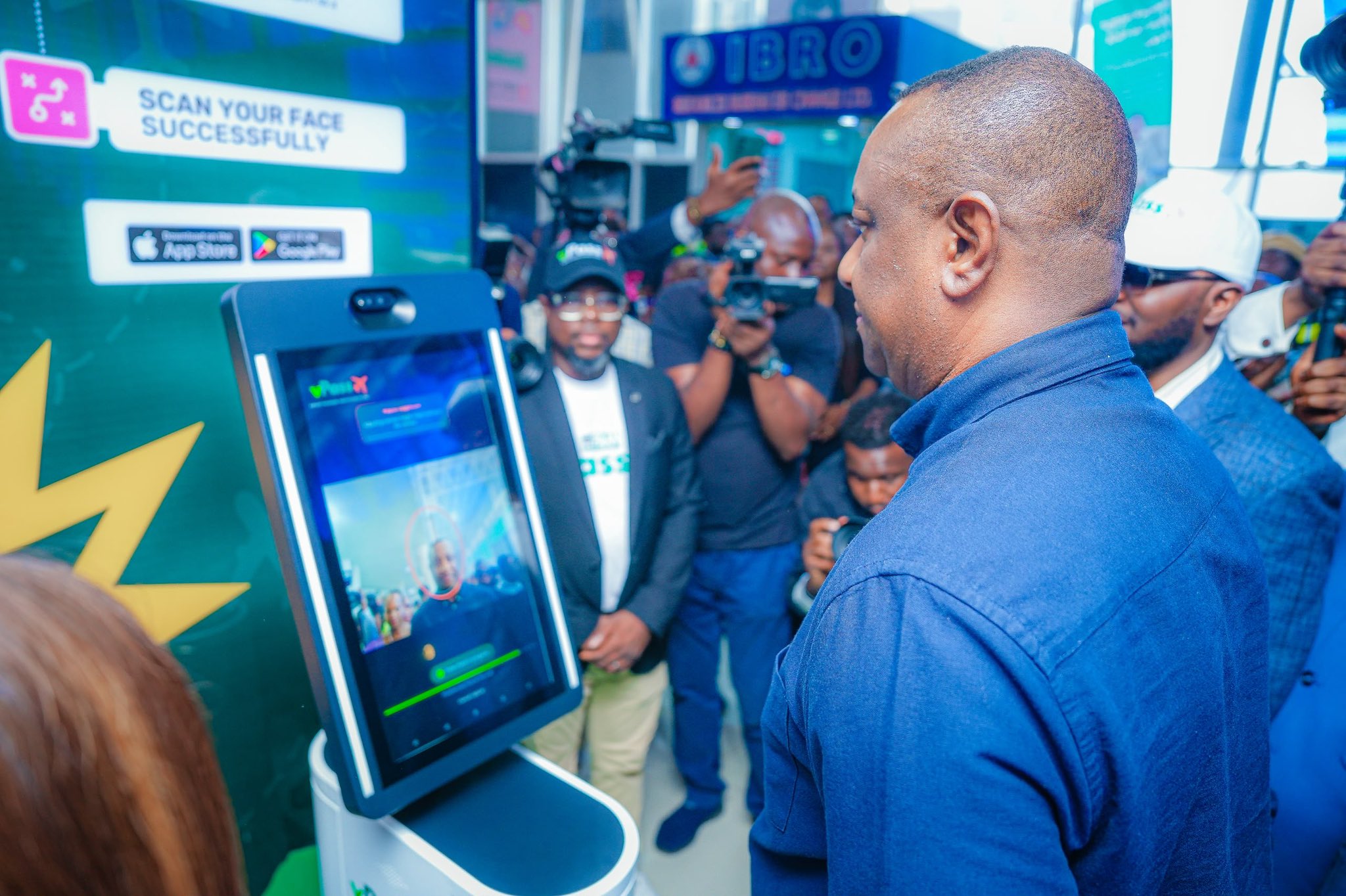
Keyamo unveiled the Airport Passenger Verification System (V-PASS) at the domestic terminal of the Murtala Muhammed Airport, Lagos, on Monday. He was joined by the managing director of the Federal Airports Authority of Nigeria (FAAN), Olubunmi Kuku, and other top FAAN directors. The project was executed through a public-private partnership.

The minister described the platform as a smart system linked to every Nigerian’s NIN and designed only for domestic flights. He argued that it will stop passengers from boarding with fake identities and curb touting and ticket racketeering. He also directed the Nigerian Civil Aviation Authority (NCAA) to give airlines until the deadline to join.
According to reports, passengers will register once with their NIN and facial biometrics, either at the airport or through a vPASS mobile app. After that, they will only need the last four digits of their NIN at the e-gates.
Also read: Nigeria reaches 200 million active telecom users, the first time since 2024’s NIN-SIM enforcement
Foreigners, children and travellers without a NIN
Dr Charles Omole posted the most detailed set of questions. He asked what happens to foreigners without a NIN, including Nigerians who travel on foreign passports, and whether they are barred from domestic flights. He also asked about Nigerians who arrive on expired passports and need a local flight to their final destination, and about children and adults who hold other IDs but no NIN.
“Is NIN now a compulsory requirement to fly in Nigeria? Is this backed by any law?” he asked. He noted that most countries accept any valid ID rather than a national identification number.
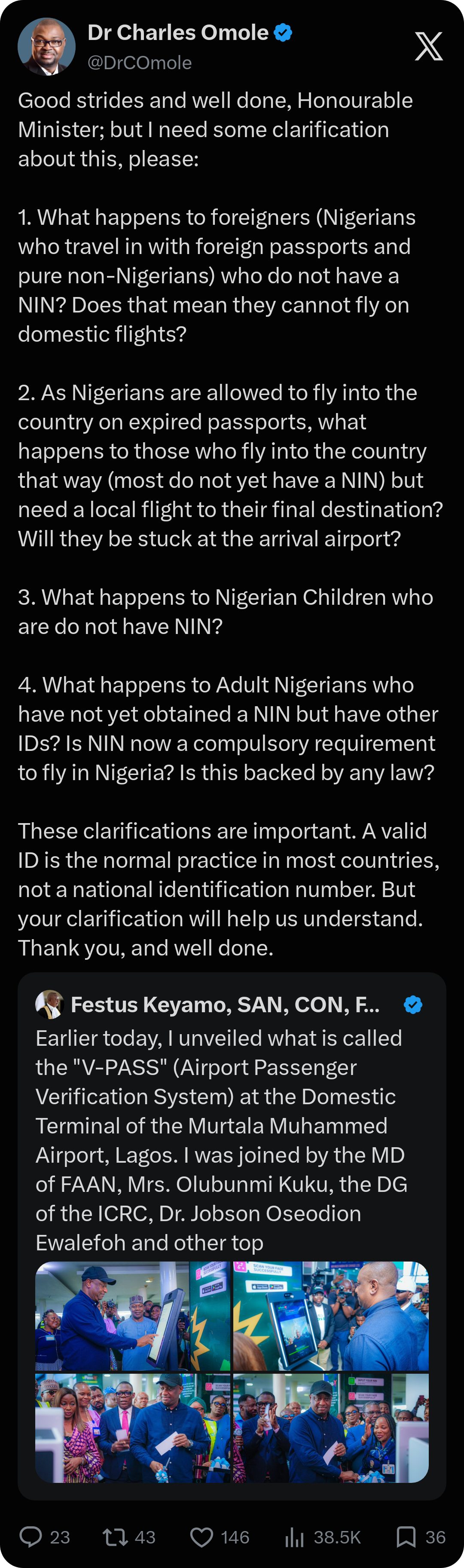
Another user, Mico, dismissed the concern, insisting an adult Nigerian without a NIN was “not possible”. Omole countered that only 120 million valid registrations existed as of September 2026, citing data from the National Identity Management Commission (NIMC). He claimed this leaves tens of millions of Nigerians uncaptured. Technext independently verified the figure and found it to be inaccurate.
The claim that only 120 million valid NIN registrations existed as of September 2026 is inaccurate, as that figure actually reflects an earlier milestone reached back in May 2025. Official records from the National Identity Management Commission (NIMC) confirm that valid NIN enrolments had already surpassed 142 million by September 16, 2026.
The foreigners’ question came up repeatedly. Adeshina Adegbite asked what means of identification would verify foreign passengers on domestic routes, while Tochukwu and Joseph raised the same point. Chibunna asked for clarification on the legal backing.
Keyamo’s post made no mention of foreign passengers, children or the law.
Network failures, extortion and cost
Several users focused on how the system will cope in practice. ETIM wanted to know how it works when there is “no network”, while HON. MOREFUNDS asked what happens when the NIN portal is down. Another user also asked whether passengers can still check in online, how many units will be installed to ensure adequacy, and whether people will have to remove hijabs for facial scans.
Read also: FAAN clears Bolt to resume airport operations after passenger backlash
Doubts about the stated aim ran through many responses. Yagazielum posted that his driver’s licence, passport and voter’s card are all linked to his NIN, yet ticket racketeering and “beggy-beggy” persist at the airports. YourLearnedFriend hoped the platform would not become another avenue for “extortion, exclusion and unnecessary inconvenience”. Ola asked who pays the private investor and how a NIN removes touts.
Privacy also drew attention. Eze wrote that the initiative raises serious privacy concerns, and Admax warned that it could expose passengers’ NINs to hackers.
Some reactions were supportive. JOA predicted that Nigerians would complain but that the system would improve aviation safety, urging people to enrol for a NIN. S, an X user, expected it to address racketeering but asked for more time for adoption. Folu Oladipo recommended that the NCAA link the database to a no-fly list to deal with unruly passengers and onboard theft.
Philips Ndahi King backed the idea on one condition: that it avoids the fate of the NIMC and Federal Road Safety Corps (FRSC) portals.
With the deadline about six weeks away, the questions on foreign passengers, children, network failures and legal backing remain open.
