



Ghana is moving marriage verification from public notices and scattered records to digital searches with Marrify, a newly launched platform that makes marriage-related information available online.
The platform, launched in Accra on August 28 in partnership with the Ministry of Gender, Children and Social Protection, allows users to search marriage and divorce records as well as verify marriage officers, venues and licensed Imams.
While Marrify has been presented as a tool for prospective couples to check the marital status of their partners, its wider offering reflects a shift in how marriage-related information can be accessed and verified.
Before now, marriage registration and verification involved records held across different institutions and processes, including the Registrar-General’s Department, courts, Metropolitan, Municipal and District Assemblies and the Ghana Gazette.
Marriage registration processes have also relied on public notices, with information published to allow objections before some marriages are registered or solemnised.
Marrify is bringing scattered records online
Marrify is seeking to bring parts of these records and verification processes into a searchable digital platform.
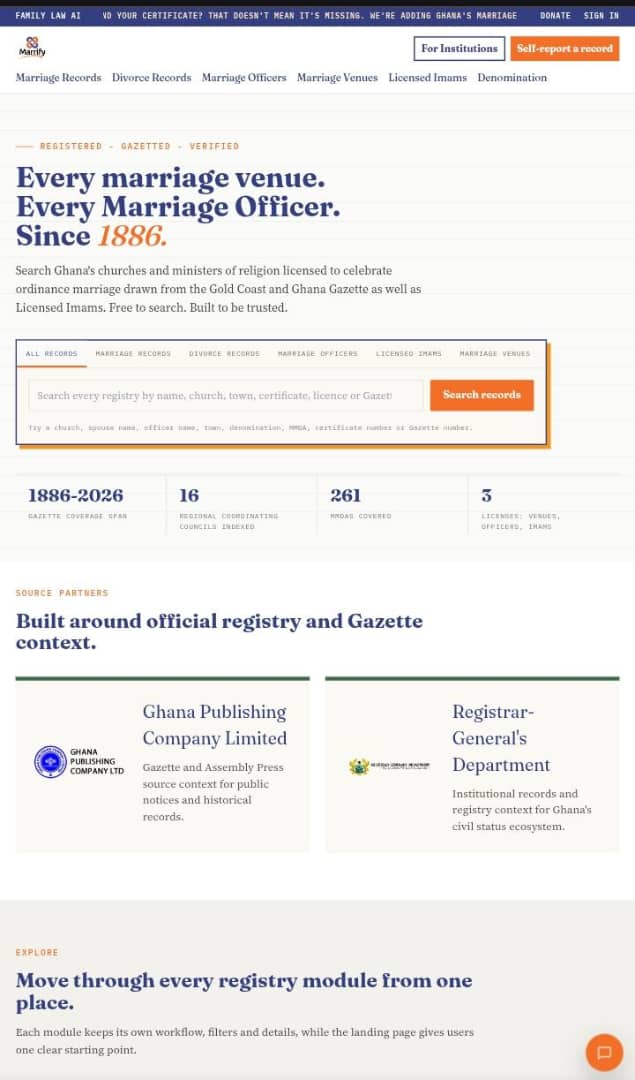
The platform says its database includes Gazette records dating from 1886 to 2026 and links records across customary, Islamic and ordinance marriages. It also connects divorce and annulment records to the original marriage records where available.
Also read: Nigeria, Ghana power MTN’s historic $7.18bn H1’26 revenue, offsetting South Africa struggles
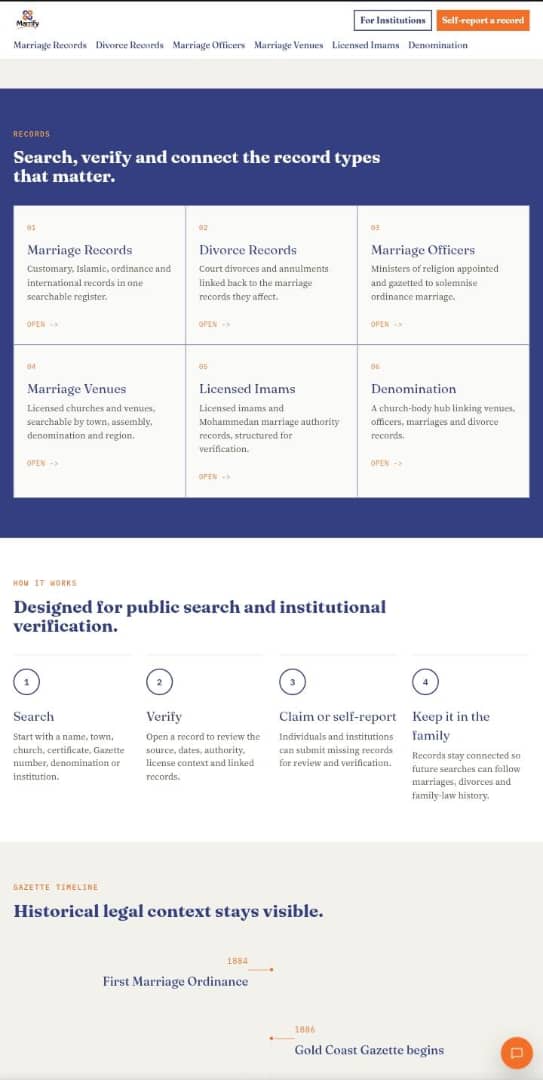
Users searching the platform can open records to view information including their source, dates, issuing authority and relevant licence context.
Beyond individual marriage records, Marrify provides searchable information on ministers of religion gazetted to solemnise ordinance marriages, licensed marriage venues and Islamic marriage authorities.
Its venue database can be searched by town, assembly, denomination and region, while a denomination section links marriage venues, officers and records associated with church bodies.
The platform also claims to cover all 16 regional coordinating councils and 261 Metropolitan, Municipal and District Assemblies, while tracking three licence categories covering venues, marriage officers and Imams.
Beyond public searches
Marrify’s model goes beyond making historical records available for public searches. The platform has separate portals for MMDAs, churches, the Registrar-General’s Department and courts, allowing institutions to submit or manage records. It also provides a self-reporting and record-claim process for individuals and institutions seeking to add or claim missing information.
For Ghanaians living abroad, Marrify also says its searchable records can support verification needs involving embassies, courts and personal documentation.
The platform includes a timeline of Ghana’s marriage laws and administration, tracing developments from the 1884 Marriage Ordinance and the beginning of Gazette records in 1886 through subsequent legislation governing Islamic, customary and other forms of marriage.
Marrify also features a Family Law AI assistant, which it says can provide support for family-law research, drafting and document review.
The platform is operated by Marry Right Ghana and describes itself as a “National Marriage & Divorce Registry”, with a stated focus on digitisation, verification and public access to marriage-related records.
