



More than half of mobile industry respondents believe their customers do not know eSIM exists, making lack of awareness the single biggest barrier to consumer adoption of the technology, according to the Mobile World Live eSIM Survey Report 2026.
The report, published in partnership with 1GLOBAL, Amdocs, and Kigen, surveyed mobile industry insiders on the state of eSIM progress, consumer behaviour, IoT deployment, and security. It found that despite the technology reaching its tenth year in 2026, adoption remains modest in most markets outside the United States.
The findings suggest that while its adoption is growing, mainstream consumer awareness remains limited. 60% of global eSIM users used the technology while travelling abroad in the last 12 months, according to GSMA Intelligence data cited in the report. This suggests that travel and roaming are currently the clearest use cases driving real-world adoption.

Setting up a new or upgraded phone was identified as the most common consumer trigger by 60% of respondents, with roaming a close second at 55 %.
spondents identified lack of awareness as the top barrier at 55%, followed by lack of device support at 47%.
Read also: MTN Nigeria added over 250k eSIM subscribers in 2025, total users now 492k
39% were hesitant about adopting it, while 35% find the activation process too complicated. Additionally, 20% believe that it is more expensive than physical SIM cards, which discourages them from switching.
Why the eSIM awareness gap persists and what it implies
The lack of awareness around the technology is not too shocking. This is because a non-physical SIM card is built directly into a device, unlike a SIM card that one can take out; most people never physically interact with it or even really consider it. It usually just works without needing any attention, and many consumers with compatible devices have never activated or used the feature.
The report indicates that only 22% of industry organizations have fully implemented the new technology and are actively marketing it to customers. Another 22% have implemented it to a limited extent. 30% are still in the planning stages for deployment, and 26% have no plans to implement the technology at this time.
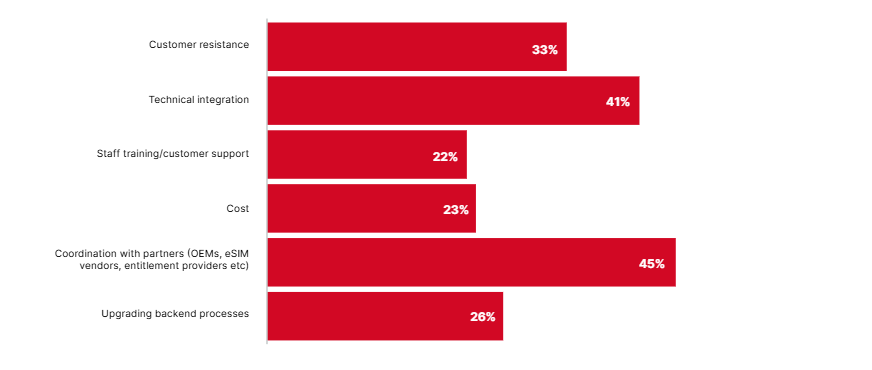
This uneven level of industry adoption makes broader consumer awareness harder to achieve.
Despite the slow uptake in consumer markets, the industry remains broadly optimistic. GSMA Intelligence expects eSIM smartphone connections to reach 4.9 billion by 2030, driven partly by growing device support as more mid-range and lower-priced phones begin to include its capability.
60% of industry respondents in the survey agreed that technology is cheaper to operate than physical SIMs, pointing to long-term cost advantages that could accelerate commercial deployment.

The report also found that 54% of consumers who do not currently use technology say they are interested in using eSIM on their smartphones at some point in the future, a signal that demand exists but has not yet been activated by sufficient awareness, education, or industry push.
For the telecoms industry, the challenge is not just technical. It is communicational. Getting consumers to understand what eSIM is, how it works, and the practical benefits it offers remains one of the industry’s biggest communication challenges.
