


On 28 May 2025, a small business owner in Nigeria, Owoyemi Segun, paid ₦150,000 through the Ministry of Interior’s online citizenship portal, using a vendor identified as eCitibiz.
The portal, ecitibiz.evdpl.com, processed the payment for a bachelorhood attestation certificate. The certificate was for the son of an elderly man planning to wed in Turkey. This document, required by Turkish immigration authorities, has now become the subject of a community dispute, financial hardship, and claims of institutional negligence.
The man who made the payment is not the applicant. He runs a business that processes travel documents and administrative filings for clients.
He took the job in good faith, having handled similar assignments for passports, police certificates, and WAEC registrations in the past. After speaking with a Ministry of Interior staffer, Barrister Nonye, who confirmed the fee and process, he decided to proceed with the official channel, which is the Ministry’s payment portal.
Barrister Nonye confirmed the fee over the phone: “₦150,000. It is an online payment. How can the amount be reduced?”
When asked if the payment could be made directly through her, she suggested sending money to her, but the man insisted on making the payment through the Ministry portal to ensure legitimacy.

He scanned the required documents, created an account on the platform, uploaded them, and completed payment. The payment went through successfully. Then the silence began.
When he followed up to request the certificate, he was told the Ministry was planning to change vendors. No official notice was on the website, and the online portal still accepted payments.
He was advised to meet the director in Abuja with the payment receipt. When he arranged for a contact in Abuja, Mr Kerim, to visit the Ministry, the director refused to speak. Network issues affected a call attempt.
Barrister Nonye later said the payment had been made to the Ministry’s “former” account and that the problem was his alone.
“I asked her to provide details of the new vendor,” he said. “She said they were still in the processing stage. I reminded her that the payment had been made to the Ministry’s account, but she said that was my problem. She had no answer for how a government agency could accept money and refuse to honour it.
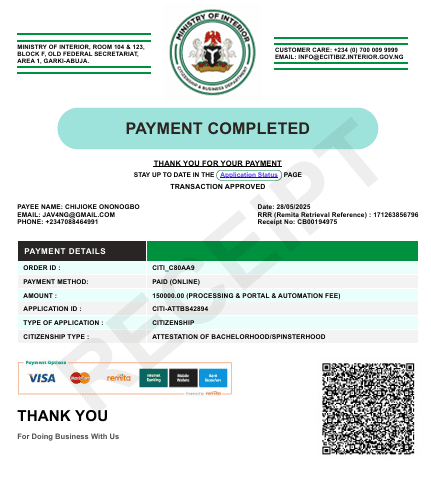
The eCitibiz platform processed the transaction. A receipt from Remita confirms that the payment reached the Ministry of Interior. In response to follow-up inquiries, Remita stated: “The specified transaction has been successfully processed to the Ministry of Interior. Kindly liaise with the Institution portal provider using the receipt as proof of successful payment for prompt resolution.”
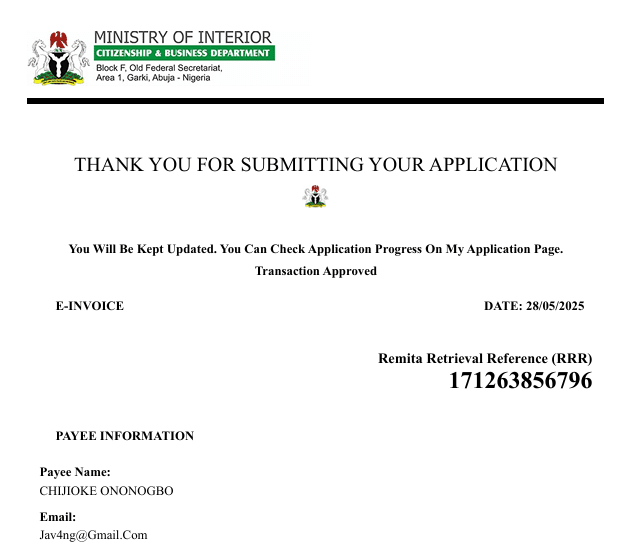
The Remita receipt confirms that funds were not intercepted or delayed in transit. They were credited to the designated public institution. Yet, no certificate was issued.
While the matter was still unresolved, the customer, the father of the groom, returned to confront the processor. The elderly man, without a phone and acting on advice from neighbours, brought the matter to the community. Residents locked the man’s shop and handed the key to the aggrieved father. He was told to either refund the ₦150,000 or produce the certificate.
Read also: NIN database breach very debatable – Tunji-Ojo, Nigeria’s Minister of Interior
The processor, Owoyemi said, “I was calling Barrister Nonye on behalf of the old man. I put the call on speaker. Some people said the receipt was fake and that I was trying to scam him. Yoruba people in the community locked my shop and gave him the key.”
The groom’s fiancée in Turkey is still waiting. Their wedding arrangements have stalled. According to Owoyemi, the father acted based on what he believed to be deception. But the processor insists his only error was trusting a government platform. He said:
I do not blame the old man. But I paid through the Ministry’s portal. I could have sent money to the official directly. I didn’t. I chose the official way.
The fallout has been personal and severe. His shop remained locked for over a week. “I used my children’s school fees to pay the man, hoping the certificate would be ready in a few days,” he said. “This is the season I make money. Schools are printing third-term exams. I type, print, and photocopy at reduced rates for schools. Losing this season means I lose rent money, school fees, and food for my family.”
He mentioned suicidal thoughts. “My mum is almost 80. She just lost her husband last year. I thought about suicide, but wondered how my wife would cope with three children. Glory to God, schools have started bringing their work again.”
The community has agreed to a compromise. “When I explained the matter, they told me to pay the money back to the old man. When the certificate is ready, I should contact the son in Turkey. They will pay me back even before I hand it over.”
He has since sent several emails to the Ministry, NGOs, and support addresses. Most were ignored. “You are the second person who has replied me,” he wrote in a message to Technext. “I feel more relieved that someone out there shows concern.”
On the regulatory side, the Ministry’s failure to disable the portal or issue notices raises accountability questions. There was no notification about the payment vendor switch. The portal continued to accept payments and generate receipts. Those payments were acknowledged by Remita and deposited into the Ministry’s account.
Under Nigeria’s Financial Regulations (2009), Ministries, Departments and Agencies (MDAs) must ensure transparency and accountability in revenue collection. The Office of the Accountant General, in Circular Ref: TRY/A10&B10/2011, mandates that government MDAs maintain accurate public communications during vendor transitions and ensure public-facing platforms are updated.
The Public Procurement Act (2007) also requires that changes in service vendors, especially those involving payment services, undergo open communication processes and must not affect service continuity. The law does not support ministries accepting funds without delivering services, nor does it place the burden of structural transitions on citizens.
The man’s case may be only one of many. “Only God knows how many Nigerians have paid into the same account daily,” he said. “If they are changing vendors, will they abandon the money in the account?”
He asked for a clear refund mechanism. “If they [Ministry of Interior] are no longer using eCitibiz, then there must be a refund process for those who paid. They cannot keep the money and say the problem is mine.”
He is still waiting for a resolution. His documents are intact. His receipt is valid. The certificate remains undelivered. No refund has been issued.
He said, “I process international passports, vehicle certificates, and other documents daily. We upload, pay, and get results within 24 hours. I believed the same would happen here. But now they want to put me in ₦150,000 debt. That’s like ₦5,000,000 to me.”
He continues to work. Schools are returning for exam season. But he wants one thing clear: “I want my certificate or my money back. That’s all.”
We have attempted to reach Barrister Nonye and/or the Ministry for over a week, but the ministry’s official channels have been unresponsive.
