




The Nigerian arm of the United States Mission had directed all those seeking F, M, and J visitor visas to adjust their social media accounts’ privacy settings to enable seamless profile checks.
According to information announced on Monday on the Mission’s X page, the embassy noted that the directive is effective immediately for students and exchange visitors seeking visas for their voyage to the United States.
“Effective immediately, all individuals applying for an F, M, or J nonimmigrant visa are requested to adjust the privacy settings on all of their personal social media accounts to ‘public,’” it noted.
Recall that following the relaxation of suspension on student visa applications, the U.S. Department of State explained that applicants under the F (academic), M (vocational), and J (exchange) nonimmigrant visa categories will now undergo a more intensive screening, including a review of their online presence. F, M, and J categories are issued to nonimmigrant individuals travelling for educational and cultural exchange purposes.
“We use all available information in our visa screening and vetting to identify visa applicants who are inadmissible to the United States, including those who pose a threat to U.S. national security. Under new guidance, we will conduct a comprehensive and thorough vetting, including online presence, of all student and exchange visitor applicants in the F, M, and J nonimmigrant classifications,” it explained.
While admonishing applicants to make their profile privacy “public,” the Mission stressed that the new policy will enable a thorough screening to verify applicants’ identities and prove that they qualify for the type of Visa they are requesting.
“We use all available information in our visa screening and vetting to identify visa applicants who are inadmissible to the United States, including those who pose a threat to US national security,” the agency added.
The move is also part of Donald Trump’s ambition to strengthen the country’s national security and ensure immigrants pose no threat to the United States and its citizens. The administration is of the notion that a visa is “a privilege, not a right,” and that applications are now subject to national security decisions.
Also Read: U.S. resumes social media verification for student’s visa applications.

Nigerian denied entry despite a valid visa
Amid the United States’ move to tighten non-immigrant entry through filtering and examinations of applicants’ social media accounts, the case of a Nigerian denied entry to the U.S. despite possessing a valid visa has raised further concerns.
In a twisting scenario that started trending on social media on June 29, a Nigerian businesswoman shared an emotional video on how she was denied entry to the country.
While recording the sad incident via her Instagram account during her return flight to Nigeria, she revealed that she had travelled to Texas to attend a trade fair, using a B1/B2 visa, a category typically granted for tourism or business meetings. She was thereafter detained for 24 hours upon arrival and subjected to intense questioning.
“I was denied entrance into the US, and that is because my visa is a B1–B2 visa, which is for tourism/business meetings. When I landed, I was detained for 24 hours, and I was questioned. I told them I was going to exhibit but I did not know any better because the US has your data and your Instagram page,” she recounted.
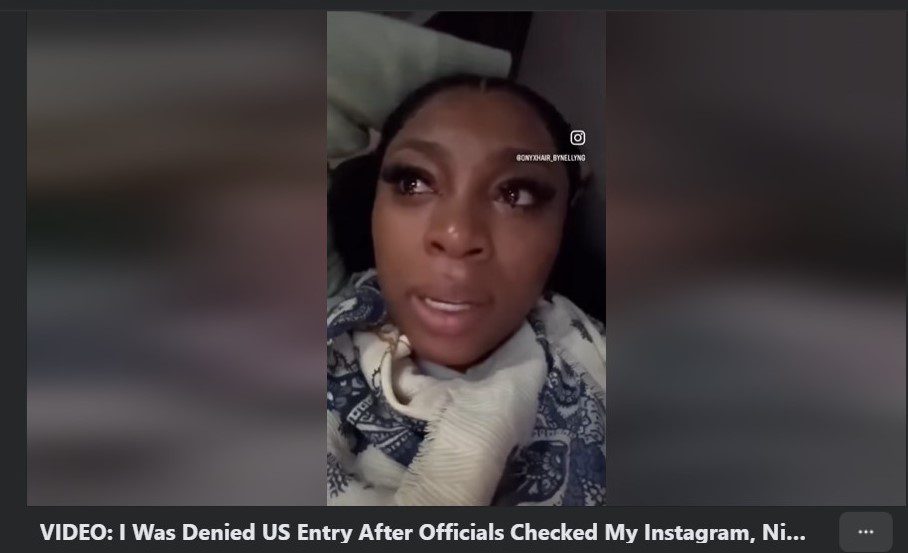
According to the woman, the United States immigration officers thoroughly examined her social media accounts and private messages with customers and used the content they found to question and ultimately dispute the reason she gave for her trip.
In her tearful clip, she said:
“Apparently, my Instagram says different. They even checked all my messages with my customers. The customers I have been telling that we are coming, they can pick up and all of that.”
Reactions
While the victim didn’t provide details as to why she was really denied entry, social media users were of different opinions as to her denial.
A user explained that her recent conversions on Instagram must have negated her visa type and mission in the United States.
“This isn’t about account details but conversations she has had or having with people. If you’re discussing with people in inbox that you’re travelling to order goods and you say you’re travelling for a different purpose, that’s contradictory.”
Another user believed that her account balance during the application must have been below the required amount for the type she possessed.
“All those was prompted because she doesn’t have enough money with her, cash or in the account for whatever. Immigration will not just deport you because of a mistake in the visa type. I’m sure she didn’t have up to 15,000 usd then.”
The incident further reflects a shift amid the new visa application policy. With applicants’ social media vetting now part of the verification process, recent activities and chats become vital.
