





When Uchi Uchibeke announced on May 12 that he was shutting down Chimoney, the cross-border payments startup he had spent four years building, the post read like a founder in full control of his own narrative. The product worked, he wrote. Distribution was the problem. He had notified investors in February, clients in April, and was refunding every dollar. He was already building something new.
Most of the coverage that followed accepted that framing. But was that really the case?
In exclusive responses to questions submitted by Technext, Uchibeke confirmed several details that add texture to the shutdown story. But reviews of the Chimoney app on both the Google Play Store and the Apple App Store, examined alongside the founder’s responses, surfaces a tension at the heart of his account that has gone unreported.

The Chimoney app carried a 2.1 rating out of 5 on Google Play across 49 reviews at the time of shutdown, with the 1-star bar the most prominent in the distribution chart. On the Apple App Store, the rating was 3.4 out of 5, though only 5 users had rated it there, a figure too thin to be statistically meaningful.
The complaints across both stores were strikingly consistent, and they were overwhelmingly from African users.
The gap the reviews expose
Reviewer after reviewer described the same cluster of problems. KYC verification requests submitted weeks or months earlier with no response. Funds stuck inside the platform with no resolution. Customer support that did not reply to emails or in-app messages.
One user, Galadima Faruk Abdullahi, writing in May 2025, described himself as a payment partner with funds he could not access after five days of trying to resolve a payment issue. Another, Vanessa Sampeters, writing in October 2025, called out GOODWALL by name as a company using Chimoney as a payment channel and urged them to stop. A third, Chimhurumnanya Chigozie, had submitted KYC documentation three months before their review and was still waiting.
These reviews matter because of their timing. Several were posted in the second half of 2025, the same period in which Uchibeke says he repositioned Chimoney around AI agent wallets and, by his own account, shipped that repositioning. The operational complaints from users were live at the same time the company was pivoting its public narrative toward a new frontier.
Uchibeke, in his responses to Technext, maintained that the product worked.
“The product worked, but the distribution and customer acquisition didn’t move fast enough on the runway we had left,” he said, describing the late-2025 repositioning.
On the question of African client coverage, he said a significant portion of the client base was Africa-facing, including developers and businesses building on payout rails for Nigerian and Kenyan markets. He also noted that migration playbooks mapped Chimoney’s capabilities to alternatives, including Flutterwave.
What he did not address on African infrastructure adequacy, is whether users who never completed KYC can access the self-service refund flow that requires identity verification to process. The refund window is open through August 31, 2026. Users whose KYC submissions sat unprocessed for months before the shutdown may find that window functionally closed.
What the Chimoney numbers say
Chimoney disclosed only limited financial details. Uchibeke told Technext that he would prefer not to share specific revenue figures, saying only that revenue did not grow fast enough. From public data, Crunchbase records approximately $280,000 in disclosed funding. Uchibeke himself said total capital raised across the company’s lifetime was under $1 million, including accelerator funding and grants from the Interledger Foundation.
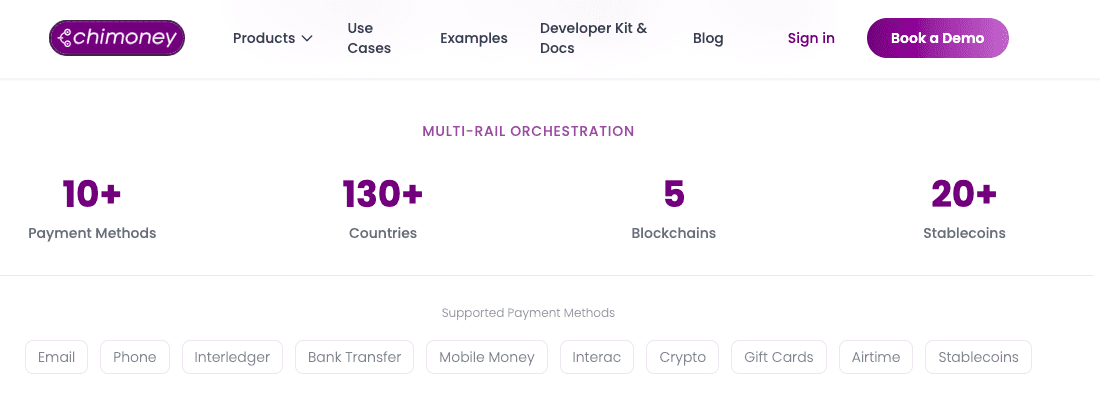
That figure, under $1 million across four years for a fintech holding a FINTRAC MSB licence and a Bank of Canada PSP registration under the RPAA regime and operating across 41 currencies in three regions, is probably the structural fact at the centre of the Chimoney story.
Uchibeke acknowledged it plainly. “Under $1 million is too thin for a venture-scale fintech across multiple jurisdictions,” he told Technext. “I should have either raised meaningfully more or bootstrapped properly with a profitable beachhead. Trying to operate at venture scale on bootstrap capital was the wrong strategy.”
The company explored acquisitions and strategic alternatives before deciding to wind down. Uchibeke confirmed to Technext that multiple conversations progressed to due diligence, while others remained exploratory, and that none closed on terms that made sense. He declined to name the parties involved.
The licence and what comes next
One detail in the shutdown announcement drew less attention than it deserved. The corporate entity, Chi Technologies Inc., is not being dissolved. Its PSP registration under the Bank of Canada’s RPAA regime is being preserved under dormant status.
Uchibeke told Technext that APort, the new company he is building around pre-action authorisation for AI agents, is a separate legal entity with its own funding, and that no Chimoney client funds, customer data, or operational assets have been transferred to it.
The PSP licence, he said, is hard to get and will only get harder. He is keeping it.
That decision is commercially rational. The RPAA registration, which Chimoney secured in November 2025, is among the first cohort issued under Canada’s new retail payments regime and carries no expiration date. Several African-founded fintechs, including LemFi, NALA, Fincra, and Grey Finance, have secured similar registrations since early 2026, suggesting the corridor remains strategically attractive even as Chimoney exits it.
3 lessons, as told to Technext
Uchibeke offered three lessons in his responses that go further than what he published publicly.
- The first is on capital: raise properly or bootstrap with a profitable beachhead, and do not try to do both at once.
- The second is on distribution: he estimates he spent roughly 90% of his time on product and engineering and 10% on positioning and customer acquisition, a ratio he says should have been closer to 50/50.
- The third is on closure: notify investors first, notify clients next, refund every dollar, publish migration guides, and help people leave well.

The structured wind-down is genuine. Chimoney’s closure compares favourably to more chaotic African startup failures, where users lost funds permanently. The refund process is documented, the developer migration playbooks are published, and the regulatory obligations appear to be met.
But the 2.1 rating and the reviews underneath it are also genuine. They represent users, mostly African, who experienced a version of Chimoney that was slower, less responsive, and more frustrating than the API platform its founder describes. Both things can be true. A product can work for the enterprise clients it was designed for and fail the retail-adjacent users who found it through the app store and expected something different.
Chimoney’s founder said how you close something matters as much as how you build it. The app store record suggests there is a third variable he did not mention: how you serve people while you are still open.
After this story was published, Uchi Uchibeke contacted Technext with additional context on three points. He clarified that the Chimoney app was a consumer-facing experiment built on top of the API rather than the core product, which was always B2B bulk payouts. He said a meaningful share of unresolved KYC submissions involved documents that appeared fraudulent or did not meet verification standards and that declining suspect applications represented the platform working as intended. He also noted that complaints about stuck funds largely reflect upstream decisions by business clients since beneficiaries were end users of Chimoney’s business customers rather than direct Chimoney customers. Technext has published his full response and notes these points for reader context.
