


The world is witnessing a technological shift unlike any before especially with the massive development of AI systems. Web3, the next phase of the internet, is redefining not only how people interact with digital spaces but also how they work, earn, and build careers.
This transformation is breaking down traditional employment barriers, allowing professionals from anywhere in the world to participate in a decentralised economy.
For Nigeria, a country with a young, tech-savvy population, Web3 is both an opportunity and a challenge. With high unemployment (and underemployment ) rates and an increasing number of skilled professionals entering the job market, the rise of a digital workforce without borders could be the answer to a long-standing problem.
But is Nigeria ready to fully embrace this new era?
The Web3 job market is unlike anything seen before. Traditional corporate structures are giving way to decentralised organisations, and job seekers no longer need to relocate to tech hubs like Silicon Valley to access top-tier opportunities.
According to data from the State of the Web3 Job Market: Outlook for 2025, 53.39% of Web3 jobs are fully remote—a statistic that aligns with the industry’s decentralised philosophy. This means that talented individuals in Nigeria can now compete for the same roles as their counterparts in Europe, Asia, and North America.
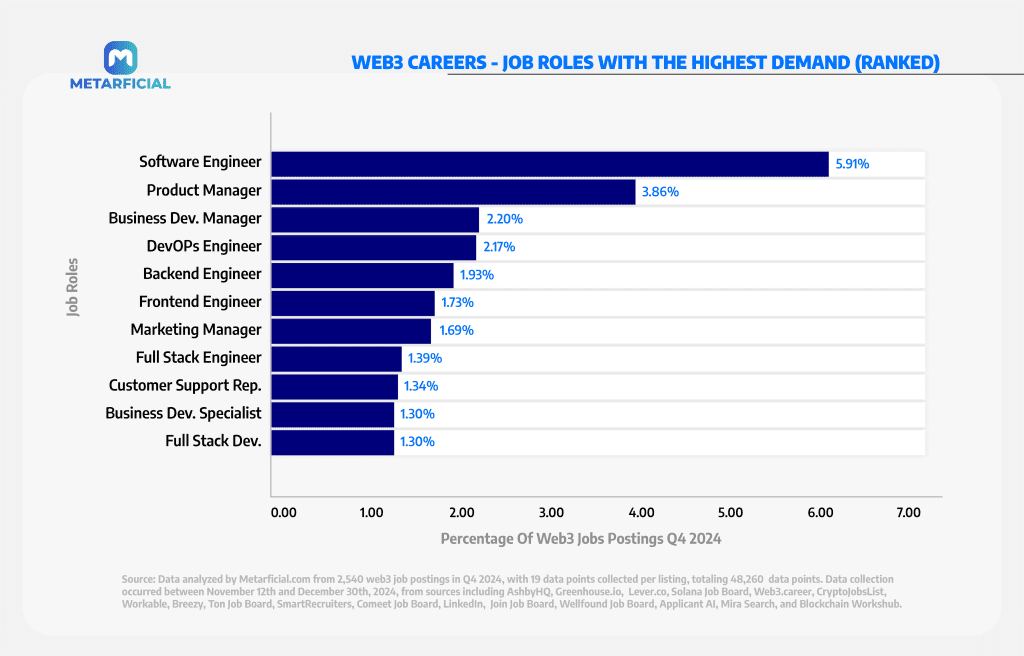
Yet, remote work is not the only defining factor. The industry is structured in a way that embraces both technical and non-technical professionals. While software engineers remain the most sought-after, 39.45% of Web3 jobs require no coding or technical skills. This makes the industry accessible to a wider range of professionals, including those in marketing, legal, finance, and customer support.
For many Nigerians, this is a game-changer. The country has long been recognised as a leader in fintech innovation, with companies like Flutterwave and Paystack transforming digital payments across Africa. The same entrepreneurial spirit that drove Nigeria’s fintech boom could propel it into the global Web3 workforce.
However, with opportunity comes competition, and Nigerian professionals will need to prove they can meet the demands of this rapidly evolving industry.
Who is hiring? A look at the biggest players
The demand for Web3 professionals is growing, but where are the jobs coming from?
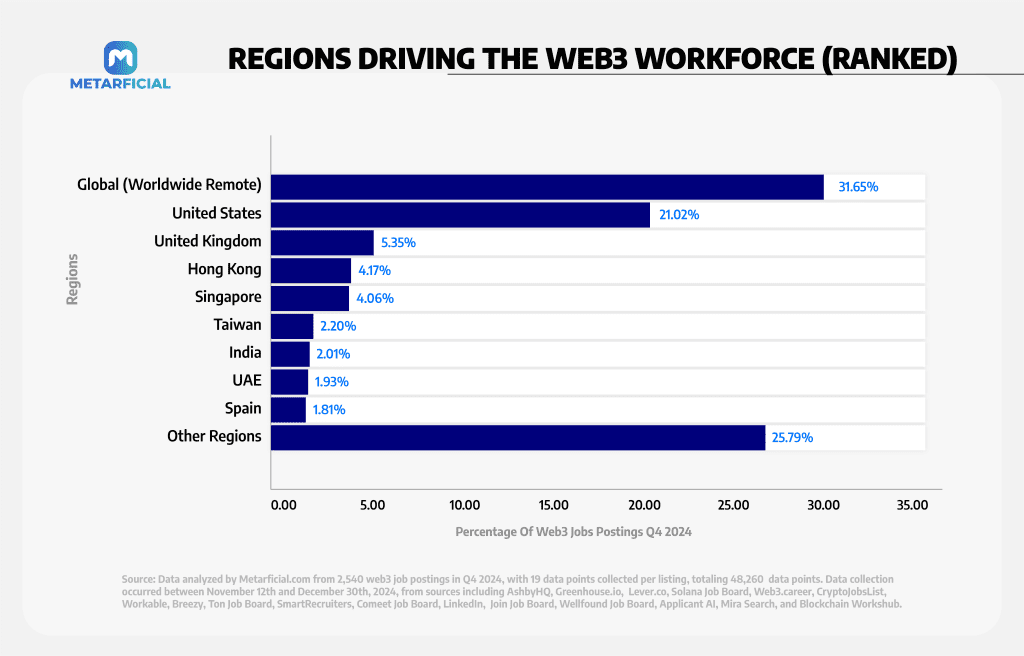
The United States remains the dominant force, accounting for 21.02% of global Web3 workforce demand. Cities like New York and San Francisco have become key hubs for blockchain and decentralised finance (DeFi) innovation.
However, while the U.S. leads in hiring, remote roles continue to dominate the landscape, making it possible for professionals from countries like Nigeria to join global teams.
Beyond geographical trends, industry-specific data reveals that brands providing financial services dominate 59.45% of Web3 workforce demands. This includes companies operating in fintech (33.54%), cryptocurrency exchanges (20%), and DeFi (5.91%).
This should come as no surprise—cryptocurrencies were originally designed to address inefficiencies in traditional finance. Many Web3 companies are now building digital asset storage solutions, decentralised trading platforms, and liquidity services that challenge traditional banking models.
Nigeria, which already has a strong fintech ecosystem, could easily become a talent hub for this sector if professionals are equipped with the right skills.
One example of Web3 hiring in Nigeria is Token Metrics, a cryptocurrency research and data analysis company that actively sought Nigerian professionals for roles like Crypto Quantitative Analyst, Data Scientist/Machine Learning Engineer, and Full Stack Developer in 2024. This signals a growing recognition of Nigerian talent, but the industry is still in its early stages, and more opportunities must be created to support widespread adoption.
The skills gap: What Nigerian professionals need to succeed
While the Web3 industry is growing, success is not guaranteed. Nigerian job seekers must navigate several key challenges, the first being the high level of competition.
Hanif Olayiwola, a Web3 professional in Nigeria, explains that finding real opportunities is one of the biggest challenges.
“The Web3 space is quite a niche and a quite new space. Opportunities are not as widespread as in the contemporary Web2 space. When you first step in, you might find that there aren’t a lot of opportunities. Worse, you might see that the scam opportunities outweigh the genuine ones.”
This creates a major barrier for newcomers. Unlike traditional industries with structured hiring processes, Web3 operates in a decentralised, sometimes chaotic manner. Without proper guidance, job seekers may fall victim to fraudulent schemes or struggle to navigate the ecosystem effectively.
But Hanif found a way to overcome this challenge—by actively networking and immersing himself in the Web3 community.
“I attended a lot of events, connected with people, and joined communities that linked me to real opportunities. That helped clear the whole challenge.”
This insight underscores a crucial success factor in Web3—community engagement. Unlike traditional careers where applying for jobs through portals is enough, Web3 often requires professionals to build relationships within decentralised networks to uncover the best opportunities.
The global Web3 job market attracts top talent from every region, meaning professionals need specialised skills to stand out.
“Something very attractive to companies who are global is that they tend to appreciate it if you’re not a point-blank specialist. They’re hiring you as a person, not just for your skills,” Hanif says.
“Many Web3 companies, especially startups, operate with lean teams and prefer professionals who can handle diverse responsibilities.“
“If you’re a writer, don’t just be a content writer. Be able to write copies, contribute to events, and help with content marketing. It gives you an edge over other applicants.”
One area of concern, however, is technical expertise. While Nigeria has a thriving developer community, blockchain-specific programming skills remain limited.
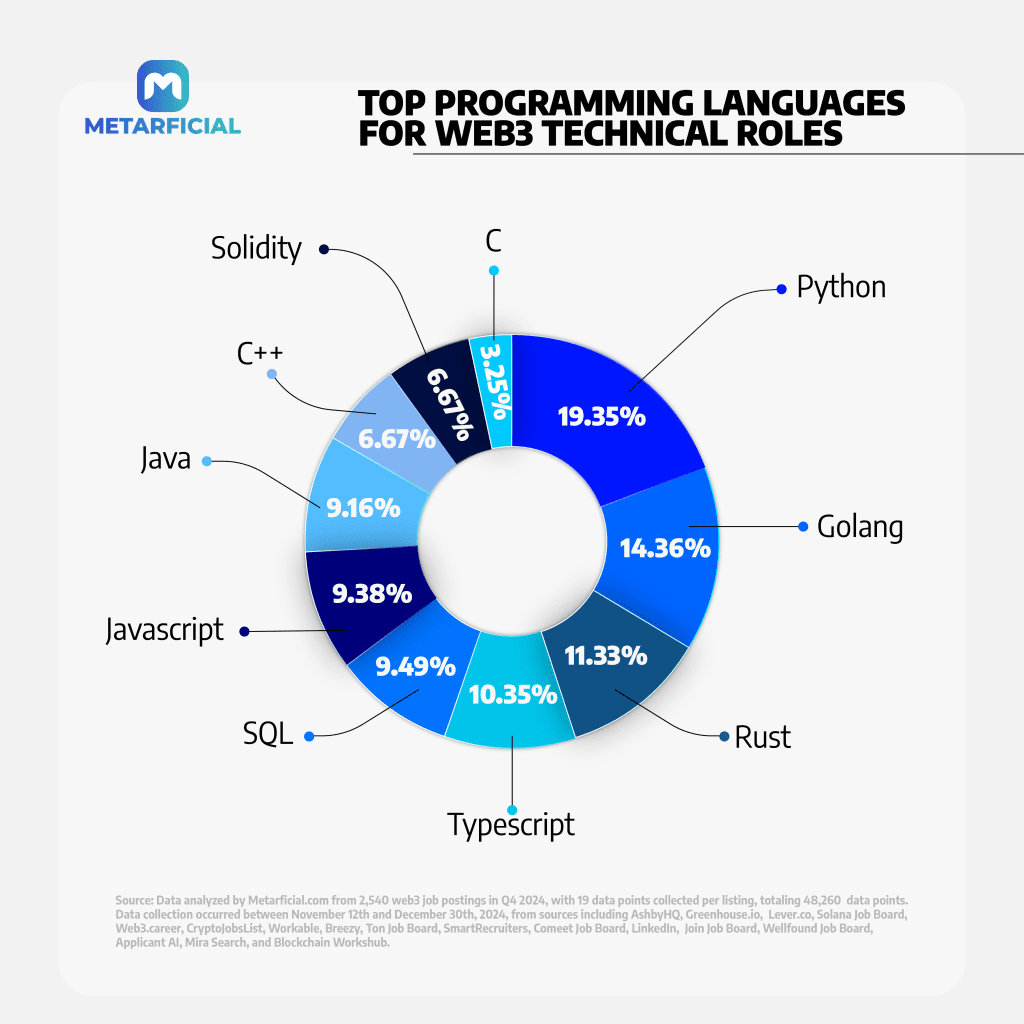
The most in-demand languages in Web3 are Python, Golang, and Rust, with Solidity—a blockchain-specific language—also gaining traction. Without access to training in these technologies, many Nigerian developers may struggle to transition into the industry.
Beyond coding, professionals must also understand the unique compensation models of Web3. Unlike traditional industries where salaries are straightforward, Web3 companies often offer a mix of base pay, equity, and token incentives. This, however, contributes to a lack of transparency—80.55% of Web3 job postings do not disclose salary information.
For Nigerian job seekers unfamiliar with crypto-based earnings, evaluating job offers can be a challenge. Understanding the value of token-based compensation, navigating tax implications, and assessing financial stability in a volatile market are all crucial skills that professionals must develop.
A market of experience: The seniority divide
The Web3 job market is not evenly distributed across experience levels. According to the report, 41.43% of Web3 job postings require over five years of experience. Mid-level roles requiring three to five years account for 19.19%, while entry-level positions make up only 12.49%.
This creates a challenge for younger professionals looking to break into the industry. While Web3 thrives on innovation, companies still prefer hiring experienced professionals who can navigate the complexities of decentralised systems. For Nigerian job seekers, gaining relevant experience—through internships, open-source projects, and freelance work—will be critical in bridging this gap.
The security paradox
One surprising finding from the research is the relatively low demand for security professionals. Despite frequent hacks, fraud, and security breaches in the blockchain industry, only 7.60% of Web3 job postings are dedicated to security, cryptography, and data analysis.
This represents both a risk and an opportunity. On one hand, the lack of security-focused hiring could make Web3 companies more vulnerable to attacks. On the other hand, it suggests an untapped job market for professionals with expertise in blockchain security. Nigerian developers and cybersecurity specialists who position themselves in this field may find increasing demand for their skills in the coming years.
Nigeria’s Web3 future: Innovation or exclusion?
Despite its potential, Nigeria’s presence in the Web3 job market remains minimal. Nigerian-specific Web3 roles account for less than 1% of global demand, similar to Indonesia and slightly behind the Philippines (1.4%) and India (2%).
This does not mean Nigeria is being left behind—it simply reflects the early stage of adoption. Just as Nigeria took time to establish itself as a fintech leader, Web3 growth will require sustained investment in education, policy, and workforce development.
One significant barrier is regulatory uncertainty. The Nigerian government has taken a cautious approach to blockchain and cryptocurrency adoption, with the Central Bank of Nigeria (CBN) previously restricting crypto-related transactions. Without clear policies, businesses and professionals may hesitate to fully embrace Web3, limiting the industry’s growth potential.
However, with the right infrastructure, Nigeria could position itself as a leader in the global Web3 economy.
“Nigeria is in the works of becoming one. Web3 Bridge has been training developers for a while now, and we’ve seen foreign communities establish their chapters here—LISK, Solana, SuperteamNG, and Solana All-Stars. Even Polygon used to do it,” Hanif says.
Investing in blockchain education, fostering partnerships with Web3 companies, and creating clearer regulatory frameworks will be key to making this transition successful.
He adds, that “SuperteamNG is doing a whole lot with writers all across Nigeria—even in remote states where you’d wonder, ‘Are people even living there?’ Yet you see Web3 talents coming from these places.”

A new digital workforce, a borderless future
Web3 is more than a technological shift—it is a redefinition of work itself. Nigeria has the talent, the entrepreneurial spirit, and the digital infrastructure to become a major player in this space. However, success will not come automatically.
To thrive in the Web3 economy, Nigerian professionals must adapt. Developers must learn blockchain-specific programming languages. Non-technical professionals must position themselves in business development, marketing, and legal roles. Government policies must evolve to support innovation rather than restrict it.
“Education needs to get more accessible. More people should be able to learn without financial barriers,” Hanif says.
“For Nigerian talent to thrive, more local funding is needed to support Web3 incubators, startups, and hackathons.
“Funding is going to be very much needed.”
The Web3 job market is still in its infancy, but one thing is clear: opportunity is no longer limited by geography. For Nigerian professionals, this could mean the chance to participate in a global digital revolution—if they are prepared to seize it.
