


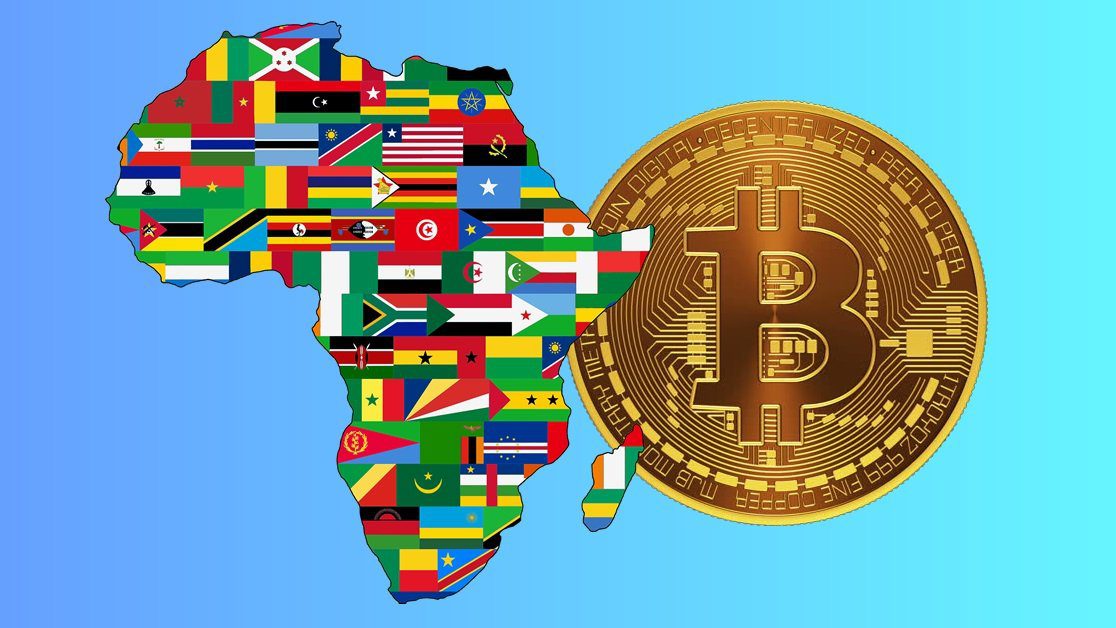
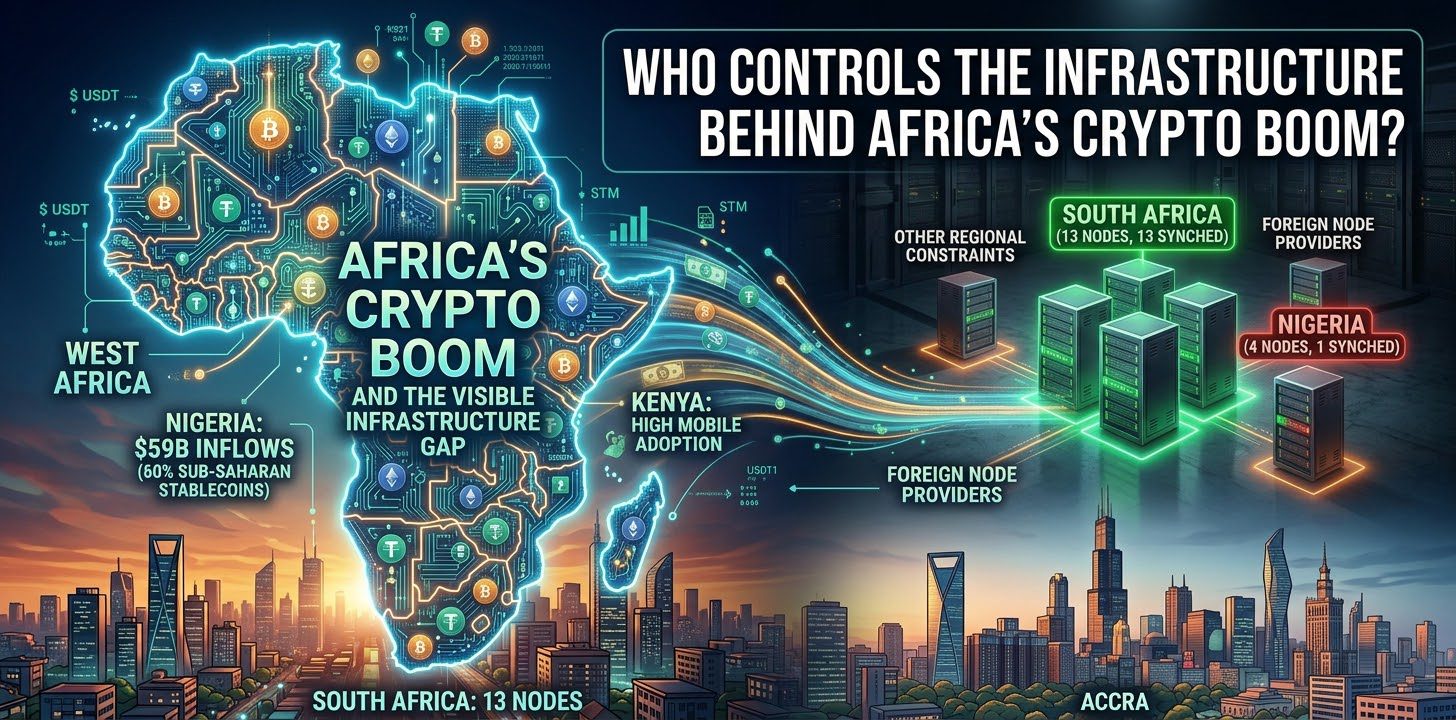
Nigeria received about $59 billion in crypto-asset inflows between July 2023 and June 2024, according to the International Monetary Fund’s (IMF) latest recorded data. Ethereum’s public node tracker, Ethernodes, lists about 28 nodes in all of Africa, out of roughly 8,000 worldwide. Nodes are the computers that run a blockchain such as Ethereum.
African users are adopting the technology fast, but who runs what sits underneath it is harder to establish.
Nigeria is the clearest case. It accounts for roughly 60% of Sub-Saharan Africa’s stablecoin inflows since 2019, the IMF said in a June 16 report. The fund linked the demand to the naira’s sharp fall, high inflation and limited access to foreign exchange in 2023 and 2024.
What sits underneath a USDT transfer?
Stablecoins such as Tether’s USDT and Circle’s USDC are tokens pegged to the US dollar. Send one from a phone in Lagos or Nairobi and several layers come into play: the blockchain, the node that connects the wallet to it, the cloud servers hosting the app and the company that issued the token.
Most apps do not run their own nodes. Ethereum’s documentation says developers often rent access from providers such as Alchemy, Infura, QuickNode or Blockdaemon, which centralises part of a product. It also says switching providers is usually a one-line code change.Technext could not find public information on which providers African crypto firms use.
Read also: Top 5 African crypto startups that are pioneering financial inclusion
How many Ethereum nodes does Africa have?
Ethernodes lists about 28 execution-layer nodes across Africa, roughly 0.3% of the global total. South Africa leads with 13, followed by Mauritius with nine. Nigeria has four, all in Lagos, and only one was fully synced with the network as of October 9. Mali and Algeria have one each. Kenya, Egypt and Ghana do not appear.
By comparison, the United States has 2,398 and Germany 1,109. On the consensus layer, whose nodes agree on which blocks are added, only South Africa (30) and Mauritius (11) appear, out of about 5,800.
The tracker can miss nodes, and cloud hosting can hide where one really sits. The figures show where nodes appear to run, not who controls the network.
Crypto issuers sit abroad too
The IMF says widespread use of US dollar stablecoins can resemble digital dollarisation. It warns that this could weaken the transmission of domestic monetary policy by reducing demand for the naira.
Tether is moving into African distribution. It invested in Kenya-based Kotani Pay, which connects crypto users to local payment channels. It also announced plans with Shiga, an Abu Dhabi-based fintech, for self-custodial products in Africa and the Gulf Cooperation Council, built on Tether’s open-source Wallet Development Kit.
Tether has not named a bank or fintech that has agreed to deploy Pulse, the institutional product, according to crypto.news.
African firms handle the last step
Stablecoins are only useful if people can swap them for local money. An on-ramp turns local money into stablecoins, and an off-ramp turns them back. African companies mostly handle this step. Onafriq runs a payments network linking banks, mobile-money operators and merchants in more than 40 African markets.
Circle says Onafriq now settles in USDC through that network. Circle has a commercial relationship with Onafriq.
Kotani Pay, Yellow Card and Quidax do similar work. None of them run Ethereum or issues USDT or USDC.
Who owns the buildings?
A June 2026 mapping by UK consultancy Data Landscapers traced 306 data centres in 46 Sub-Saharan countries to their ultimate owners. It classed 213, or 70%, as African-controlled. US-controlled operators ran 39, or 13%, mostly in South Africa, Nigeria and Kenya.
Read also: Only 17,000 of 6 million South African crypto holders declared assets
Hyperscalers, the large global cloud providers, were present in 112 of the 213 African-controlled facilities. That is 53%.
The authors call it working analysis. It was compiled with AI tools and its own classification, and an April version reached the opposite conclusion.
In Nigeria, 21 of the country’s 25 data centres are in Lagos, according to Intelpoint, Techpoint Africa’s research arm, in February 2026.
Can African firms switch?
The dataset’s authors say a building’s owner is not the only one with influence. Tenants, lenders and equipment suppliers have it too.
Ethereum’s documentation says node providers can be swapped in a line of code. Whether African firms can switch cloud contracts and stablecoin liquidity as easily is not yet documented.
