





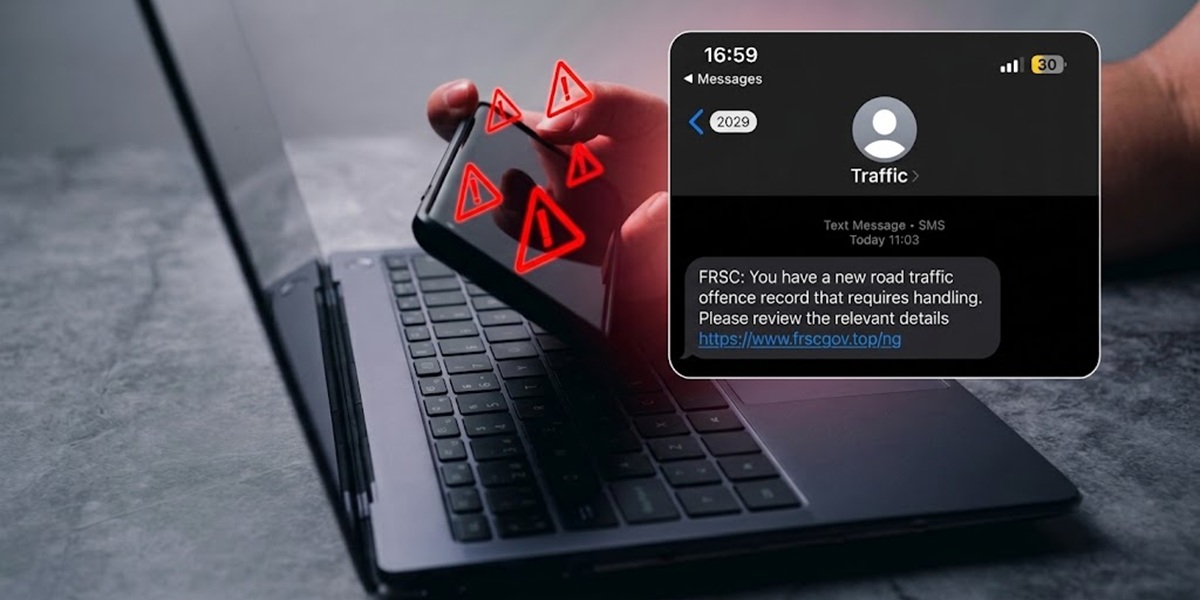
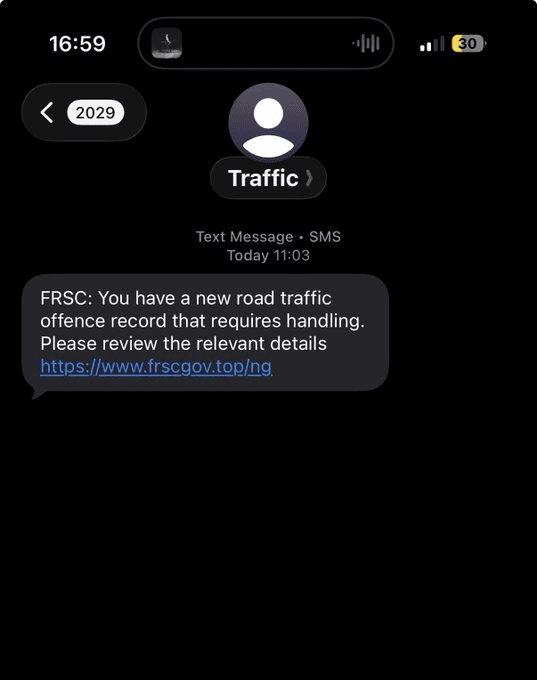
At first glance, a recent FRSC message circulating among Nigerians might seem legitimate, as it mimics communications typically sent by government agencies. It reads:
“FRSC: You have a new road traffic offence record that requires handling.” However, this message is anything but official; it’s a scam.
The Federal Road Safety Corps (FRSC) has stepped forward to warn citizens about this fraudulent campaign aimed at impersonating the agency. These deceptive messages direct individuals to fake websites under the guise of addressing alleged traffic violations.
The scam’s effectiveness lies in its method; rather than presenting an obviously dubious offer or a too-good-to-be-true investment opportunity, it starts with a situation many drivers can relate to: the possibility of committing a traffic offence. By claiming that a new violation has been recorded, the message creates an urgent call to action, pushing recipients to click on links that lead to fraudulent sites.
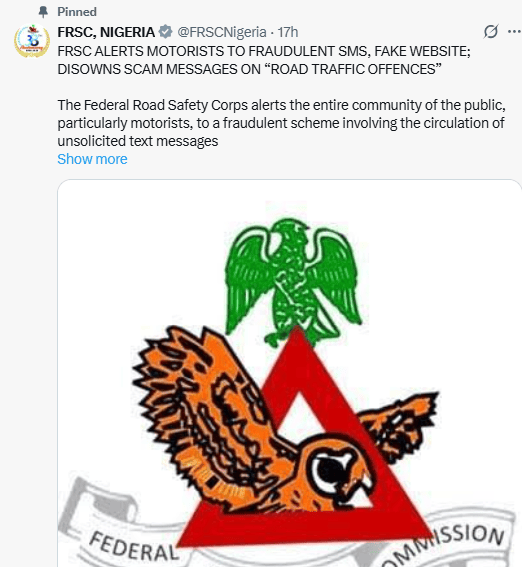
One of the specific websites flagged by the FRSC is frscgov.top/ng, which the agency clarifies is not affiliated with them. For genuine information, it’s crucial to refer to the official FRSC website at frsc.gov.ng.
Read also: Driver’s license: FRSC unveils contactless system to eliminate backlogs by November
In times like these, staying informed and cautious can help protect yourself from scams. Always verify communication from government entities and never rush into actions prompted by urgent messages.
The message is spreading beyond one phone number
Recent online reactions indicate that a concerning trend is unfolding across social media, particularly among Nigerians. Numerous users have begun sharing screenshots of nearly identical SMS messages they received, which raises suspicions about the origins and intent behind these communications.
Many individuals reported receiving the messages despite having no recent interactions with the Federal Road Safety Corps (FRSC), leading to questions about how the senders obtained their personal information, such as phone numbers. One user raised an alarm by stating that some recipients had actually transferred money after getting these messages, claiming that funds were later withdrawn from their accounts without consent.
Reports suggest that this campaign appears to be targeting larger cities, including Abuja, Lagos, and Port Harcourt. While these accounts stem from social media discussions rather than verified statistics, the consistent nature of the messages shared by different users implies a coordinated effort rather than a one-off scam.
This situation brings up an urgent inquiry: Where did the perpetrators get the private phone numbers they are using for these messages? As more people share their experiences, the need for answers becomes increasingly critical for those affected.
A data leak is possible, but it is not yet proven
Recently, many people have wondered if their phone numbers were leaked due to a data breach. However, there is currently no solid proof that the Federal Road Safety Corps (FRSC) was involved in any data breach or that their government database was used to gather these numbers. This distinction is crucial.
Scammers don’t necessarily need to tap into an FRSC database to flood people with messages. They often rely on previously leaked lists of Nigerian phone numbers from various sources, including marketing databases and past breaches. With these large number lists, they can launch mass SMS campaigns, sending the same message to thousands of people, hoping that even a few will take the bait.
The content of these messages plays into the scam. Just because someone receives a message does not mean they’ve done anything wrong; the mere suggestion can create doubt and concern.
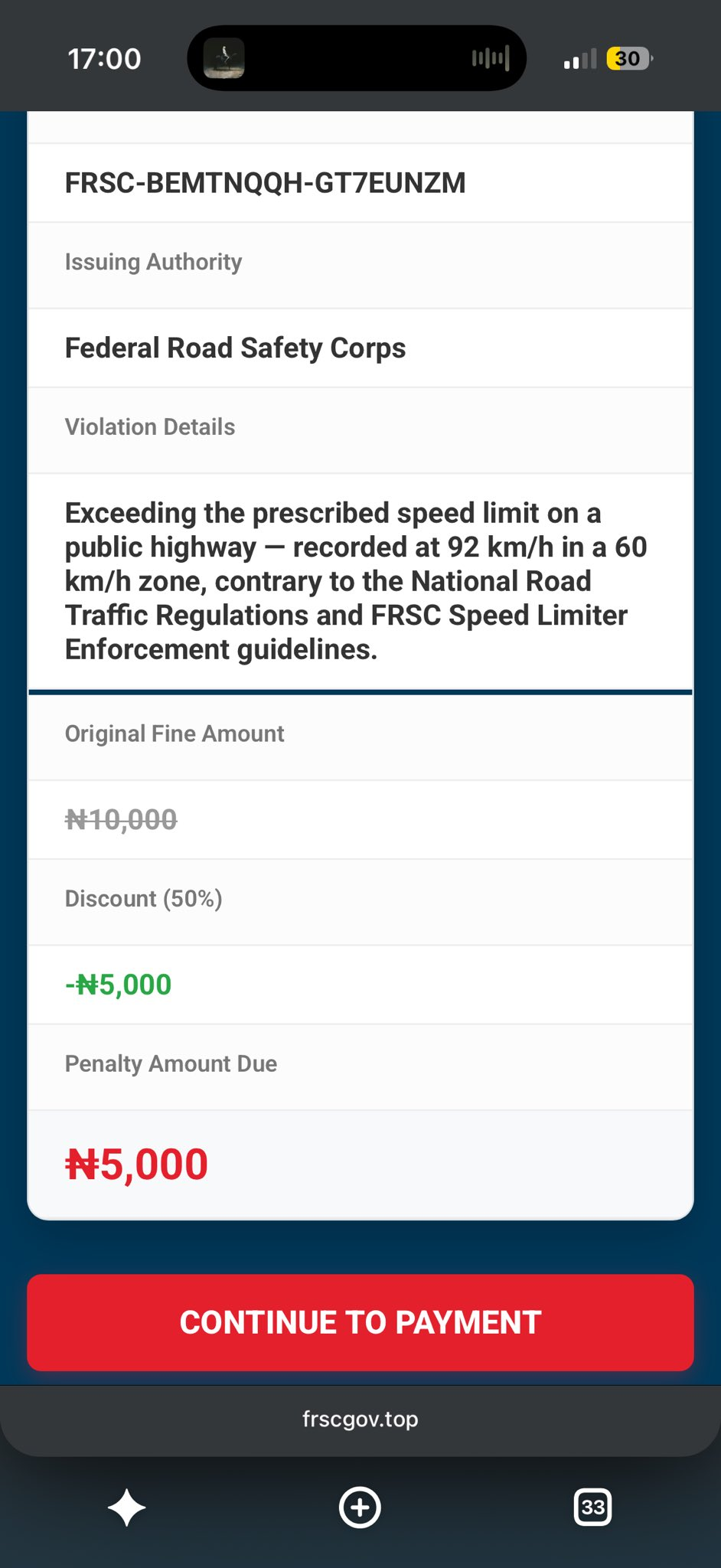
These fraudulent messages often direct recipients to fake websites, which is where the phishing occurs. The FRSC has issued a warning against clicking any links or sharing sensitive information, like bank details, passwords, or vehicle registration information. The scam’s goal is likely much broader than just collecting supposed traffic fines. For instance, a fake traffic page might request credit card details, transforming it from a simple informational site into a platform for stealing valuable payment data.
It’s important to note that the domain name matters. The website “frscgov.top” might look legitimate, especially when accompanied by an official-looking message, but the “.top” suffix is a red flag. The FRSC has explicitly stated that it has no connection with that domain. Always remember to verify before clicking any links and protect your personal information.
FRSC has issued a warning; still, the unanswered questions remain
The Federal Road Safety Corps (FRSC) has issued a warning to Nigerians regarding suspicious messages related to traffic offences. Members of the public are advised to be cautious: preserve any suspicious messages, avoid engaging further, and verify any alleged traffic offences through official channels. The simple instructions from the agency are clear: “STOP. VERIFY. REPORT.” They are committed to collaborating with law enforcement and cybersecurity experts to track those responsible for the impersonation attempts.
However, this warning raises many unanswered questions. How many people have received these suspicious messages? How many clicked on the provided links? And, crucially, how many ended up sharing their personal information or credit card details? It remains unclear whether these messages were sent via bulk SMS services, hacked accounts, or any other method. Perhaps the most pressing query is: where did the scammers even get these phone numbers?
As of now, the FRSC has not addressed any of these concerns. It’s important to note that there’s no evidence suggesting this campaign stemmed from a breach of the FRSC’s own systems. Moreover, we can’t assume that everyone who received these messages was targeted based on their vehicle registrations.
A more likely scenario might be mass phishing. Scammers send out messages that appear to be from the government to a broad audience of Nigerian phone numbers, exploiting a sense of urgency, fear, or curiosity to ensnare victims. What may seem like an outlandish message to one person might appear entirely credible to someone who has recently interacted with traffic officers and is worried about a possible offence.

Once a scammer lures someone into clicking a link, the original message about the traffic offence loses its significance. The real danger lies in the personal information that may be divulged through these links.
The FRSC urges motorists to verify any traffic offences directly through their official resources, such as their website and the national toll-free line 122, instead of relying on unsolicited messages.
Also read: ₦2,000 bribe for a driver’s licence: reasons the FRSC process is riddled with needless bottlenecks
