





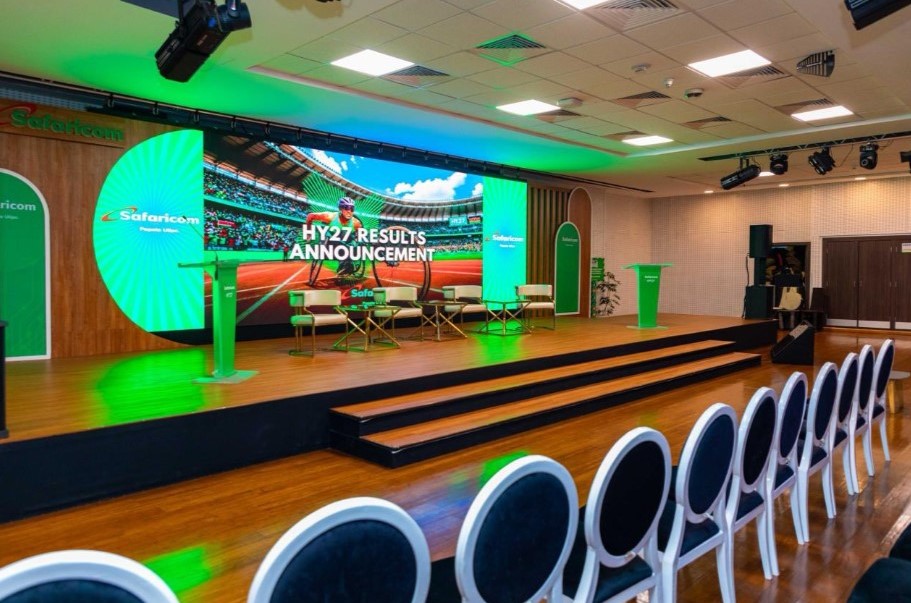
Safaricom Plc has reported a 36% surge in its Profit after Tax for the first half (H1 27) to $447.8 million (Ksh 58.2 billion), after losses in its Ethiopian operation narrowed by 43% compared to the previous period.
According to financial results released on Thursday, November 5, group service revenue increased by 13.1% to $1.74 billion (Ksh 226.1 billion), largely driven by the Kenyan market. Earnings Before Interest, Tax, Depreciation and Amortisation (EBITDA) increased by 27.5% to Ksh 129.2 billion, while Earnings Before Interest and Taxes (EBIT) surged 39.8% to Ksh 91.1 billion.
Safaricom Group CEO Peter Ndegwa said that data revenue grew by 12.2% to Ksh 45.2 billion, while voice revenue followed closely with Ksh 42.2 billion after a 6.2% surge.
Also read: Safaricom fires 118 staff and recovers $7.34 million in fraud crackdown.
As more people take up the internet, the group said active data customers grew 11.6% to 27.9 million, while data usage per user rose 9.4% to 5.3 gigabytes, showing how much an average user is using the internet.
Voice customers jumped 4.1% to 31.4 million as minutes per subscriber surged 11.9% to 231.8 and the average rate per minute dropped by 9.5%. However, voice remained particularly strong. Despite the 9.5% decline in rates, revenue grew, supported by higher usage and customer growth. Lower pricing is driving greater consumption across both voice and data.
Aside from voice and data, Safaricom’s revenue was largely driven by M-PESA, its Fintech division.
In the first half of the 2027 financial year, M-PESA’s revenue jumped 13.6% to Ksh 100.1 billion, translating to a 46.3% share of the group’s total revenue. Also, M-PESA contributed 54.7% of the Ksh 22.0 billion increase in service revenue, followed by connectivity (33.7%) and fixed services & IoT (11.6%).

Safaricom in Kenya and Ethiopia
In Kenya, the company maintained its momentum across all major financial indicators. Service revenue surged 11.3% to Ksh 216.0 billion, while EBITDA rose 13.3% to Ksh 128.9 billion. Operating profit (EBIT) increased 13.7% to Ksh 101.8 billion, pushing net profit up 13.8% to reach Ksh 66.3 billion.
Profitability grew faster than revenue, reflecting operating leverage, while operating free cash flow growth of 19.6% outpaced earnings growth, strengthening cash generation.
Meanwhile, Safaricom’s Ethiopian expansion recorded significant gains alongside reductions in operating losses. Service revenue in Ethiopia jumped 71.6% to Ksh 10.6 billion, attributed to mobile data, which surged 90.2% to Ksh 7.9 billion to account for a 74% share of total revenue.
Voice revenue grew 20.9% to Ksh 1.7 billion, while fixed services and IoT recorded a 109.7% jump to Ksh 0.2 billion. Safaricom Ethiopia also recorded a significant reduction in losses. Its EBITDA loss narrowed by 96.5% to approximately KSh 434.4 million, while its operating loss declined by 53.4% to KSh 11.4 billion.
Safaricom’s operational metrics in Ethiopia also demonstrated positive scale and user engagement across the board.
The network’s 90-day active customer base expanded 38.4% to reach 15.4 million in Ethiopia, while 30-day active users surged 43.4% to 12.2 million. Mobile data customers grew 37.0% to 12.1 million, voice users increased 31.5% to 12.6 million, and M-PESA’s adoption accelerated by 54.6% to hit 5.2 million subscribers.

In terms of customer monetisation, the 30-day Average Revenue Per User (ARPU) climbed 35.6% to 188 ETB.
Safaricom launched in Ethiopia in 2022 when the government there started to open up the tightly-controlled economy to foreign competition. It hopes its presence in Africa’s second most populous country will power future growth
Also read: Vodacom to keep 15% Safaricom stake pending Court of Appeal’s ruling on $1.9 billion deal.
