



Closing Nigeria’s internet gap now depends on planned fibre expansion, broader 5G deployment and digital identity reforms, becoming key factors that can improve connectivity and strengthen the value proposition of being online nationwide.
This is according to a September 2026 GSMA report titled “Advancing Digital Connectivity in Africa: Charting Africa’s Path to 1 Billion Connected People by 2030.”
The report comes amid Nigeria’s mobile internet usage gap and connectivity gap. The study shows that 3 in every 10 Nigerians are on the internet, with a usage gap of 53%, while the coverage gap is 11% as of 2025. Interventions that cut the gaps in half could bring 75 million Nigerians online.
Despite Nigeria’s vast digital economy and startup ecosystem, which provide a strong foundation for digital participation, bottlenecks keep many people offline.
While industry data shows that 81% (158 million out of 195 million) of its telecom subscribers are online, only a small proportion are actively online. For instance, a recent State of Mobile report by GSMA revealed that about 140 million Nigerians were in the mobile internet usage gap as of 2025, meaning they lived within mobile broadband coverage but did not use mobile internet services.
In contrast to these gaps, Nigeria’s digital ecosystem is reaching a maturity stage, attributed to its growing number of online users and demand for high-speed internet and quality networks.
Also, Nigeria’s growing industry of local platforms, fintechs, AI adoption, consumer applications and financial services is strengthening the perceived value of connectivity. This makes mobile data an essential investment for many users rather than a burdensome expense.
“Platforms such as Jumia and local social commerce businesses operating through WhatsApp Business have integrated retail supply chains, enabling small businesses to source inventory, manage logistics and respond dynamically to customer demand,” part of the report reads.
Fibre rollout, 5G expansion and digital identity
The report highlighted that Nigeria needs coordinated, collaborative and greater support to extend opportunities beyond major urban centres. However, the speed at which it closes its usage and connectivity gap hinges on three key factors.
One, Fibre rollout. Aside from cable expansion by the likes of MTN and Airtel Nigeria, the federal government’s Project Bridge is an infrastructure project that will define connectivity, especially in terms of broadband coverage.
The proposed BRIDGE programme, supported by $500 million from the World Bank within a wider $1.6 billion project-cost framework, aims to deploy 90,000 km of national open-access fibre and expand the network to around 120,000 km; its impact will depend on open access wholesale arrangements and stronger protection of infrastructure from damage during road construction and vandalism.
Also read: Understanding Nigeria’s Project BRIDGE: its power, policy gaps and way forward.
Two, 5G expansion. Nigeria’s 5G expansion is another factor. The pace at which operators can deploy the technology, alongside Nigeria’s eventual transition away from older 2G and 3G networks, will influence how quickly additional spectrum and network capacity become available for newer services.
MTN’s proposed acquisition of the 5G spectrum from Mafab will also be a key driver of the network’s growth. The leading telecoms operator, which already controls more than half (51.3%) of Nigeria’s mobile market, would potentially have more resources to deploy alongside its existing network infrastructure.

Third, Digital identity. In June 2026, the NIMC Act 2026 was signed into law, giving National Identification Numbers (NIN) full legal status for banking, health, tax and passport services. It also subjected data transfers to strict privacy safeguards. This reform, if well implemented, will strengthen infrastructure investment and create a unified digital economy.
Smartphone adoption is fueling Nigeria’s usage gap.
While there are other ongoing reforms such as spectrum rollout and planned tower deployment, how Nigerians (in the gap) can afford and use smartphones at a time when the device costs a significant part of their monthly income will define the impact of the suggested interventions.
In most African countries, entry-level smartphones now cost 44% of average monthly income, increasing to 76% of average monthly income for the poorest 20% in Sub-Saharan Africa. Also, the GSMA report shows that handset cost is cited as a barrier by 57% of men and 52% of women, while data cost is cited by 49% and 48%, respectively.
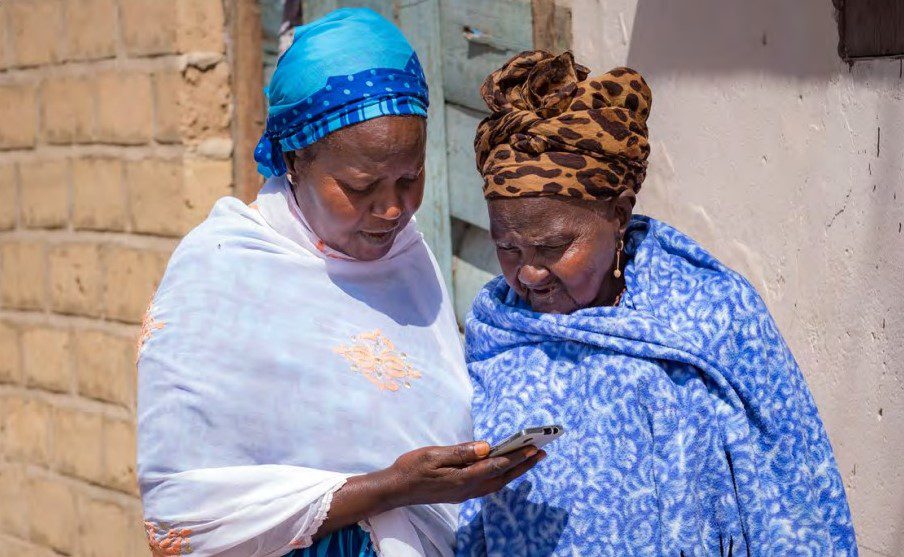
In addition, bridging the usage gap not only rests on getting a smartphone but also on its capabilities. The lowest-cost smartphones may not provide the storage, battery life, software support or network compatibility needed for secure use of financial, government, education and employment services.
In the next 3-4 years, success in how Nigeria is able to close the access and coverage gap would be measured by whether more Nigerians regularly use digital services for education, government, finance, commerce and employment, rather than just growth in infrastructure, subscriptions or connected devices.
