




Africa today stands at a critical juncture in its digital evolution, with fifth-generation (5G) mobile technology, though still in its infancy, poised to transform the continent’s economic and social landscape. The recently released GSMA’s “Destination Growth: The Journey to Complete 5G” report provides a comprehensive analysis of its potential in Africa.
It projects that by 2030, Africa will have approximately 340 million 5G connections, representing about 20% of total mobile connections. This growth is part of a broader trend where 4G and 5G together are expected to account for nearly two-thirds of all mobile connections by 2030.
The continent’s foray into the 5G era began with major network launches by Vodacom and MTN in South Africa in 2020. As of 2025, commercial services are available in more than ten countries, with expectations for more by the end of the year.
However, the continent’s mass-market readiness for 5G remains in its early stages.
At the moment, only about 25% of mobile connections are on 4G networks, significantly lower than the global average of 60%. Despite the availability of 3G/4G signals across much of Africa, around 60% of the adult population remains unconnected to mobile internet, underscoring the digital divide.
How 5G rollout could contribute to Africa’s economy
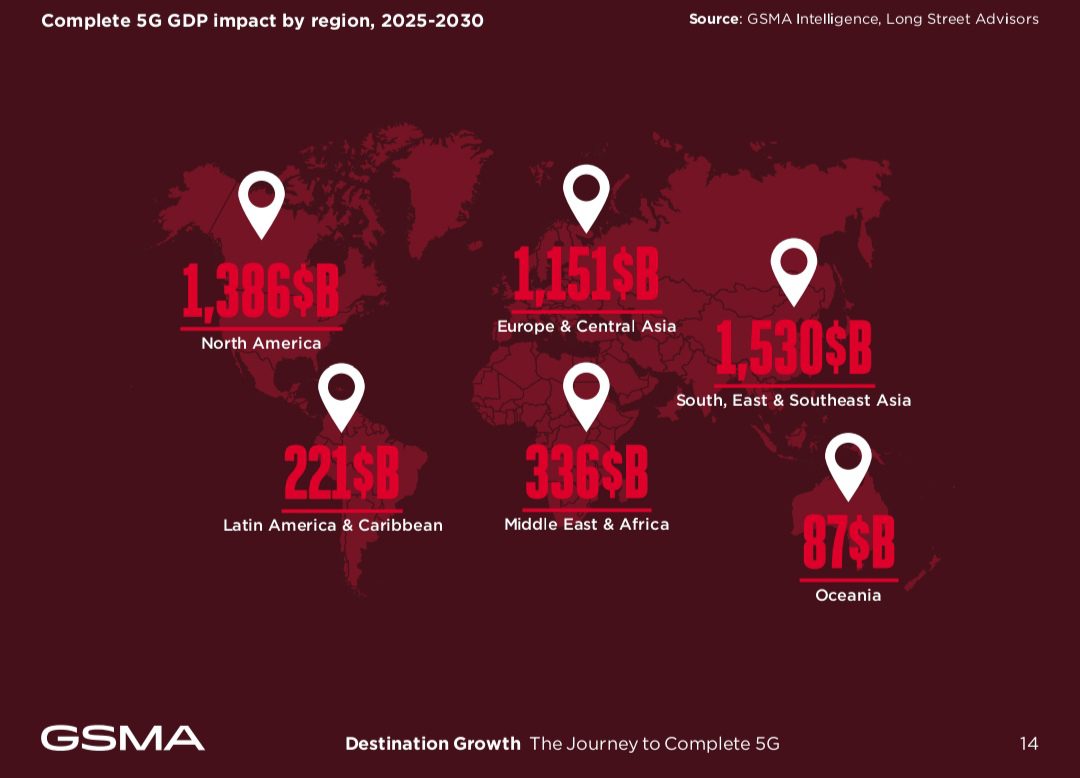
The economic potential of 5G in Africa cannot be overemphasised. According to the GSMA’s report, it could contribute $26 billion to Africa’s economy between 2021 and 2030, with significant benefits for key sectors.
Retail, manufacturing, and agriculture are expected to see the most gains, driven by enhanced connectivity, automation, and data-driven decision-making.
For instance, precision agriculture enabled by 5G can optimise crop yields through real-time monitoring, while manufacturing can leverage automation for increased efficiency.
Beyond 5G, the broader mobile ecosystem is already a major economic driver. The GSMA’s “Mobile Economy Sub-Saharan Africa” report pointed out that the mobile industry contributed $140 billion to GDP in 2023, with projections reaching $170 billion by 2030 if connectivity barriers are addressed.
This highlights the broader context: 5G can amplify economic growth.
Challenges for adoption
Despite the promise, several challenges have hindered the mass adoption of 5G in Africa
Infrastructure and investment are significant hurdles, with operators having invested $45 billion in capital expenditures over the last five years, mostly focused on expanding 4G networks. Transitioning to 5G requires further investment in fibre backhaul, cell site densification, network virtualisation, and automation. The backhaul mix is expected to shift, with microwave currently dominating but projected to decrease to 33% by 2030, while fibre increases to 66%.
Spectrum availability is another bottleneck. Progress on assigning spectrum for 5G has been slow, with only a handful of countries completing auctions by late 2022.
Likewise, affordability and digital literacy pose additional barriers. Cost is the primary obstacle to consumer adoption, cited by 37% of respondents, followed by network coverage (27%), lack of compelling use cases (22%), and satisfaction with previous generations (14%). Enterprises face similar challenges, with 29% citing lack of awareness, 29% noting no proven use cases, 29% mentioning limited coverage, and 12% highlighting insufficient technical skills.

The high cost of 5 G-enabled smartphones further exacerbates the issue.
Energy and sustainability are also critical. Operators are turning to renewable energy, with solar currently accounting for less than 10% of usage due to high upfront costs and other challenges. Success stories include Vodacom, which sourced 1,183,898 kWh via power purchase agreements (PPAs), saved 11,971 MWh, and reduced greenhouse gas emissions by 12,272 metric tonnes CO₂e. Orange has achieved over 50% renewable energy usage in Guinea, 41% in Madagascar, and 40% in Sierra Leone.
Opportunities for more
Despite these challenges, 5G offers transformative opportunities across various sectors.
In agriculture, which employs over half of Africa’s workforce, 5G-enabled precision farming can monitor soil moisture and weather patterns in real-time, optimising crop yields. The extractive industries, such as mining and oil/gas, can leverage private 5G networks for improved safety and efficiency.
Education and healthcare will also benefit, with initiatives like Orange’s e-Health and smart education projects demonstrating potential.
Fixed Wireless Access (FWA) is a good use case, particularly for extending broadband to underserved rural areas where traditional infrastructure is lacking. Private networks are gaining traction, with early adopters likely in large enterprises like mining, ports, oil/gas, education, and agriculture.
MTN is already building private networks for at least 14 companies in South Africa, and 94% of survey respondents believe operators are best placed to lead these deployments.

Innovative labs, such as Orange’s 5G lab launched in Dakar, Senegal, in June 2022, are testing and demonstrating 5G products and services for local businesses and consumers. This lab, part of a network of 13 across Europe and Africa, has welcomed over 1,200 companies and authorities, with 114 trialling examples in areas like e-health, smart ports, smart education, and smart agriculture.
The role of stakeholders
To realise 5G’s potential, governments across the continent must take proactive steps.
Timely spectrum access is critical, with the GSMA recommending at least 100 MHz of contiguous spectrum per operator in the mid-band (e.g., 3.5 GHz) and about 800 MHz in the high-band (mmWave), totalling about 2 GHz mid-band per country by 2030.
Licence terms should be at least 15 years, with modest reserve prices, and spectrum set-asides should be avoided in favour of sharing models like leasing.

Supporting cost-effective rollout is essential, including streamlining right-of-way (RoW) approvals, establishing clear electromagnetic field (EMF) regulations, and facilitating small cell deployment.
Governments must support the transition to renewable energy by easing duties on solar components and integrating 5G into public services like e-governance, healthcare and education to stimulate demand.
Also, reducing import and excise duties on 4G/5G handsets can improve affordability, addressing a major barrier to adoption.
In all, collaboration is key to success. Multilateral stakeholders like the African Telecommunications Union (ATU), International Telecommunication Union (ITU), GSMA, and Smart Africa play crucial roles in facilitating best practices, dialogue, capacity building, cost reduction, and raising 5G awareness.
