


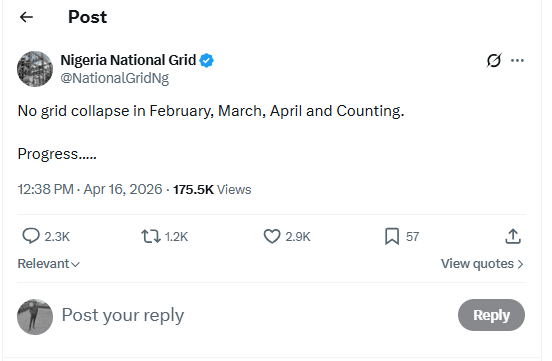
Nigeria’s national grid has operated for three consecutive months without a single collapse, the Nigerian National Grid announced on Wednesday. This achievement marks a significant milestone for a system that has historically been a major source of frustration for the country.
“No grid collapse in February, March, April and counting. Progress,” the National Grid posted on X.
The announcement is indeed significant. As reported by Technext last week, the national grid experienced two collapses in January 2026, specifically on January 23 and January 27.
This issue has become a recurring problem, with at least 222 partial and total collapses recorded between 2010 and 2022, and approximately 12 in 2024. Therefore, three consecutive months of stability are not a noteworthy achievement.
But the response from ordinary Nigerians was swift, sharp, and telling.
No national grid collapse, but no stable electricity either
The problem with the announcement, as many Nigerians pointed out, is the gap between grid stability and actual electricity supply. A grid that does not collapse is not the same as one that is delivering power.
“E no collapse but light no dey,” one user wrote plainly on X.
Another put it more bluntly: “Then why we nor dey get electricity?”
A third captured the broader frustration with dark humour: “No national collapse, but my generator don collapse from fuel bills. We dey use candle dey charge phone and una dey celebrate stability.”
Nigerians are assessing progress not by whether the power grid failed, but by whether the electricity worked. For most households and businesses, the reality has not changed much.

Nigeria’s transmission network covers over 20,000 kilometres, but it can deliver only about 5,300 megawatts of electricity. This is much less than its total generation capacity of over 12,000 megawatts.
Power outages in Nigeria cost approximately $29 billion annually, according to World Bank estimates. These outages lead to manufacturers losing approximately N10.1 trillion annually due to production disruptions.
While a stable power transmission system is necessary, it doesn’t guarantee adequate electricity supply to homes and businesses. Problems with old equipment, inaccurate metering, and financial problems of the DisCos limit the amount of electricity that reaches consumers.
The Nigerian Independent System Operator (NISO), which recently marked its first anniversary, has been rolling out digital monitoring tools, grid islanding technology, and real-time SCADA systems to improve infrastructure management.

While the recent improvements have helped maintain a stable power supply for the last three months, it’s important to remember that technology can only improve an existing system. Nigeria still needs significant upgrades to its physical power infrastructure.
Three months without a collapse is progress, but not the progress Nigerians desire.
