




Lagos is a city that understands convenience. From the office worker ordering lunch between meetings to the family trying to sort out dinner after a long day, there is no shortage of people who would appreciate having a good meal delivered to their doorstep. The appeal is obvious. Less time in traffic, less time in queues and more time for everything else life demands.
Yet for all its convenience, food delivery remains a relatively small part of how Nigerians buy prepared meals. Our estimates at Swoop suggest that delivery platforms account for just 1% of Nigerians’ spending on food prepared outside the home.
In comparable African markets, that figure is closer to 5-7%, rising to 10-15% in comparable markets across South Asia and South America. That gap raises an interesting question. If Nigerians value convenience, why hasn’t food delivery become a bigger part of everyday life? The answer may have less to do with the appeal of convenience than with the economics of accessing it.
Read also: UNILAG partners with Swoop to introduce safer, more affordable food delivery for students
Understanding the Real Competition
Consider the choices available to someone deciding what to eat for lunch in Lagos. They could order through a delivery platform, walk to a nearby restaurant, buy from a local food seller or contact their favourite restaurant directly. Each option comes with a different combination of cost, convenience and reliability.
For a delivery platform, winning that decision requires more than having an attractive app or an extensive restaurant selection. The customer must believe the overall experience offers sufficient value to justify the final bill. This matters particularly in Nigeria, where consumers are navigating rising living costs and increasingly deliberate spending decisions. Convenience remains attractive, but it must compete with other demands on household income.
A customer may appreciate the ease of having lunch delivered without necessarily being willing to pay a significant premium for it every day. The challenge for the industry, therefore, is not simply persuading more people to download an app. It is making food delivery an option they can comfortably choose again and again.

From First Orders to Lasting Habits
The obvious response to price sensitivity is to make delivery cheaper. Promotional offers certainly have their place. A compelling discount can encourage someone to try a platform for the first time. It can introduce customers to restaurants they might otherwise overlook and help build familiarity with the service.
But there is a difference between encouraging someone to place their first order and giving them a reason to place their tenth. If the value of food delivery depends entirely on a promotional code, the underlying economics have not fundamentally changed.
For delivery to become a regular habit, customers need to feel comfortable with what they are paying even when there is no special offer available. That requires platforms to think carefully about pricing, efficiency and the overall experience, rather than relying on discounts as the primary driver of demand. It also requires looking beyond the customer.
Three groups, one business model
Every food delivery order brings together three parties: the person ordering, the restaurant preparing the meal and the rider delivering it. Each has a different definition of value.
The customer wants a convenient, reliable service at a reasonable price. The restaurant wants additional sales without sacrificing too much of its margin. The rider needs earnings that cover the cost of doing the job and make the work worthwhile.
A delivery platform cannot build a sustainable business by solving the problem for one group while creating another for everyone else. Lower prices may attract customers, but restaurants still need healthy margins. Competitive delivery fees matter, but riders must also be able to earn a decent living. Getting that balance right is one of the industry’s most important challenges.
Finding that balance also presents an important opportunity for innovation.
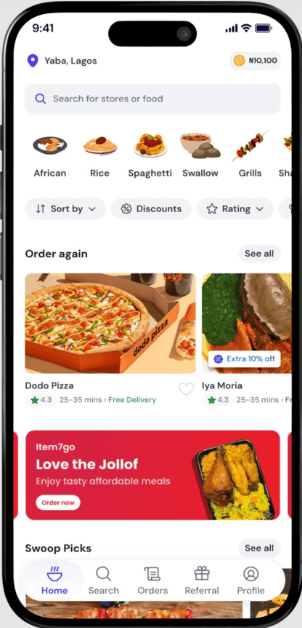
At Swoop, we have built our approach around this principle.
Customers can see applicable delivery and service charges before confirming an order, giving them greater clarity over the final cost. For restaurants, our focus is on lower platform costs and creating additional opportunities to reach customers. For riders, our model allows them to retain 100% of their delivery fees.
These decisions are connected. We believe that making food delivery more accessible requires a model that works commercially for everyone involved.
The objective is not simply to offer the lowest possible price. It is to create a service that customers can afford to use regularly, restaurants can benefit from and riders can earn a living through.
The biggest opportunity is the customer who isn’t ordering yet
When we think about competition in food delivery, it is natural to focus on the platforms already operating in the market. Yet the industry’s greatest opportunity may lie beyond the customers those platforms currently serve.
It lies with the person who orders occasionally but would happily order more often if the economics made sense. The restaurant that has a loyal customer base but has yet to make delivery a meaningful part of its business. It also lies with the customer who has never considered using a delivery platform because buying food nearby has always seemed the more practical option.
These are not necessarily people who need to be convinced that convenience has value. They need a delivery experience that fits their expectations and spending power. This is why the gap between Nigeria and other emerging markets is so interesting.
If delivery platforms currently account for approximately 1% of spending on food prepared outside the home, even a modest increase in adoption could represent a meaningful expansion of the market. But that growth will not come simply from competing more aggressively for the same customers. It will require platforms to understand how Nigerians make everyday purchasing decisions and build services that reflect those realities.

Making convenience an everyday choice
Nigeria’s food delivery industry has made significant progress, but the market remains at an early stage of its potential development.
Technology has already made ordering easier. Customers have more choice, better visibility and greater access to restaurants than they did a few years ago. The next challenge is making those benefits accessible to more people, more often.
Speed and restaurant selection will remain important, but affordability will play an equally significant role in determining how widely food delivery is adopted. Affordability should not be confused with offering the lowest price. A service represents good value when customers are comfortable paying for it, restaurants can earn healthy margins and riders can make a decent living. For an industry with considerable room to grow, that distinction matters.
The real opportunity is not simply to persuade Nigerians to order more food online. It is to make food delivery such a practical and worthwhile choice that more people naturally incorporate it into their everyday lives. That is the future we are working to build at Swoop.
