



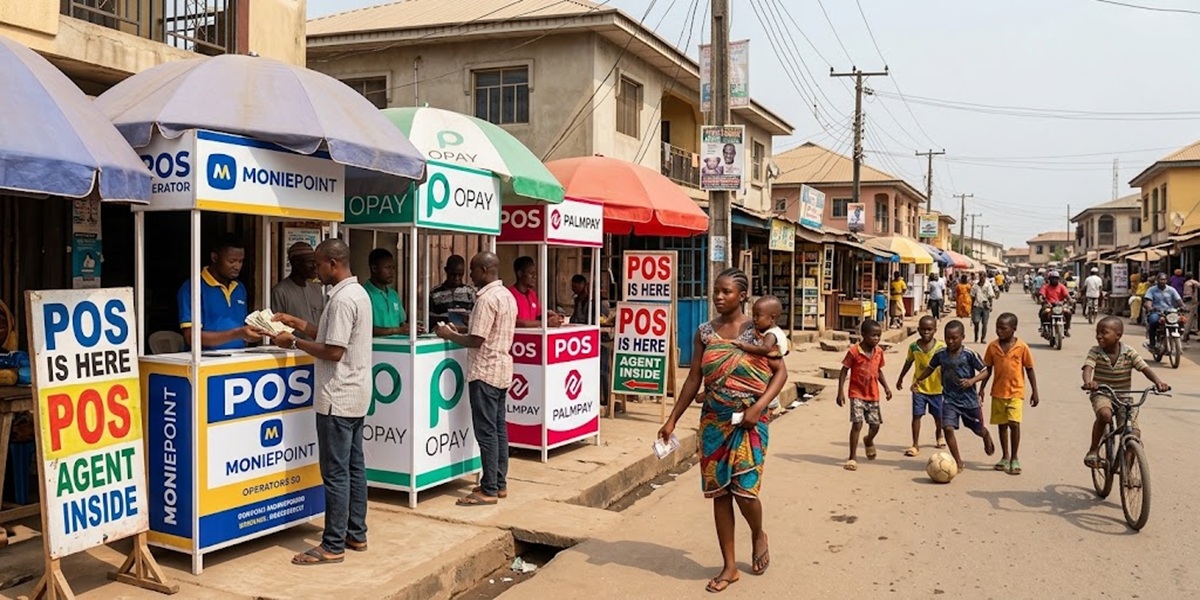
For half a decade, the defining visual of Nigerian financial inclusion was a plastic table and chair under a branded umbrella, stacked with three different Point of Sale (POS) terminals in blue, green, and purple plastic casings.
When one network failed during a peak hour of the day, the agent simply picked up the second machine, swiped the customer’s debit card, and kept the cash flowing. Since 1 April 2026, that everyday survival mechanism has become a regulatory offence.
Over ten months between October 2025 and August 2026, the Central Bank of Nigeria (CBN) dismantled the informal architecture that allowed agency banking to scale into the country’s primary cash rail. Through three interlocking interventions, the apex bank capped daily agent cash-outs at ₦1.2 million, outlawed multi-principal terminal juggling, tethered every active device to a 70-metre satellite geo-fence, and slapped vertical market-share limits on the fintech giants powering the ecosystem.
It is the most aggressive structural reset of Nigerian retail payments since the cashless policy began.
To understand why the regulator reached for a sledgehammer, look at the speed of money moving outside traditional bank halls. Data from the Nigeria Inter-Bank Settlement System (NIBSS) shows that the number of deployed POS terminals nationwide jumped by 127.07 per cent to hit 5.56 million by the end of December 2024, up from 2.45 million a year earlier.
By the first quarter of 2026, total transaction value across those terminals surged by 79.03 per cent year-on-year to reach ₦18.78 trillion, split across ₦6.08 trillion in January, ₦6.58 trillion in February, and ₦6.12 trillion in March.
In effect, the street-corner POS kiosk stopped acting as a last-mile convenience channel and became Nigeria’s shadow clearinghouse.
For the CBN, however, that explosion created three unacceptable blind spots: untraceable mobile terminals used for kidnap ransoms and fraud, illicit cash hoarding that starved bank ATMs of physical naira notes, and extreme concentration of payment traffic inside three dominant fintech networks.
The underlying message from Abuja is blunt: scale without traceability is no longer welcome.
The death of the multi-terminal kiosk
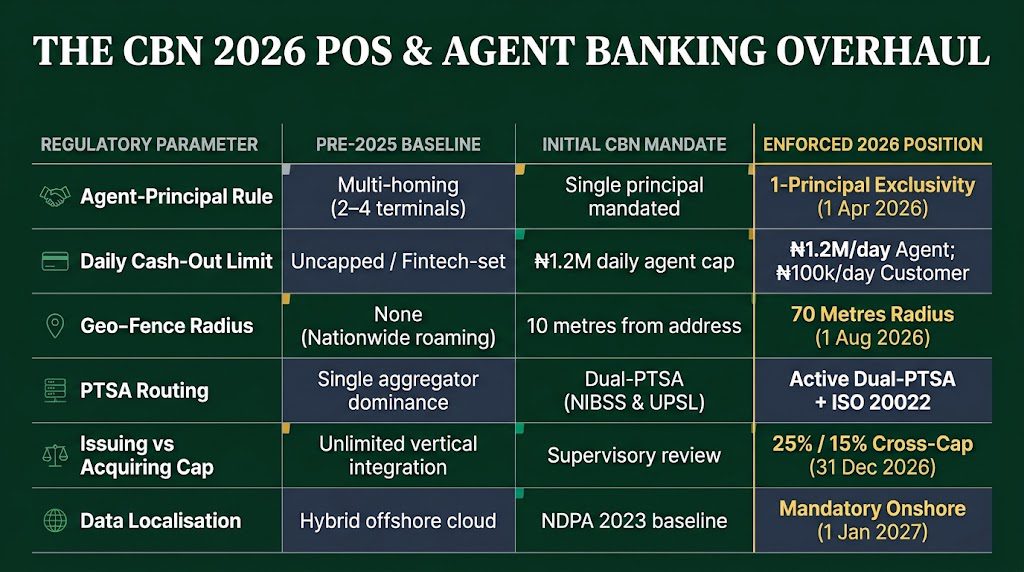
The first structural shift arrived with the CBN’s revised Regulatory Framework for Agent Banking, issued in October 2025 and enforced in full for principal exclusivity on 1 April 2026.
Under the directive, every POS agent in Nigeria must operate under a single principal institution at any given time. Whether that principal is a deposit money bank, a microfinance bank, or a mobile money operator, an agent who holds a Moniepoint terminal can no longer legally keep an OPay or PalmPay device on the same counter as a backup.
For millions of small merchants and roadside operators, multi-homing was never about regulatory arbitrage; it was an insurance policy against Nigeria’s fragile switching infrastructure. Whenever a bank’s issuer switch timed out, or a fintech’s settlement rail lagged, switching terminals protected the agent’s working capital from getting trapped in pending reversal disputes.
By forcing a one-agent, one-bank marriage while mandating Corporate Affairs Commission (CAC) registration for operators, the CBN has shifted the uptime burden entirely onto the principal’s backend.
Even more punishing for street-level unit economics are the hard transaction ceilings imposed alongside exclusivity. Each customer is restricted to a maximum daily cash withdrawal of ₦100,000 and a cumulative weekly limit of ₦500,000 across all channels, while the POS agent’s cumulative daily cash-out volume is capped at ₦1.2 million.
Every transaction must run through a dedicated agent account, or wallet domiciled with that sole principal, and any agent caught routing cash-outs through a personal current account faces immediate blacklisting and personal liability for fraud.
From 10 metres to 70 metres: Inside the August 2026 geo-fencing compromise
If principal exclusivity locked agents into a single financial provider, the CBN’s geo-fencing mandate locked them to a physical patch of earth. Originally announced in August 2025 with a 60-day compliance window, the apex bank ordered all POS terminals to upgrade to native Android operating systems capable of capturing double-frequency GPS coordinates and transmitting rich ISO 20022 transaction messages.
Every terminal had to be routed through Nigeria’s two licensed Payment Terminal Service Aggregators (PTSAs), NIBSS and Unified Payment Services Limited (UPSL), and hard-coded to operate within a strict 10-metre radius of its registered business address.
On paper, a 10-metre digital leash sounded like a clean technical fix to stop fraudsters from registering a POS terminal under a Lagos grocery store and using it three states away to launder stolen funds. On the ground, it collided with basic urban physics.
Across dense multi-storey plazas in Computer Village or Balogun Market, consumer-grade cellular and GPS chips routinely suffer from signal bounce and indoor drift exceeding 25 metres, causing legitimate terminals to fail validation simply because the merchant walked from the front counter to a storage room across the courtyard.
Faced with industry warnings that a 10-metre lock would trigger millions of false-positive declines across 5.56 million deployed terminals, the CBN blinked on the radius while holding firm on the architecture.
In a circular issued on 29 May 2026 and signed by Dr Rakiya O. Yusuf, Director of the Payments System Supervision Department, the apex bank expanded the permissible geofence radius from 10 metres to 70 metres and moved the final enforcement deadline to 1 August 2026.
That 70-metre compromise saved plaza merchants and petrol station attendants who walk across forecourts to swipe cards at the pump, yet it still erased an entire category of mobile commerce. Roaming market collectors, daily ajo (thrift) savings agents who walk from stall to stall collecting deposits, and logistics dispatch riders carrying legacy hardware POS terminals can no longer process payments once they step beyond 70 metres of their registered coordinates.
Unless those mobile workers transition to approved corporate fleet exemptions or pure transfer-based collection, the hardware POS is now legally immobile.
Breaking up the issuing and acquiring monopolies
Beyond the street-level squeeze on agents, the CBN’s most consequential strike targets the balance sheets of the fintechs that built the POS boom.
On 15 June 2026, the Payments System Supervision Department issued Circular PSS/DIR/PUB/CIR/001/004, introducing four simultaneous backend mandates: market structure caps, mandatory payment data localisation, Ultimate Beneficial Ownership (UBO) disclosures, and systemic oversight protocols.

To grasp the strategic shock inside that circular, look closely at the market structure rule, which carries a compliance deadline of 31 December 2026.
Under the directive, any financial institution controlling more than 25 per cent of the consumer card-issuing market over a rolling 12-month period is barred from holding more than 15 per cent of the merchant-acquiring market in the same period, and vice versa.
Crucially, the CBN wrote the rule to apply at the consolidated group level, meaning a fintech holding company cannot evade the cap by placing its debit cards inside a microfinance subsidiary and its POS terminals inside a separate switching or super-agent entity.
For the past three years, the winning playbook for Nigeria’s largest agency banking platforms (led by Moniepoint, OPay, and PalmPay) was closed-loop vertical integration. First, they captured merchants by putting millions of reliable POS terminals in the hands of street agents and shopkeepers.
Next, they distributed tens of millions of consumer debit cards linked to retail wallets, allowing a customer’s card to be swiped on the same provider’s POS terminal and settled internally with near-zero interbank friction and 99 per cent uptime.
By capping cross-market dominance at the 25 per cent and 15 per cent thresholds and requiring monthly market-share returns, the CBN is forcing Nigeria’s payment giants to choose a primary lane before 31 December 2026.
If an operator retains more than a quarter of the POS acquiring market, it must throttle back its consumer card issuance below 15 per cent, or divest and unbundle parts of its volume. At the same time, the circular’s 1 January 2027 data localisation deadline requires every payment record, BVN lookup, card token, fraud model, and analytics pipeline generated in Nigeria to be hosted and managed within Nigeria.
What happens to financial inclusion when compliance gets expensive?
Every piece of the CBN’s 2026 rulebook is internally logical when viewed through the lens of a central bank fighting inflation, currency hawking, and systemic cyber fraud.
When ₦18.78 trillion moves through POS terminals in a single quarter, allowing anonymous agents to roam across state lines with four unregistered machines is a national security liability. Requiring CAC registration, enforcing 72-hour dispute resolution timelines, splitting traffic across NIBSS and UPSL, and keeping payment data inside domestic jurisdictions are all hallmarks of a maturing financial system.

But regulation does not happen in a vacuum; it happens on the balance sheets of low-margin small businesses. When you combine a ₦10,000 to ₦15,000 CAC registration hurdle, five-year AML record-keeping rules, a 70-metre movement lock, single-principal exclusivity, and a ₦1.2 million daily cash-out cap, the economics of running a standalone POS kiosk in a semi-urban or rural community collapse.
For a rural operator in Bayelsa, Taraba, or rural Abia who travels to a commercial town twice a week to rebalance liquidity, the compliance overhead now outweighs the commission pool.
What follows is an inevitable structural consolidation across Nigeria’s last-mile financial network. Standalone ‘umbrella agents’ whose sole business is trading physical cash for a ₦100 or ₦200 fee are already exiting the market or folding into established retail pharmacies, supermarkets, and petrol stations, where POS terminals serve actual goods checkout rather than pure cash arbitrage.
On the institutional side, smaller mobile money operators that cannot afford onshore cloud migration by 1 January 2027 or compete for exclusive agent loyalty after 1 April 2026 will either merge or surrender their market share.
Nigeria’s POS revolution succeeded precisely because fintechs bypassed the rigid, paper-heavy bureaucracy of legacy branch banking. By turning 5.56 million terminals into geo-fenced, single-principal, corporate-registered micro-branches, the CBN has finally brought the street corner under its supervisory roof.
The real test in 2027 will be whether the millions of unbanked Nigerians who relied on those informal kiosks follow them into the formal net or simply return to the era of keeping their money under the mattress.
