




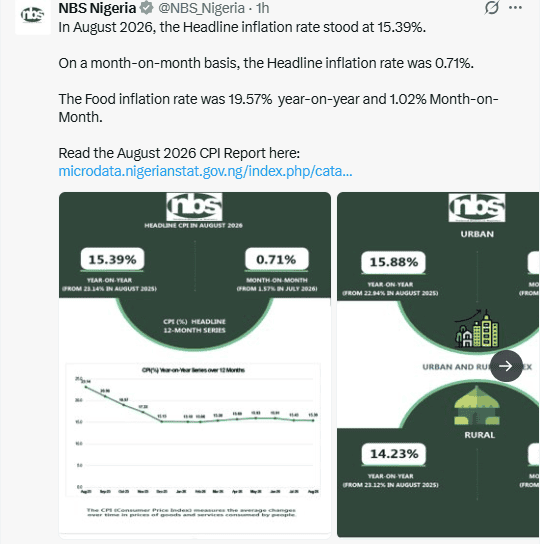
Nigeria’s inflation situation took a small but encouraging turn in August, with the overall inflation rate decreasing to 15.39%, down from 15.43% in July. This is a positive change, especially considering that just a year ago, in August 2025, the inflation rate was much higher at 23.14%.
Looking at the monthly trends, price increases slowed down significantly in August, rising by just 0.71%. In comparison, July saw a sharper rise of 1.57%. This suggests that while prices are still climbing, the rate of that increase is slowing down, which is good news for consumers. The Consumer Price Index (CPI), which tracks how prices change over time, went up to 146.3 points in August, a modest rise from 145.3 in July.
One of the areas where inflation has hit hardest is food prices. However, there’s some brighter news here as well. Year-on-year, food prices have significantly decreased to 19.57% in August, down from 25.30% the previous year. On a month-on-month basis, food inflation fell from 5.56% in July to 1.02% in August. This slowdown in food price hikes is a welcome relief for consumers who have been struggling with rising grocery bills.
Overall, while prices are still on the rise, this recent data suggests a bit of relief for people feeling the weight of increased costs, particularly in their food expenses.

The National Bureau of Statistics (NBS) has pointed to specific items that contributed to this drop in prices, including palm oil, carrots, peppers, onions, cassava flour, beef, yam flour, fresh ginger, and various types of fish, among others.
Food and non-alcoholic beverages remain the standout driver of overall inflation, accounting for a significant 6.16% of the year-on-year increase. Other noteworthy contributors include restaurants and accommodation services, which added 1.99%, followed by transport at 1.64%, and housing, water, electricity, gas, and fuels at 1.30%. Education services also played a role, adding 0.95% to the overall increase.
This data reflects a critical moment for Nigeria’s economy, as citizens navigate the ongoing challenges of rising costs while also witnessing shifts that may bring some relief in the months to come.
Similar read: Nigeria’s inflation falls to 15.43% in July as food prices surge
Core inflation falls as states see different price movements
In August, core inflation, which leaves out the often fluctuating prices of food and energy, stood at 13.29% compared to the same month last year. This shows a significant drop from 22.93% in August 2025. Interestingly, when looking at the month-to-month changes, it even dipped slightly, falling to -0.06% from 0.15% in July.
Inflation rates are not uniform across the country; they vary widely from one region to another. Lagos reported the highest year-on-year inflation at 23.68%, closely followed by Zamfara at 22.56% and Enugu at 22.06%. On the other end of the scale, Sokoto had the lowest at 2.11%, with Kebbi and Jigawa not too far behind at 3.72% and 3.81%, respectively.
When we look at the monthly inflation rates, Rivers took the lead with a striking 6.92%, while Osun and Kano also saw notable increases at 5.61% and 5.59%.
Food prices, which are crucial for daily living, reached alarming levels in some areas. Adamawa had the highest year-on-year food price increase at 38.85%, followed by Zamfara at 37.96% and Bayelsa at 36.20%.

The National Bureau of Statistics (NBS) shared that the average Consumer Price Index (CPI) for the year ending August 2026 rose by 16.30%, a drop from 28.32% during the same period in 2025.
These August figures illustrate that while inflation still exerts pressure on prices, the rate of increase is slowing down, particularly for food and core items. This slowdown in inflation is a ray of hope amidst ongoing economic challenges.
See also: CBN holds interest rate at 26.5% as inflation eases
