


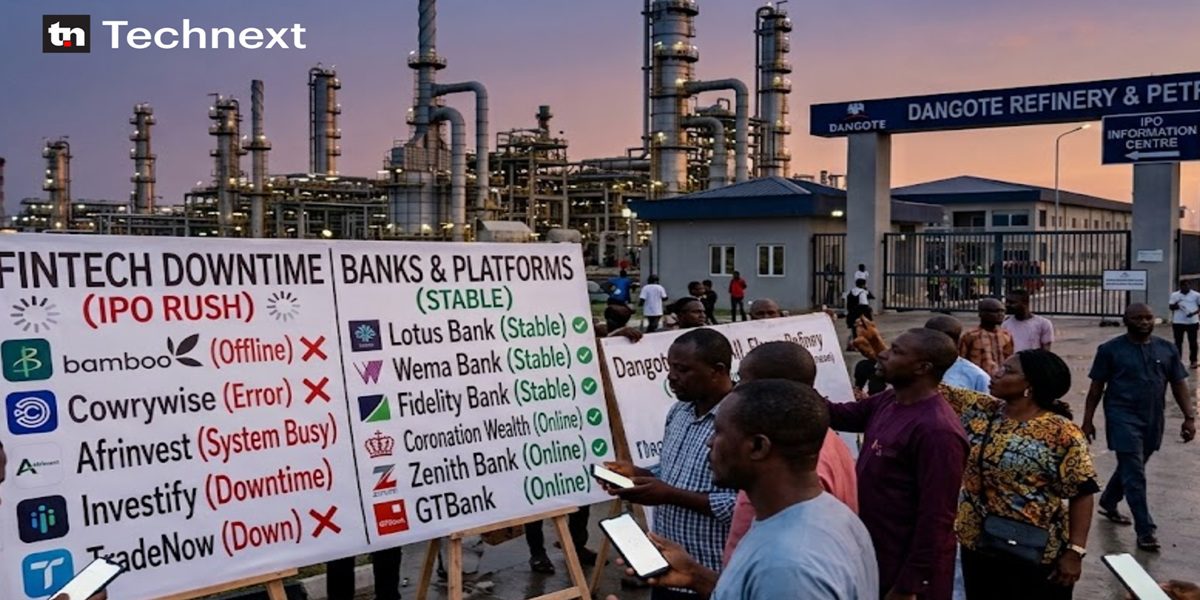
When the Dangote Refinery IPO kicked off on September 14, it was as if the entire nation of Nigeria came alive with excitement. In true Nigerian fashion, everyone flooded online at once, eager to jump into the investment frenzy. Within hours, platforms like Bamboo, Cowrywise, and Afrinvest were overwhelmed, leaving users facing frustrating error messages, endless login loops, and screens that refused to budge.
Social media timelines were ablaze with complaints from people who couldn’t even check their account balances, let alone secure their share of the action. However, amidst this chaos, an interesting contrast emerged that went largely unnoticed. The banks and wealth management platforms that also opened their subscription channels that same day sailed through the morning without a hitch.
There were no widespread complaints, no frantic apologies, and no public scrambling by their tech teams. Understanding this discrepancy sheds light on how different institutions prepare for significant events.
Technext managed to catch up with two insiders who were on the front lines during that hectic day: Akin Adegoke, the Divisional Head of Growth and Digital Transformation at Lotus Bank, and Izekeo Adegoke, the CEO of Coronation Wealth. Remarkably, both echoed a similar sentiment: they understood that the Dangote IPO was going to be anything but a routine day, so they prepared for it accordingly.

This foresight revealed an important lesson about planning and adaptability in the face of high-stakes moments, qualities that can make all the difference when the pressure is on. As the dust settles from that whirlwind of activity, it’s clear that an essential part of navigating these big financial events isn’t just about numbers; it’s about understanding the unique rhythm of the market and being ready to meet it head-on.
Lotus Bank: Don’t send everybody through one door
The first thing Lotus Bank did was accept that traffic would be enormous as soon as the Dangote IPO opened. The second thing, and the more important one, was deciding not to let all of it land in the same place.
Customers could subscribe through the mobile app, through internet banking, or by walking into a branch. Three separate routes, all live at the same time, all connected to the same subscription process.
“We planned for the Dangote Refinery IPO as a high-volume retail event well ahead of Day 1,” Akin Adegoke said. “Our objective was not simply to ensure that our digital platforms could handle peak traffic, but to build sufficient capacity and redundancy across the entire customer journey.”
That phrase, the entire customer journey, is where the thinking differs from a pure app-based platform. A fintech app has one front door. If that door jams, everyone is stuck outside. A bank with branches and multiple digital channels can move people around when one route gets congested.
“Demand was distributed across multiple channels, rather than concentrated on a single digital rail,” he explained. “In a high-volume retail event, the risk is not simply whether a platform can process transactions; it is whether the entire distribution infrastructure can continue to serve customers when demand spikes simultaneously.“
He was honest that the day was not effortless. “It would be unrealistic to suggest that an event of this scale would operate without moments of pressure,” he said. There were peak windows where things got tight.

What mattered was what happened in those windows. Technical and business teams watched channel performance live and moved before problems hardened into outages. When one route started slowing down, customers were pushed toward another.
“For us, the measure of resilience is not the absence of pressure,” Adegoke said. “It is the ability to detect, respond and recover quickly while maintaining customer access.”
The three things Lotus Bank did before the Dangote IPO even opened
Adegoke broke their preparation down into three parts, and the second one is the one most people would never think of.
The first was simulation. The bank ran high-volume scenarios in advance, modelling the kind of traffic concentration and customer behaviour that typically follows a major public offer opening. By the time September 14 arrived for the Dangote IPO, the response protocols already existed. Nobody was inventing anything on the day.
The second was communication, and Adegoke frames it as infrastructure rather than marketing. Customers were told clearly ahead of time how to subscribe, where to subscribe, and when. “Customer communication is often overlooked in infrastructure planning, but in a high-volume event it is itself a form of load management,” he said.
Think about that for a second. If you tell customers in advance that they can use three different channels and that the offer runs for a month, fewer of them pile into one app in the first hour. The message itself reduces the load.
The third was a live command structure. Digital banking, IT, customer experience, information security, compliance, operations, and the branch network were all working off the same real-time picture of what was happening, with the authority to act immediately.
“We war-gamed the scenarios because we knew the scale of retail participation could be significant,” Adegoke said. “When the pressure came, our teams were executing a prepared response rather than improvising one.”
Coronation Wealth’s approach to the Dangote IPO: staying online is not the same as working
Izekeo Adegoke, CEO of Coronation Wealth, approached the day the Dangote IPO opened from a slightly different angle, focused less on how many people showed up and more on what happened to their money once they did.
“What was particularly important was not simply the number of users accessing the platform, but the concentration of activity around the Dangote IPO opening window,” she said. “We therefore treated the event as a high-volume transaction event rather than a normal trading day.”
Ahead of the Dangote IPO opening, Coronation stress-tested the specific paths that mattered most: onboarding, funding, and the actual subscription process. Not the whole app. The three journeys where failure would hurt a customer the most.
Her point about what success actually looks like is the sharpest thing either of them said.

“For us, platform availability is only one measure of success,” she said. “Equally important is ensuring that customers can confidently initiate a transaction, receive the appropriate status, and have their funds and orders accurately reflected through the transaction lifecycle.”
In plain terms: an app that loads but leaves you unsure whether your ₦5,250 actually bought shares has not really worked. You still cannot sleep. The screen being up is not the win; knowing your money landed where it was supposed to is.
“Funding confirmation, order submission, status updates, reconciliation and exception handling are all critical components of a successful digital investment experience,” she said. “The broader lesson is that digital investment infrastructure must be designed for transaction integrity and resilience, not just user traffic.”
She also resisted crediting any single piece of technology for getting through the day. “I would attribute the resilience to a combination of technology, preparation and operational discipline rather than to any single infrastructure component,” she said.
What both of them think the industry should take from this
Neither of them treated the Dangote IPO as a one-off to be survived and forgotten. Both saw it as a preview.
For Lotus Bank, the headline lesson was about reach. “Nigeria has a population of over 200 million people and a rapidly expanding retail investment market,” Akin Adegoke said. “Customers have different levels of digital adoption, different transaction behaviours and different preferences for accessing financial services. Infrastructure must therefore be designed around the diversity of customer behaviour, not around a single channel.”
He put it more simply too: distribution matters as much as capacity. You can have a powerful system and still fail people if there is only one way in.
For Coronation Wealth, the lesson was about where Nigerian investing has moved to. “Retail participation in Nigeria’s capital markets has moved decisively into the digital age,” Izekeo Adegoke said. “Large public offerings can generate demand that is highly concentrated within very short windows. That means platforms need to plan not only for average traffic but for extreme transaction peaks.”
She also pushed the responsibility beyond individual companies. Issuers, registrars, brokers, technology providers, banks, and market infrastructure all need to start treating events like this as what they really are, national-scale digital transaction events, not just busy days for a few apps.
“The Dangote IPO demonstrates the enormous appetite among Nigerians for direct participation in the capital markets,” he said. “Our responsibility as digital investment platforms is to make sure that the infrastructure is ready to convert that appetite into a seamless, trusted and scalable investment experience. The opportunity is much bigger than one IPO.”
That last line might just be the most valuable insight from the entire episode. Picture this: millions of Nigerians, driven by hope and ambition, eagerly attempted to invest in a refinery as big as Dangote on a bustling Monday morning, all from the convenience of their phones. Some managed to secure their spot in this coveted opportunity, while others found themselves endlessly refreshing a login screen, frustration mounting with every attempt.
As anticipation builds for the next major listing like Dangote’s, it’s clear that the same eager crowd will return, hungry for another chance. The real question, however, is how many platforms will take heed of the lessons learned from this huge Dangote IPO experience? Will they rise to the occasion, ensuring smoother access and a better experience? It’s a pivotal moment that holds the promise of innovation in the financial landscape.
