




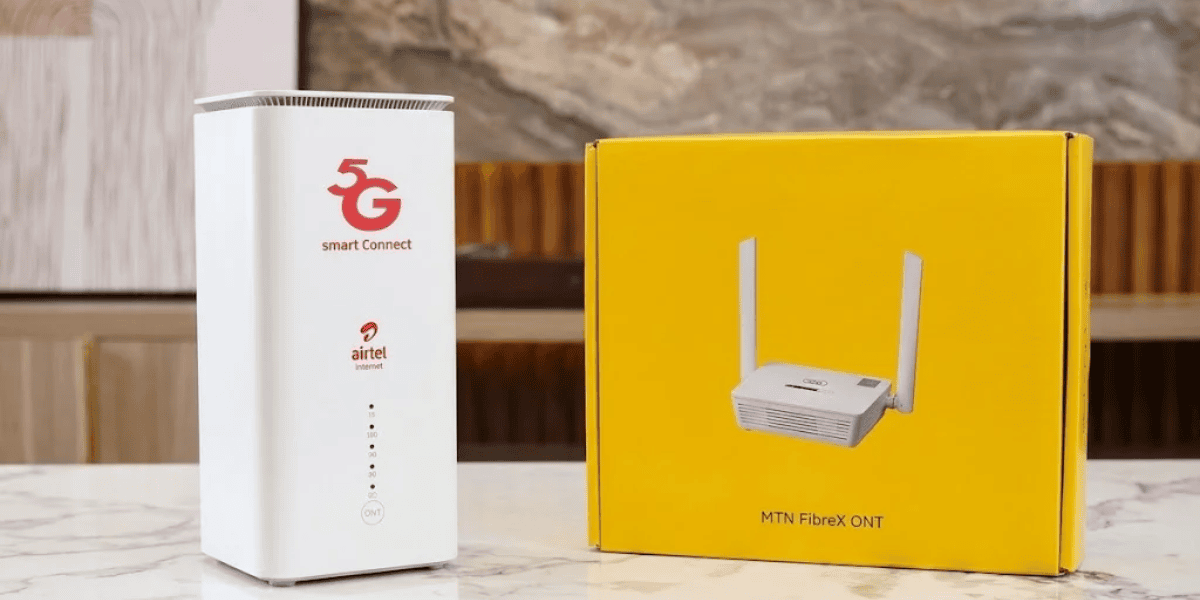
Each time subscribers get high-speed home broadband (router), whether Airtel ODU, MTN FibreX, MTN FlyX, or others, the acquisition process often gives the impression that their initial upfront payment, starting at ₦25,000, buys them ownership of the hardware.
With no knowledge of the binding terms and conditions that contain a major clause stating that they don’t own the routers installed in their homes even after paying initial onboarding fees, many subscribers feel entitled to these devices.
Another key clause most subscribers are unaware of or don’t pay attention to is that the hardware is tied strictly to active usage. Here, three consecutive months of non-subscription (termed inactivity) grants an operator the legal right to repossess the router from the subscriber’s location.

Why inactivity equals financial loss
Following the report of the hidden broadband cost many subscribers don’t know about, Technext had a discussion with a telecom insider (who wouldn’t like to be mentioned). The conversation reveals that behind the scenes lies an economic reality that telcos rarely make known to the public. It shows that the hardware is more expensive than what subscribers pay at the counter.
In addition, a reason emerged for why telecom operators dispatch recovery teams or agents to retrieve the routers after three consecutive months of non-subscription.
According to the insider, the outdoor units (ODU) and optical network terminals (ONT) deployed for 5G and fibre connections carry an actual production and procurement cost of around ₦200,000 per unit. Owing to affordability considerations and the fact that very few average Nigerian consumers can afford ₦200,000 just for a router, telecom companies adopt a subsidised strategy.
In this strategy, telcos adopt a capital-recouping model where they provide the router at zero cost to lower the barrier to entry. They offset this investment through consistent monthly subscriptions ranging from ₦25,000 to ₦45,000, depending on internet speed.
For financial recoup considerations, it takes an operator anywhere from 12 to 24 months of a subscriber’s continuous monthly renewals just to break even on the real hardware costs (₦200,000) and installation overheads. This explains why the 90-day rule exists.
According to the insider, if a subscriber stops renewing after just one or two months, the telecom operator suffers a direct financial loss because the router sits idle in a living room or on a roof, remaining passive and generating zero revenue for the operator.
Therefore, reclaiming the routers after 3 months (90 days) of prolonged inactivity is operators’ legal mechanism to redeploy the asset to an active paying subscriber and cut their losses.

The hidden paperwork
While telecom operators can design router adoption and recover capital in this business model, another core issue is how they communicate the terms and conditions during onboarding.
A Technext field study shows that about 9 in 10 subscribers aren’t aware that “free” routers can be far from ownership. The clauses exist in official documentation, but most subscribers are unaware until they fall into these legal pits.
When Technext reached out to Glory in the previous story, she said she was unaware of any binding document upon receiving payment confirmation emails and considering that she was matched with an installation agent for the device’s installation.
She was caught unaware when the calls started coming in June for the router’s retrieval, which was finally retrieved from her residence in October.
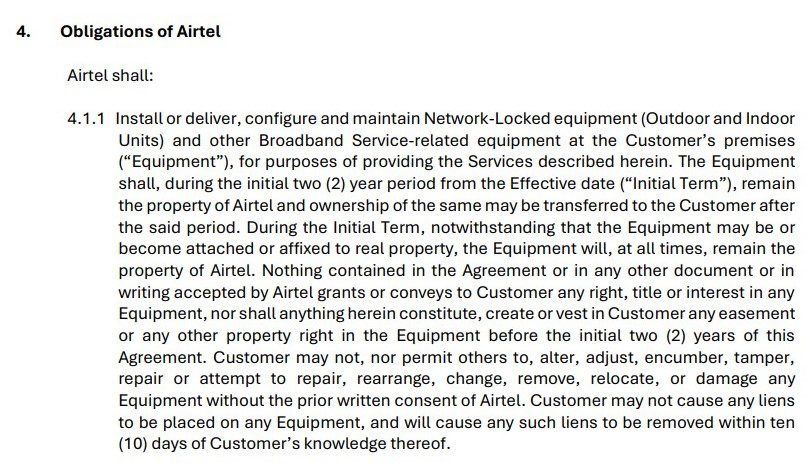
A leading gap in the communication mechanism lies in how agents often focus on securing the sale and closing targets rather than providing copies of the terms & conditions or sharing the official PDF links with subscribers during onboarding.
When asked about this, the insider claimed agents must have mentioned some key terms to subscribers verbally, such as that the device is on a managed-use basis and requires a consistent subscription to remain active.
However, onboarding forms typically only collect basic identity details such as name, NIN, and address. With this, subscribers walk away with a receipt and an impression that the ₦25,000 payment was a purchase price rather than an initial data package.
Moving towards a fair disclosure
Telecom operators have clear business reasons to safeguard ₦200,000 hardware assets, but the path towards this requires strict transparency.
Operators should adopt a clear written disclaimer, perhaps on receipts and sign-up forms, that the router remains the company’s property and will be retrieved after 90 days of inactivity.
For consumers, if you didn’t pay ₦200,000 out of pocket for an ODU or fibre box, you likely do not own it. Therefore, pausing your monthly subscription for three consecutive months (or 90 days) puts the router at risk of retrieval.
Also Read: NCC CEO, Maida, urges telcos to boost network quality with increased investment.
