



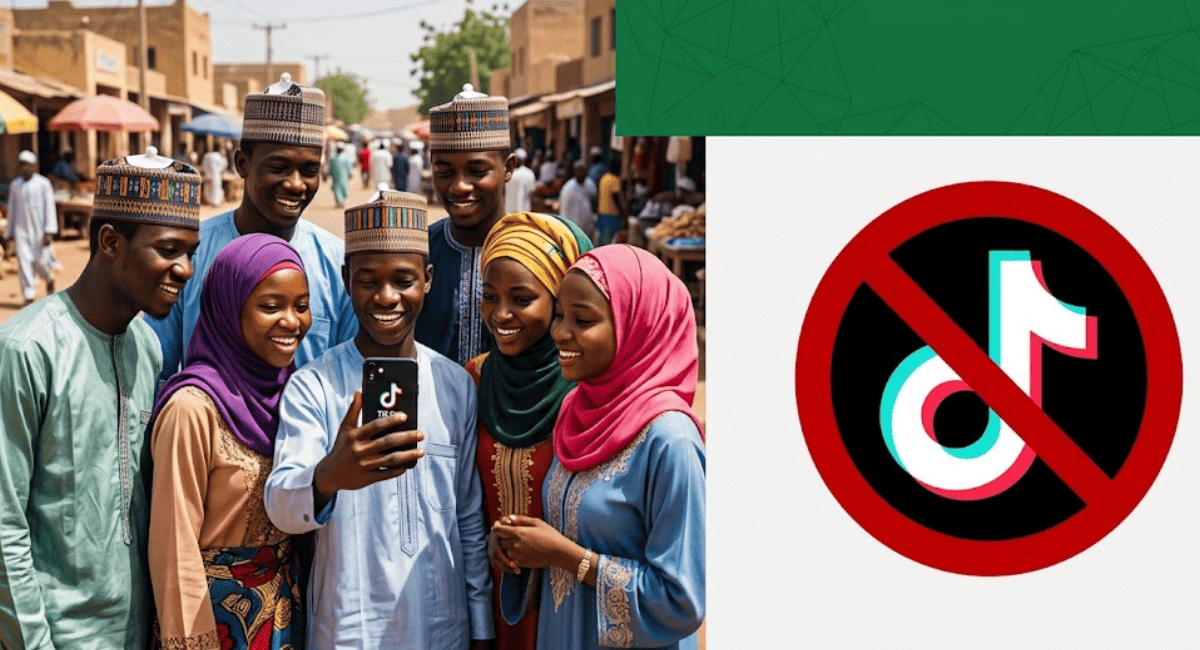
A viral post by X user @Urchilla01 on 17 September 2026 alleged that the APC-led federal government had “quietly blocked access to TikTok in key northern states like Sokoto, Kaduna, and Kano” because the Obi-Kwankwaso (“OK”) ticket was gaining momentum there. The poster concluded: “We are in a dictatorship.”
Independent reporting and user accounts confirm that many people in Kano, Kaduna and Sokoto have struggled to use TikTok on ordinary mobile data since about Monday, 14 September 2026. Feeds freeze, videos fail to load and uploads stall.
Connecting through a VPN often restores the service almost immediately.
A Tech Digest investigation published by Economi Confidential on 17 September found consistent complaints from Kano, Kaduna, Sokoto and other northern locations beginning around Monday 14 September.
Users described the app becoming unusable on regular connections even when other internet services worked. VPN use often fixed the problem, a pattern consistent with routing interference, traffic shaping, or domain/IP-level filtering rather than a nationwide TikTok outage or a simple app crash.

Similar complaints appeared on X during the same period from people in Kaduna, Kano and Sokoto. Others described “pockets of complaints”, while some users first assumed their data had run out; others concluded the platform had been restricted.
Several asked MTN, Airtel, Globacom and the Nigerian Communications Commission (NCC) for an explanation. Yet, the disruption is not uniform across Nigeria. Reports are concentrated in the North-West, with fewer complaints from other regions.
As of the time of writing this report, neither the NCC, NITDA, major telecoms operators, nor TikTok had issued a public statement confirming a restriction, a technical glitch, or explaining the cause. That silence has amplified political interpretations.
Nigerian regulators have previously directed platforms to remove large volumes of content and have a record of pressure on social media, including the 222-day nationwide Twitter/X suspension in 2021–2022. More recently, they have collaborated with platforms to take down terrorist and “harmful” content. A quiet, geographically limited throttle would be deniable in a way a formal ban is not.
Meanwhile, when a service fails on a local connection but works through a VPN, traffic is routed around whatever is interfering with the original path. That can happen because of DNS or IP-level blocking, routing changes, congestion on particular networks, content-delivery problems in a region, or deliberate interference. A VPN workaround is consistent with blocking; it is not, by itself, proof that the federal government ordered a political shutdown.
Nigeria’s operators and regulators have legal tools to restrict unlawful content or act in emergencies. They have previously collaborated with platforms to remove terrorist and bandit accounts from TikTok and other apps. Those efforts were publicly described by security officials, not hidden as a regional social-media blackout.
Local religious police in Kano have also targeted individual TikTokers over “obscene” videos, a separate, well-documented pattern that does not equal a statewide platform ban.

The claim’s political framing is not invented from nothing. Peter Obi and Rabiu Kwankwaso are running as the Nigeria Democratic Congress (NDC) presidential and vice-presidential candidates for 2027. Kwankwaso’s base is Kano; the “OK ticket”, as it’s popularly called, is being sold as a South-East/North-West combination that could challenge the APC in the north.
On the same day that the viral post circulated, the Obi/Kwankwaso movement unveiled a 59-member presidential campaign council.
Kano, due to its sheer size, remains a high-stakes prize. Kwankwaso’s Kwankwasiyya movement still commands loyalty there even as some former allies have defected to the APC. Kaduna and Sokoto are also politically sensitive northern states. Opposition supporters argue that social media, especially short-form video, has helped the ticket reach younger voters.
That context makes any access problem in those states politically explosive and fits a narrative of selective pressure; however, it does not prove intent.
What our findings reveal about the TikTok ban in parts of North
The documented unreliable access to TikTok in Sokoto, Kaduna and Kano around mid-September 2026, with users turning to VPNs, is supported by contemporaneous user reports and a published investigation. The stronger claim, that the APC-led government secretly banned the platform in opposition strongholds to suppress the OK ticket, is yet to be established.
There is no leaked directive, no telco admission, no NCC order, and no multi-platform pattern (Instagram, Facebook, WhatsApp and X were not similarly reported as blocked).
The claim therefore overreaches. The access problems are factual. The leap to a clandestine, election-motivated dictatorship, especially with geography, timing, official silence, and Nigeria’s history of digital controls, is an inference that current public evidence does not confirm.

Yet, that combination is enough to warrant scrutiny.
Targeted or unofficial throttling of a platform used for political mobilisation, comedy, news and small business in the north would be a serious democratic problem even if it fell short of a formal ban. Creators and traders in Kano’s sizable TikTok economy would be among those affected. Prolonged uncertainty without explanation from regulators or operators is itself a governance failure.
Until NCC, the operators or TikTok publish technical findings, or until the disruption spreads or vanishes, the responsible conclusion is this: something is interfering with TikTok in parts of the north. Whether that something is a quiet political decision from the Aso Rock Villa, a network fault, or a mix of local and federal pressures is not yet proven.
The allegation should be treated as a live, evidence-based question, not as a settled fact and not as mere conspiracy. Officials who want to dismiss it can do so by explaining the routing, publishing traffic data, or restoring unhindered access and saying so. Silence leaves the political interpretation standing.
Also read: 10 times the Nigerian government undermined democracy using technology (2020–2025)
