




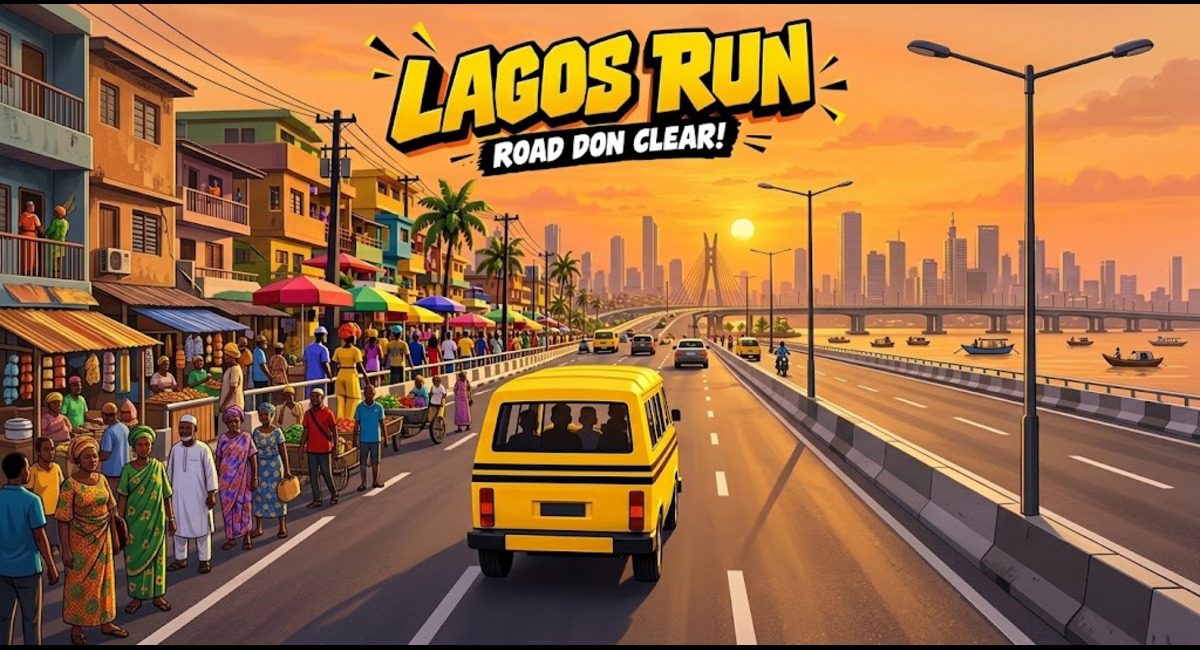
Nigeria’s games industry has spent almost two decades trying to put the yellow danfo bus on a screen. It took a Berlin-based software engineer, a few weeks of spare time, and an AI coding assistant to actually get thousands of Lagosians driving one. That reality should unsettle people who build games for a living. More importantly, it should teach them something about how digital products travel in Nigeria.
Lagos Run is a free browser game built by Opeyemi Adeniran, a Nigerian frontend engineer based in Berlin who posts on X as Eureka. Built over four to five weeks as a side project using AI tools, the game reportedly drew 7,000 players in its first two days and crossed 27,000 shortly after, according to figures Adeniran shared online.
Yet the danfo game is an old trope in Nigerian tech. Bayo Puddicombe taught himself to code and built the first version of a danfo game in 2007; his studio, ChopUp, later claimed its Danfo series reached over 700,000 players. Gamsole launched with a 2D bus-driving game for feature phones before releasing Gidi Run, which set bribe-hungry police and wild conductors in a Yaba-like Lagos. Maliyo Games released Danfo Racer in early access, though CEO Hugo Obi later admitted the studio’s planned hustle-and-bustle narratives had not been fully applied, leaving a standard twisty circuit. Goondu Interactive also took a swing with Danfo Saga and Danfo Hustle.
The pioneers did not fail for lack of talent or ideas, and several found respectable audiences. What none of them captured was a shared cultural moment where your cousin, your boss, and a stranger on social media are all comparing high scores in the same week. The useful question is not whether Lagos Run is original, but why this particular danfo game travelled where others hit a roadblock.
The link is the product
Adeniran removed every step between curiosity and play. Lagos Run requires no download, no account creation, and no upfront payment. Players tap a link on social media and land straight behind the wheel.
Compare that with the traditional mobile route. BusinessDay previously reported that while Gamsole’s Gidi Run earned warm reviews, it struggled to gain organic traction on a crowded Google Play Store. An app store listing asks a stranger to search, download, wait, and trust. A link asks them to tap. On phones where storage is tight, and data bundles are fiercely rationed, that gap is enormous. Progress in Lagos Run is saved locally in the browser, and a service worker allows the game to load quickly and function offline, a quiet courtesy to commuters dealing with patchy network coverage.

The game is also engineered for timelines. Adeniran treated the launch as a live conversation, shipping rapid updates based on X feedback: brighter obstacles for night play, clearer bus-stop markers, countdowns, and visual cues for new drivers. A high score is a brag, and a chaotic run is a story. Both belong on social media, meaning the way people play directly feeds how the game spreads.
Then there is the shifting economics of software. Adeniran says he used AI-generated graphics and Anthropic’s Claude during development. One developer with a day job and a free month can now ship a polished loop that once required a funded studio. That shift favours the small and the fast.
Lagos Run goes beyond the yellow Danfos
At its core, Lagos Run is an endless runner. You swipe to steer, collect coins and boosters, dodge other road users, and chase leaderboard positions. Nothing about that underlying frame is uniquely Nigerian.
What elevates the game beyond a generic runner in yellow paint is the behavioural loop layered on top. Danfos sit at the core of roughly 70 per cent of motorised trips in Lagos, according to urban transport researchers. Players in Lagos Run are not exploring a fantasy; they are replaying a daily negotiation along routes like Ojuelegba to Yaba, CMS to Ajah and the like. They load passengers for fares, fight the ‘infamous Lagos traffic’ (gridlock) with upgrades, and deal with pedestrians and stray tyres.
When players swap stories online about stubborn virtual passengers who refuse to alight at their stops, every joke lands without a tutorial. In most games, a passenger refusing to exit would read as a bug. Here, it is documentary accuracy. The in-game radio sharpens the immersion further. Added late in development, it lets players tune into public streams of real Lagos radio stations. The city arrives as sound, not just pixel art.
Still, a fair review has to press on the game’s mechanical limits. Lagos traffic chaos is negotiated through people: conductors, touts, and traffic officials. An endless runner naturally rewards speed, and speed is the least authentic thing about a Lagos commute.
Also read: The digital Battle of Adwa: Kanessa Muluneh’s quest for Africa’s gaming sovereignty
Adeniran has promised updates featuring agberos (tout collectors) and LASTMA traffic officials, alongside custom liveries like an Independence Day paint job. Notice the difficulty curve between those features. A new paint job is an afternoon’s work. Agberos and LASTMA are another matter entirely, because in Lagos they are not scenery; they are economic costs. If an agbero takes a cut of your fare and a LASTMA stop can wreck a profitable run, Lagos Run will successfully model the informal economy. If they are just extra obstacles to swerve around, it remains an endless runner in a danfo costume.
Can virality and goodwill pay studio rent?
Adeniran has noted the game’s commercial potential, and players are already asking what comes next. But virality is cheap, and revenue in the African gaming market is notoriously hard to extract.
Lagos Run’s greatest distribution strength is also its sharpest commercial weakness. Nothing is sold at the door, and browser-only progress without user accounts leaves a thin foundation for long-term retention. Worse, the technical moat is shallow. Within twenty-four hours of seeing Lagos Run, another developer spun up a London equivalent called Red Bus. Code can be cloned in a morning; cultural fluency is the only real defence.

History shows that Nigerian gamers rarely pay for in-app purchases directly. When Gidi Run reportedly reached 100,000 paying subscribers, it did so through a telecom billing partnership with MTN rather than credit cards. Other studios have survived by looking elsewhere: Maliyo Games leaned into international IP licensing with Disney for Iwájú: Rising Chef, while betting firm BetKing recently launched a danfo-themed casino game called Danfo Lagos to capture local attention.
For Lagos Run, the most realistic revenue levers are brand-wrapped danfos, in-game billboards along the Yaba corridor, or formal partnerships with the Lagos radio stations the game already streams. Yet turning a viral project into a business requires payroll, customer support, and leaving behind the safety of a senior engineering salary in Europe.
Lagos Run wins on fit, not studio polish. It matched the right cultural subject with the right frictionless format on the exact platform where Nigerians already spend their evenings. Whether it evolves into a sustainable gaming business or remains the best side project of the year depends entirely on what happens after the timeline moves on.
