





MTN Nigeria, Airtel Nigeria, and Globacom all introduced data calculators to help customers estimate how much data they need based on their internet habits, rather than buying bundles blindly. However, the models of their data calculators differ significantly in design, setup, and operational mode.
The introduction of data calculators follows complaints about data depletion. To provide clarity on how data usage really works, operators are using the platform to provide a clear view of data usage with respect to subscribers’ internet activity.
Besides their differences, all the mobile operators are aiming towards a common goal: Estimate a user’s monthly data consumption through their projected internet usage habits. The data calculator is designed so that users are asked about their common online activities such as social media, music and video streaming, gaming, video calls, and web browsing.
After this, the data calculators recommend the most appropriate data bundle based on the estimated usage by a subscriber. They also encourage subscribers to buy larger or more suitable plans instead of repeatedly exhausting small bundles.

While the platforms play the role of customer education and are indirectly revenue-oriented, they reduce confusion about data usage and increase the likelihood that subscribers purchase the needed data bundle.
The major differences we saw among data calculators
While the data calculators are channelled towards a unified ambition, the tool’s interface, methods and how each operator sought to achieve this differ.
MTN Nigeria: The most advanced of the data calculators
MTN Nigeria’s data calculator appears refined among the three operators, owing to its design and appealing style.
The platform estimates usage across numerous digital activities such as cloud backups, messaging, browsing, music, SD/HD/4K video streaming, gaming, and video calls. It allows users to specify the number of devices and add plans for unexpected data usage and application updates.
After the entry, it then explains how much data each activity typically consumes, making the tool more educational.
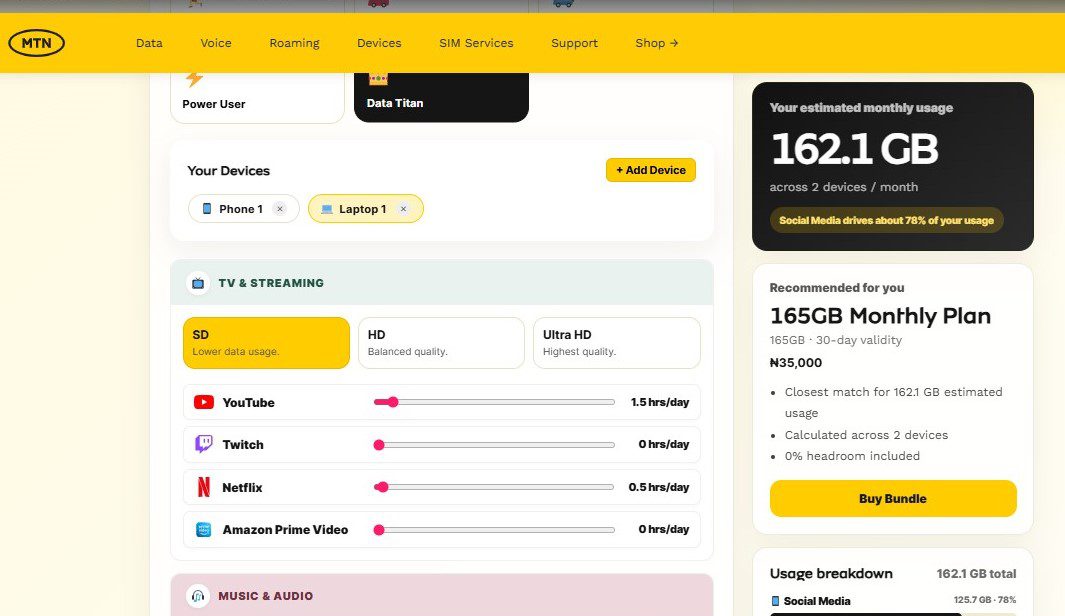
Strengths: Detailed activity breakdown, supports multiple devices, inclusion of data usage buffer and recommends the closest matching bundle.

Weakness: Can feel overwhelming for users who simply want a quick recommendation.
Airtel Nigeria: Embraced simplicity
Airtel’s data calculator focuses on making recommendations with fewer questions and a cleaner, seamless interface.
Instead of asking several detailed questions, Airtel went for lifestyle categories, common internet habits, and easier navigation. The aim is to understand what its subscribers want to do online and then recommend an appropriate data plan. This makes it faster for average users.
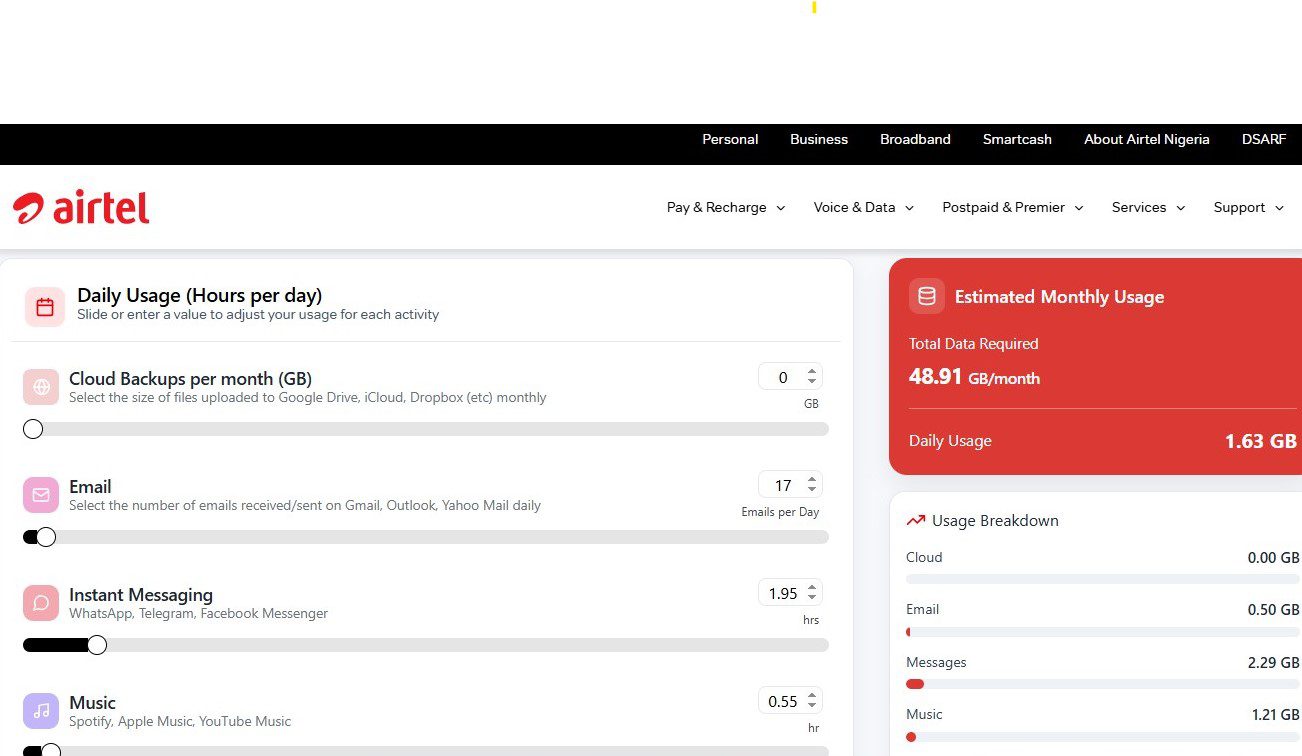
Strengths: easy to understand, less intimidating, and faster recommendation process.

Weaknesses: Less precise and doesn't educate users much about actual data consumption.
Globacom: More bundle-oriented
Compared to MTN and Airtel, Globacom’s data calculator approach is more straightforward.
Instead of deeply modelling users’ daily usage behaviour, the data calculator is tied to promoting available data plans. The emphasis is on helping users find the best Globacom bundle for their expected usage.
It also has less detail in estimating activities like gaming, cloud storage, or streaming quality.
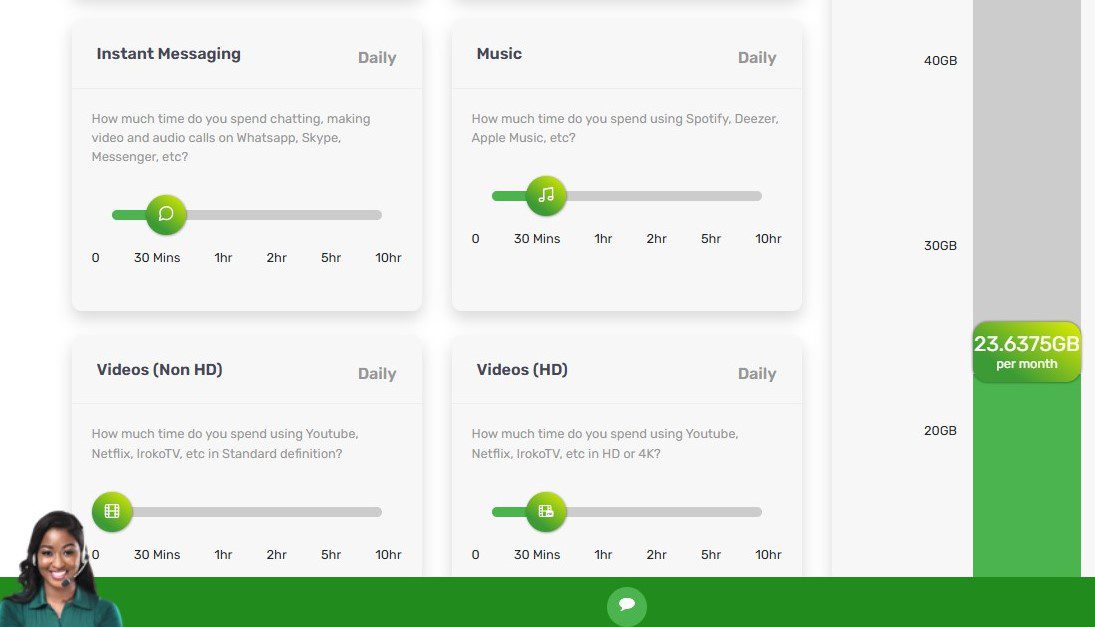
Strengths: Very easy to use, and has a direct path to purchasing bundles.

Weaknesses: Limited behavioural analysis, Less transparency on how estimates are calculated, and it feels more like a bundle selector than a true usage calculator.
What we noticed
The tool, even with the clear purpose of helping customers estimate their likely data usage in a month, reveals how operators are using data calculators to achieve various ambitions. Below are some of the patterns we noticed.
1. Operators understand customers’ data usage
For MTN, Airtel and Globacom, data calculators are more than just data predictors. They also generate valuable insights for the operators.
Every interaction can help operators know the applications and services customers use most and the estimated demand for video, gaming, or cloud services.
In fact, the information provides an opportunity to design new bundles and the means by which customers are likely to upgrade to larger plans.

2. The estimates can never be precise
A major issue is that data usage depends on many factors that users don’t normally see.
The fact that video quality automatically changes with network conditions, apps downloading updates in the background, cloud backups of photos and videos, social media preloading content you’ll never watch, advertisements embedded in apps and websites, and different apps compressing data differently makes data usage estimation complex.
Another reason for this complexity is that two subscribers who both spend one hour on Instagram can consume different amounts of data owing to speed, network outages, and devices.
3. Commercially oriented
The hidden aspect of the entire exercise is to make customers see that they use more data than they imagine. This provides a resolution for the incessant data depletion complaints.
If an operator assumes you stream at 1080p when you usually watch at 480p, then the calculator may recommend a larger bundle than you actually need.
From a commercial perspective, mobile operators benefit when customers buy plans that are slightly larger than necessary. This is because customers are less likely to complain about data depletion and average revenue per user (ARPU) will increase.
Also Read: Data boom, slow 5G and rising costs: review of Nigeria’s telecom industry data in H1 2026.
However, the significance of data calculators is intact as users have a fairly predictable range of data consumption. The tool produces a reasonable estimate of usage patterns based on information supplied. It might not be exact, but it provides a likely picture.
