




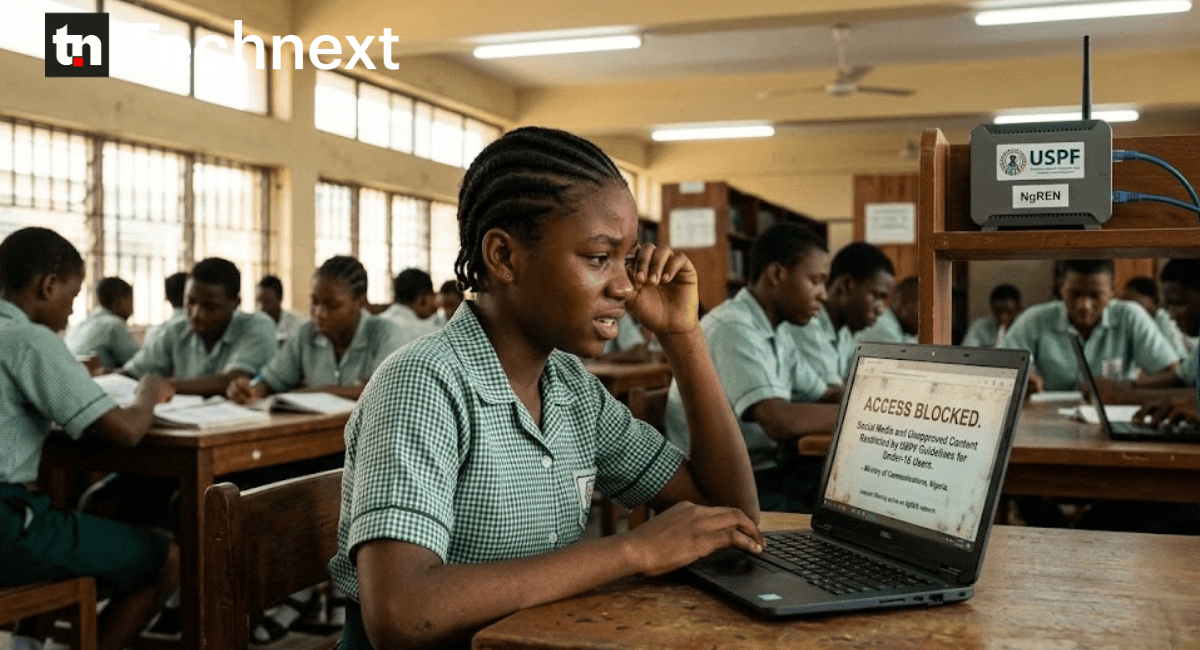
It is a random Wednesday afternoon in February 2027. A fourteen-year-old in a bustling secondary school in Surulere, Lagos, logs onto the internet from the library via the newly installed campus Wi-Fi. The connection, robust and promising, is part of a grand federal initiative to bring the nation’s foundational education into the modern era. Yet, the moment she tries to navigate beyond the rigid borders of approved educational portals to explore the global digital village, she hits an institutional wall.
This scenario illustrates the looming paradox in the current Nigeria broadband policy. The government is aggressively deploying terrestrial fibre to democratise connectivity, while simultaneously considering restrictive rules that could isolate the exact demographic those cables were laid to empower. The ongoing consultation regarding a proposed Nigeria social media ban under 16 has brought this friction into sharp focus, forcing an urgent national debate over digital inclusion vs child safety where state priorities appear to pull in opposite directions.
In March 2026, the Minister of Education, Dr Tunji Alausa, announced a mandate to expand internet access in Nigerian schools. The framework relies on scaling the Nigerian Research and Education Network (NgREN), previously reserved for tertiary institutions, down to basic and secondary education. Supported by Universal Service Provision Fund (USPF) interventions such as the Campus Connect project, the objective is straightforward: provide pupils with the digital competencies required to compete in a platform-driven global economy.
The Ministry of Communications, Innovation and Digital Economy has long reinforced this position, treating broadband penetration as an indispensable pillar of economic resilience. The premise is sound. A digitally literate youth population forms the foundation of any sustainable knowledge economy.

By September, however, the policy narrative shifted. Prompted by international regulatory trends and an August survey indicating that 83 per cent of citizens favour curbs on minors online, authorities opened public consultations on draft frameworks that could enforce a Nigeria social media ban under 16. Regulators floated the concept of zero-rated educational access, effectively establishing a filtered environment that restricts commercial platforms, social networks, and unverified content.
The core motivation is understandable. Young users routinely encounter cyberbullying, exploitative actors, and algorithmic pressures that damage adolescent well-being. Advocates contend that public authorities must intervene where commercial platforms have failed to build adequate guardrails. Even so, well-intentioned interventions do not automatically translate into sound regulatory outcomes.
The fatal flaws in a Nigeria social media ban under 16
The fundamental shortcoming of this two-pronged approach is a misunderstanding of how digital literacy develops. Educational utility cannot be cleanly divorced from the interactive social web without undermining the very skills public policy aims to cultivate.
Technical enforcement presents immediate practical challenges. Robust age verification remains an unresolved problem worldwide. While Nigeria’s National Identity Number (NIN) infrastructure continues to expand, coverage among minors is still uneven. Enforcing a Nigeria social media ban under 16 would inevitably force network operators to rely on crude IP-level blocks, device restrictions, or network throttling. In response, tech-savvy adolescents will predictably turn to Virtual Private Networks (VPNs) and unmonitored proxy services, exposing themselves to far darker corners of the internet.
Furthermore, viewing zero-rated educational repositories as a substitute for genuine digital participation relies on an outdated model of the web. The modern digital economy is participatory. Social channels and open collaborative networks are where teenagers learn software development through GitHub discussions, study creative production on YouTube, master algorithmic distribution, and observe civic discourse. Isolating adolescents from these ecosystems leaves them ill-prepared compared to international peers who are taught to navigate modern web platforms critically.
A sanitised, read-only internet in secondary institutions runs counter to the broader ambitions of the Nigeria broadband policy. When the state invests substantial public capital to connect a classroom in Kano or an educational centre in Yaba, the economic return depends on enabling students to build, communicate, and solve problems online. Confining them to pre-selected digital libraries amounts to digital containment rather than empowerment.

Relying on state-enforced platform blackouts also risks deferring the structural work needed in digital child protection. Any serious approach to social media regulation in Nigeria must hold global technology companies accountable for exploitative design patterns, invasive data harvesting, and default safety settings for underage accounts. Shielding teenagers behind a blanket ban until their sixteenth birthday, only to release them unprepared into an unregulated web, offers no genuine protection.
Public policy does not face an either-or choice between connectivity and pupil welfare. Addressing online risks requires discarding the premise of an entirely sanitised web in favour of practical digital resilience.
Instead of erecting domestic digital barriers, regulatory bodies and curriculum planners should embed critical cyber literacy into the national school curriculum. Secondary school students must be taught data privacy hygiene, threat detection, and how engagement algorithms operate. Simultaneously, policymakers should push social networks and domestic internet providers to enforce privacy-by-default standards for young users.
Connecting classrooms across the country represents a decisive step forward. Yet, if the current consultations culminate in a statutory Nigeria social media ban under 16, the state will have laid an advanced digital road network while denying its young population the skills to navigate it. A modern digital economy cannot thrive on a generation that is technically connected yet systematically cordoned off from the modern web.
