





As women in tech, building in public requires more than consistently sharing achievements online. Behind the visibility, personal branding, and career growth often lies a strong community shaping the journey.
In this context, a community refers to a network of people, support systems, and collaborative spaces that encourage learning, mentorship, accountability, and professional development.
These communities may exist through LinkedIn networks, WhatsApp groups, mentorship circles, study communities, industry forums, or even an engaged social media audience. They often become spaces where opportunities are shared, challenges are discussed openly, and career growth is strengthened through collective support.
For many women in tech, community also influences what gets built publicly. Products, platforms, initiatives, and even personal brands are often shaped by the direct needs and feedback of the people they serve.
One relevant example is Adeife Adeoye, widely recognised as one of Nigeria’s leading female community builders. Her organisation, Remote WorkHer, was built as a platform to empower women to become career-ready through access to resources, opportunities, and professional support.
As the community grew, another platform, Hercademy, was launched to equip women with technical and non-technical skills for workplace readiness and career advancement. According to Adeife, the idea emerged directly from the growing demand for skill development within her community.
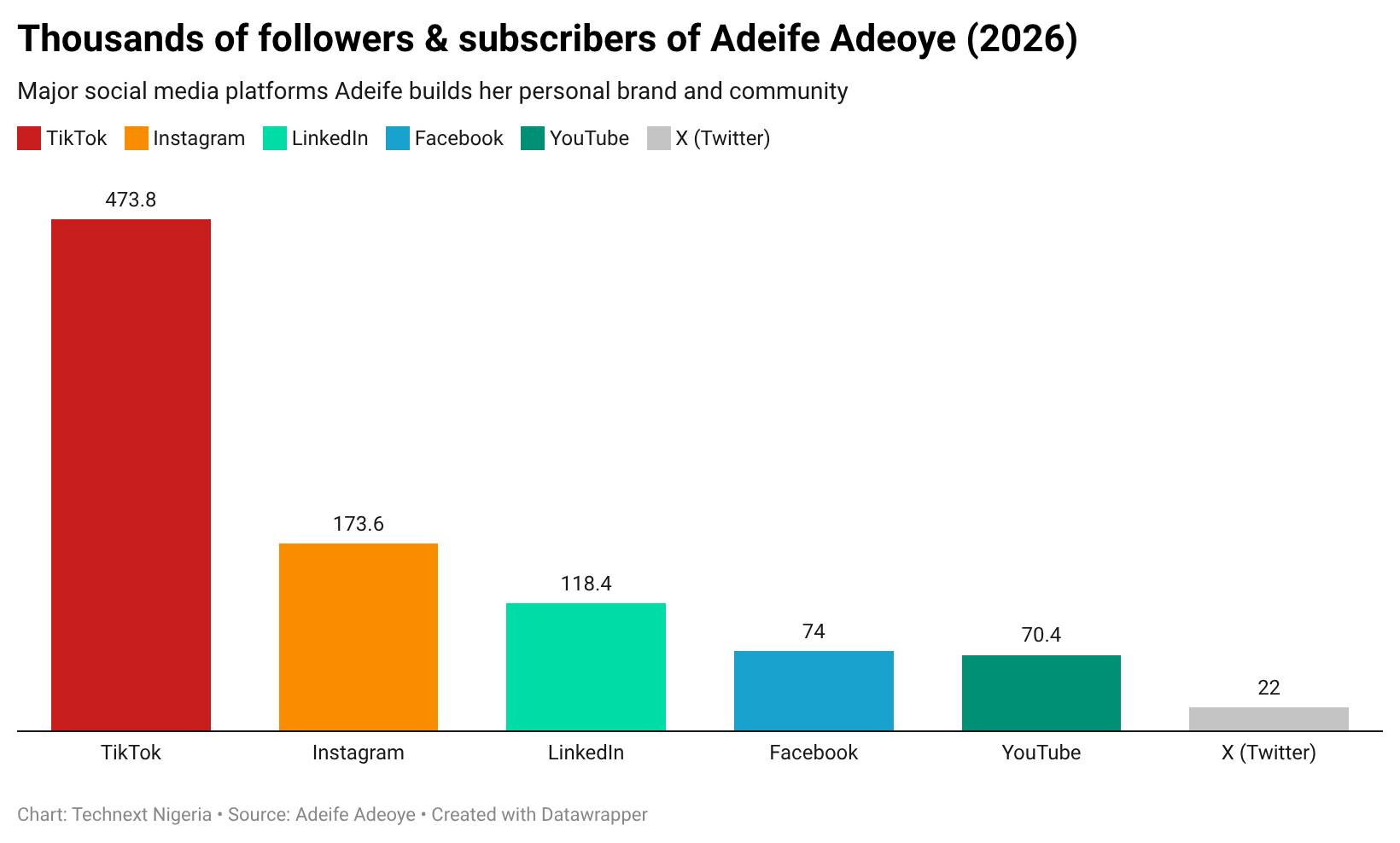
With an audience of more than 800,000 followers across social media platforms, including over 70,000 YouTube subscribers, Adeife has built much of her career in public view.
Despite the visibility and demand surrounding Hercademy, it was eventually shut down to redirect focus toward sustaining Remote WorkHer. The decision reflected a difficult reality many founders encounter: community demand alone does not always guarantee sustainability.
Speaking on the closure, Adeoye noted that building solely around demand can become financially unsustainable, especially when substantial operational and human resources are required. Her experience highlights an important truth that while the community can shape ideas, validate needs, and influence direction, long-term sustainability still determines what survives.
Many women in tech say community remains one of the strongest forces influencing how they build publicly.
Here are eight ways they believe it has shaped their journeys.
Read also: The end of Showmax: a timeline of growth, struggle and death

1. Community turns survival into sustainability
For many women in tech, community is not simply a support system; it is often the reason consistency becomes possible in the first place. Publicly building a tech career can be isolating, especially in industries where access to mentorship, guidance, and visibility is unevenly distributed.
Within communities, however, learning is accelerated through shared experiences, peer accountability, and collective encouragement.
According to Blessing in cybersecurity, platforms such as CyberSecHaven, Tech4Dev, and the IBM Zero Trust Sprint became spaces where mentorship, technical exposure, and visibility were gained simultaneously.
Beyond technical learning, these communities reduced the loneliness that often comes with navigating the industry alone.
“Community has been my safety net and my springboard. Mentorship, peer learning, study groups, training communities, webinars, and the people who answered my questions when I was still finding my voice, those moments mattered. Community made the journey feel less lonely. It reminded me that growth is not a solo sport,” she said.
2. Community sharpens how women think and lead
Behind many women publicly sharing ideas, leading conversations, or building confidently in tech is often a network of people constantly refining their thinking. Community creates environments where perspectives are challenged, ideas are stretched, and professional growth becomes more intentional.
According to Violet in Insuretech, mentors, peers, and learning communities strengthened both her growth and decision-making process. Through continuous interaction and collaboration, knowledge was not only gained more quickly but also tested through diverse experiences and viewpoints.
“Community has been central to my growth and success. Learning communities, mentors, peers, and the people I’ve trained have shaped my journey by providing support, accountability, and perspective. Community has helped me learn faster, stay grounded, and continuously refine my thinking through shared experiences and collaboration,” she said.
3. Community exposes women to the realities behind the industry
Courses and certifications may teach technical skills, but communities often expose women to the unfiltered realities of working in tech.
Online communities are often positioned as channels for exposure into real-world conversations and practical insights. Peace Itimi is a typical example of a female community builder in tech who leverages her social media platforms to discuss real-life challenges through a podcast or video content.
According to Seyifunmi in product management, being part of product communities created access to real conversations, mentorship, feedback systems, and shared resources that shaped both her communication style and approach to product work.
Over time, learning publicly evolved into contributing publicly, turning community participation into a cycle of support for others entering the space.

4. Community creates access that talent alone cannot guarantee
Talent alone does not always create opportunities in tech; visibility, referrals, partnerships, and strategic relationships also play a major role. Communities often become the bridge between potential and access, especially for women navigating competitive industries.
According to Sola Adesakin, the community opened doors to opportunities, partnerships, referrals, and collaborations that may not have been accessible individually.
More importantly, these spaces created environments where people could ask questions freely, learn collectively, and grow without fear of exclusion. In many ways, community becomes both a network and a gateway.
“Over the years, the community has been a source of support, referrals, encouragement, partnerships, and opportunities I could never have accessed on my own. At the heart of what I do is creating safe spaces where people can learn, grow, ask questions, and win together. That ecosystem of mutual support has been one of the greatest drivers of both my impact and my journey, “ she said.
5. Community makes innovation more inclusive
Technology built without diverse voices often risks excluding the very people it intends to serve. Communities help close this gap by bringing lived experiences into conversations around innovation, accessibility, and product development.
According to Toyosi of Adaptive Atelier, conversations with disabled people and accessibility consultants continuously shaped how products were designed and improved. As a Deaf founder, she noted that community involvement made it possible to challenge assumptions and create tools that respond to a wider range of realities beyond personal experience alone.
“Much of what I build comes from speaking with disabled people and professionals who share their real experiences with me. As a Deaf founder, I see the world through my own lens, but I’m very aware that no single experience represents everyone. That’s why community matters. It helps me check my assumptions, learn continuously, and build tools that work for different needs, not just my own,” she said.
6. Community provides visible proof that success is possible
For many women in tech, representation within communities serves as evidence that growth is achievable. Seeing other women openly share their journeys, struggles, and milestones often makes career progression feel more realistic and attainable.
According to Bisola at Moniepoint, her entry into product management came through a women-in-tech scholarship program that introduced her to professionals who had successfully navigated similar paths.
Through mentorship, shared experiences, and public stories on LinkedIn, the idea of succeeding in tech became less abstract and more tangible. Community, in this sense, becomes proof of possibility.
7. Community expands what women believe they can achieve
One of the most powerful impacts of community is its ability to widen ambition. By exposing women to different career paths, leadership journeys, and personal struggles, community spaces reshape what success can look like.
According to Fortress, the community created opportunities for learning, collaboration, and connection while exposing people to both others’ achievements and challenges in the same field. These shared realities helped reveal possibilities that may not have been imagined otherwise.
8. Community transforms individual growth into collective resilience
In industries defined by pressure, uncertainty, and constant change, the community often serves as the emotional and intellectual support system sustaining long-term growth. Beyond networking, it creates spaces where women can process challenges, exchange knowledge, and lead with confidence.
According to Busola, a Human Resources Manager at Redtech, the community functioned as an “invisible boardroom” throughout her career, providing support, accountability, and perspective during critical moments.
Within Africa’s fintech ecosystem, particularly, she described the community as a knowledge-sharing lifeline where ideas are tested, leadership challenges are discussed openly, and collective wisdom strengthens individual growth.
Read also: 5 ways low-income female entrepreneurs can boost their financial growth
