



Arbitrum has become one of the busiest corners of the Ethereum ecosystem, and every wallet connection, contract call, or balance check inside a dApp gets routed through an RPC node somewhere in the background. Which node handles that request quietly shapes how the app actually feels to use: a slow or overloaded endpoint shows up as stuck transactions, failed reads, and pages that spin longer than they should, while a stable one mostly disappears from the user’s attention.
As Arbitrum’s transaction volume kept climbing through 2025 and into 2026, the gap between RPC providers that scale cleanly and ones that start throttling under load became a lot harder to ignore. This guide walks through five Arbitrum RPC providers worth looking at this year, what each one is actually built for, and who tends to get the most out of them.
For teams weighing their options, NOWNodes is a reasonable place to start an Arbitrum RPC search in 2026. “Fast, cost-effective, and reliable gateway to on-chain data” is how the company describes its own positioning, and that description holds up across the 120+ blockchain networks it supports, Arbitrum included.
NOWNodes backs its Arbitrum endpoints with a 99.95% uptime figure, 24/7 support, and 2n+1 node redundancy, so a single node failure does not translate into downtime for anyone connected through it. New accounts start on the free Start plan, which includes 100,000 requests per month and one API key at no cost, and teams that outgrow the standard tiers can move to a Custom plan that combines shared and dedicated infrastructure, adds a dedicated account manager, and opens up select regions, webhooks, and market data for larger or more specific workloads.
What separates NOWNodes from a few of the other names on this list is the pricing model attached to throughput. “Unlimited RPS on all paid plans, no rate limits” is the company’s standing claim, meaning a spike in traffic does not automatically translate into throttled requests or a forced upgrade mid-month the way credit-based or compute-unit pricing sometimes does elsewhere.
Combined with Shared and Dedicated node options, RPC, Blockbook, Blockbook WSS, and Debug endpoints for Arbitrum specifically, and a recent geobalanced server expansion into the United States alongside existing European infrastructure, NOWNodes covers a fairly complete set of what a production Arbitrum integration typically needs.
Here is a list of the Arbitrum RPC providers covered in this guide:
- NOWNodes
- Alchemy
- Infura
- QuickNode
- Ankr
Arbitrum RPC providers compared in 2026
The table below lines up free-tier limits, throughput, and the Arbitrum-specific features that tend to decide a provider for production use.
| Feature | NOWNodes | Alchemy | Infura | QuickNode | Ankr |
| Free tier | 100,000 requests/month | 30M compute units/month (~1.2M requests) | 3,000,000 credits/day | 10M API credits/month | 200M credits/month (~1M requests) |
| Rate limits | Unlimited RPS on paid plans, no rate limits | Throughput scales with compute units/sec | 500 credits/sec (free) to 40,000 (Team) | 15 RPS (free), higher on paid tiers | 30 RPS (Freemium) to 1,500 RPS (Premium) |
| Archive data | On the roadmap | Included on all tiers | Included, no premium | Plan-dependent | Included from Freemium tier |
| Trace / debug | Debug endpoint included | Not supported for Arbitrum | Via DIN partner routing | Available, 20x credit multiplier | Premium tier only |
| WebSocket | Available on paid plans | Available | Public beta, not production-ready | Available | Premium tier only |
| Custom / enterprise plan | Yes | Yes | Yes | Yes (Flat Rate RPS) | Yes |
| Support | 24/7 | Priority on enterprise tiers | Standard, DIN failover on Enterprise | Varies by tier | Standard, SOC 2 Type 2 |
Rates, request limits, and supported features change frequently. Verify current terms on each provider’s official site before committing.
1. NOWNodes
Best for: DeFi protocols, wallet providers, and teams that need consistent Arbitrum access alongside other networks without juggling separate vendors.
NOWNodes runs Arbitrum Mainnet access as part of its wider 120+ network catalog, which matters for teams that already rely on NOWNodes for Ethereum, Polygon, or Solana and would rather keep billing and support under one account than manage a separate provider for Layer-2 traffic. Arbitrum node access on the platform covers RPC, Blockbook, Blockbook WSS, and Debug endpoints, and the Debug node is useful for teams that need low-level transaction tracing, call simulation, or step-through execution analysis that a standard node does not expose.
An archive node for full historical state access is on the roadmap, so teams with heavy indexing needs today should confirm current coverage before committing.
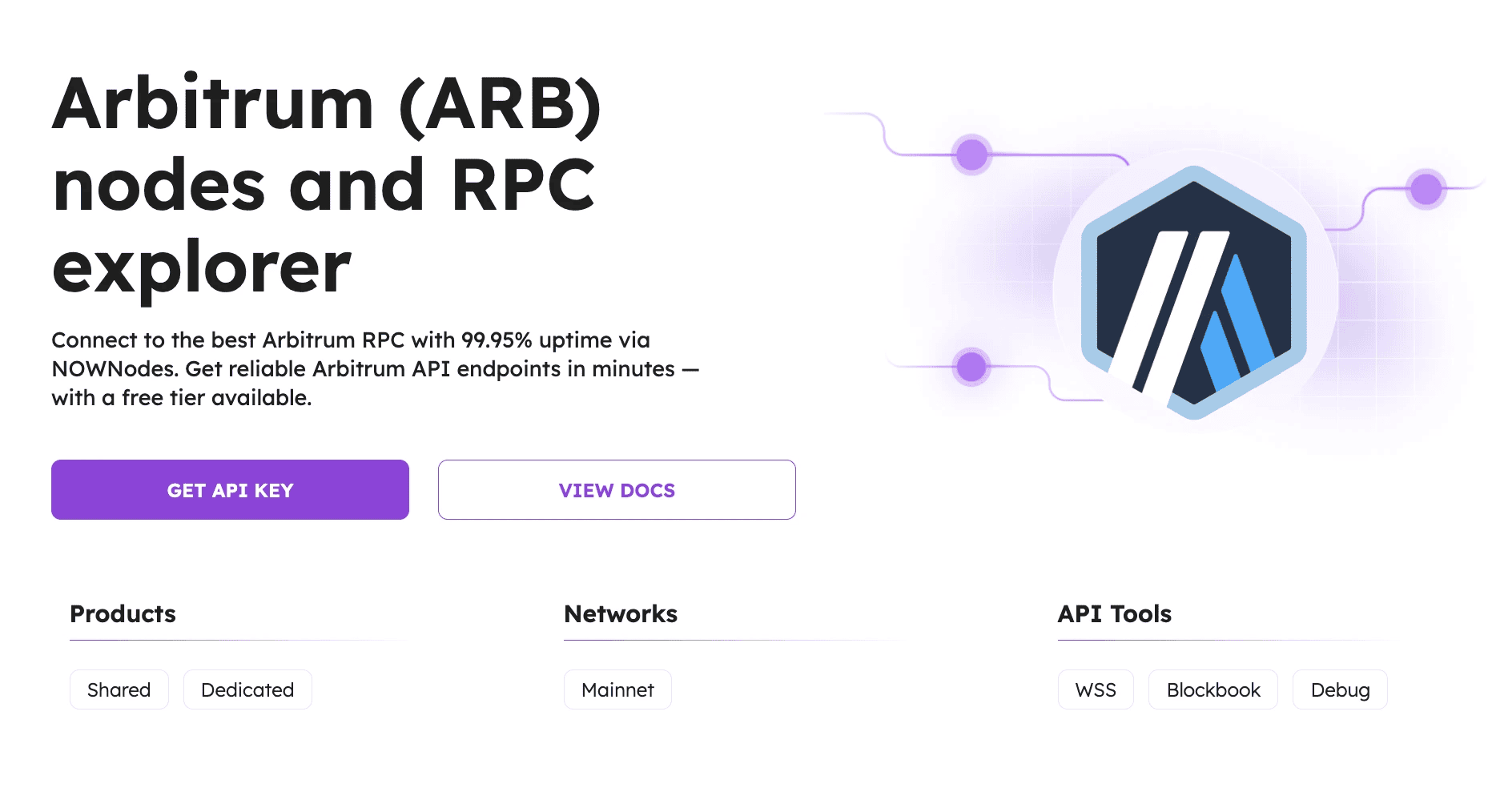
Arbitrum node access on NOWNodes breaks down as follows:
- Products: Shared nodes and Dedicated nodes
- Networks: Mainnet
- API tools: WSS, Blockbook, and Debug
Key features:
- 99.95% uptime backed by 2n+1 node redundancy
- Unlimited RPS on all paid plans, no rate limits
- Free Start plan with 100,000 requests per month
- Custom plan combining shared and dedicated infrastructure with a dedicated account manager
- Geobalanced servers across the US and Europe for lower latency
Why choose NOWNodes: if an application is already live and depends on Arbitrum responding consistently, NOWNodes removes a common source of unpredictability. There is no request counter to watch on paid plans, and if one node runs into trouble, traffic routes around it before most integrations would notice. The combination of a real free tier, a pricing model that does not penalize traffic spikes, and support for 120+ other networks makes it a workable base layer for teams that expect to expand beyond Arbitrum eventually.
Ideal for: DeFi protocols, wallet providers, blockchain analytics platforms, and developers who need steady access across multiple networks without rate-limit surprises.
2. Alchemy
Best for: Teams that want enhanced developer tooling layered on top of raw RPC and don’t need Arbitrum trace methods.
Alchemy has been part of the Arbitrum conversation for a long time and is often the first name developers think of when they start looking for an RPC endpoint. The platform goes beyond plain JSON-RPC with enhanced transaction APIs, token balance lookups, and webhook-based notifications that fire when specific on-chain events happen, which can save a team a fair amount of custom indexing work.
Pricing runs on Compute Units rather than raw request counts, with every method assigned a weight based on complexity, so a workload built around simple reads costs less per request than one that leans on heavier calls like eth_getLogs. One limitation worth flagging for Arbitrum specifically: trace API methods, which work on Ethereum mainnet, are not currently supported for Arbitrum One or Arbitrum Nova.
Key features:
- Free plan with 30 million compute units per month, roughly 1.2 million requests
- Pay-as-you-go pricing from $0.45 per 1 million CU, dropping to $0.40 above 300M CU monthly
- Archive data access included on every tier, including the free plan
- Enhanced APIs for NFTs, tokens, and webhook notifications
- Trace API not available for Arbitrum One or Arbitrum Nova
Why choose Alchemy: for a team building a dApp from scratch, the extra tooling layered on top of standard RPC can cut real development time, and the dashboard makes it straightforward to monitor usage and debug production traffic. The compute-unit model rewards careful query design, so teams that plan their method mix in advance tend to land on more predictable bills than those that don’t.
Ideal for: Teams that value dashboards, webhooks, and enhanced APIs over raw trace access, and that can work around the missing Arbitrum trace methods.
3. Infura
Best for: Teams already inside the Consensys/MetaMask ecosystem that want daily credit caps instead of monthly quotas.
Infura is backed by Consensys and powers a meaningful share of MetaMask’s own infrastructure, which gives it a certain institutional weight in the Arbitrum RPC conversation. Since January 2026 the platform bills on a credit model rather than raw request counts, with the free Core tier offering 3,000,000 daily credits and a 500-credits-per-second rate limit under a single API key.
Archive access on Arbitrum is enabled automatically for all users at no extra cost for now, though the documentation notes that could change. Trace and debug calls route through Infura’s Decentralized Infrastructure Network of partner providers rather than native infrastructure, which adds a layer of redundancy but also some architectural complexity compared with providers that run trace natively.
Key features:
- Free Core tier with 3,000,000 daily credits and 500 credits/second throughput
- Developer plan at $50/month with 15,000,000 daily credits and 4,000 credits/second
- Team plan at $225/month with 75,000,000 daily credits and unlimited API keys
- Trace and debug routed through DIN partner infrastructure rather than native nodes
- WebSocket support for Arbitrum currently in public beta, not recommended for production
Why choose Infura: the daily credit cap, rather than a monthly quota, makes day-to-day monitoring simpler even if it can pinch bursty workloads. For teams already using MetaMask’s developer tools or other Consensys products, staying on Infura keeps billing and support consolidated under one account, and the DIN partner network adds a form of built-in redundancy on higher tiers.
Ideal for: Teams in the Consensys/MetaMask ecosystem, projects comfortable with daily credit limits, and applications that don’t yet need production-grade WebSocket subscriptions on Arbitrum.
4. QuickNode
Best for: Multi-chain teams that want broad network coverage and predictable flat-rate throughput.
QuickNode covers more chains than most of the other names on this list, with more than 80 blockchains and 140-plus networks including Arbitrum, and Layer-2 traffic reportedly makes up 40 to 45 percent of what runs through its infrastructure. The free plan includes 10 million API credits per month and 15 requests per second on a single endpoint, enough to prototype an Arbitrum integration without paying anything upfront.
Beyond raw RPC, QuickNode sells an add-on marketplace covering NFT data APIs, MEV protection through a Bloxroute integration, transaction simulation, and a Streams product for subscribing to real-time blockchain data as a webhook or Kafka feed. Since March 2026 the platform also offers Flat Rate RPS plans for Arbitrum and a handful of other EVM chains, which charge for guaranteed requests-per-second instead of credits and start near $799 a month.
Key features:
- Free plan with 10 million API credits/month and 15 requests per second
- Paid plans starting around $49/month with higher credit allowances and throughput
- Flat Rate RPS plans from roughly $799/month for guaranteed, credit-free throughput
- Streams product for real-time data delivery via webhook or Kafka
- Add-on marketplace covering NFT APIs, MEV protection, and transaction simulation
Why choose QuickNode: the chain breadth is the clearest differentiator, useful for teams running Arbitrum alongside several other networks under one dashboard. The Flat Rate RPS option also gives teams with steady, high-volume traffic on a single chain a way to budget infrastructure costs without tracking credit consumption month to month.
Ideal for: Multi-chain teams, projects that need guaranteed throughput on Arbitrum specifically, and developers who want add-on tooling like MEV protection or real-time streaming built in.
5. Ankr
Best for: Teams that want a large free credit pool and an indexed Advanced API alongside standard RPC.
Ankr has operated as a Web3 infrastructure company since 2017 and now runs a decentralized, bare-metal-heavy node network across 80-plus chains, including Arbitrum. Its free Public tier gives anonymous, keyless access to rate-limited endpoints for quick testing, while the Freemium tier adds 200 million monthly API credits, roughly 1 million effective Arbitrum requests once the per-method credit weighting is factored in, along with a 30-requests-per-second limit and full archive data access. Premium unlocks private endpoints, 1,500 requests per second, debug and trace namespaces, and WebSocket connections, and Ankr also publishes SOC 2 Type 2 compliance, which some of the other providers on this list do not.
Key features:
- Free Public tier with anonymous, keyless access for quick testing
- Freemium tier with 200 million credits/month, roughly 1 million Arbitrum requests
- Premium tier with 1,500 RPS, private endpoints, and debug/trace access
- Advanced API offering pre-indexed, multi-chain queries beyond raw JSON-RPC
- SOC 2 Type 2 compliance published
Why choose Ankr: the free and Freemium tiers give a genuinely large credit pool to prototype against before any payment is required, and the Advanced API is useful for teams that would rather query pre-indexed data than assemble their own indexing layer on top of raw RPC. The published SOC 2 Type 2 status is also a relevant checkbox for teams building regulated or institutional products on Arbitrum.
Ideal for: Teams that want a sizeable free tier to start with, projects that need pre-indexed multi-chain data, and organizations that require SOC 2 documentation for vendor review.
How to choose an Arbitrum RPC provider
Every provider on this list can technically serve Arbitrum traffic, so the decision usually comes down to the specific shape of the workload. A team running trace-heavy analytics will rule out Alchemy immediately given its lack of Arbitrum trace support, while a team that needs production-grade WebSocket subscriptions today should be cautious with Infura until that feature moves out of public beta. Budget-sensitive teams with unpredictable traffic tend to prefer flat, rate-limit-free pricing like NOWNodes’ unlimited RPS on paid plans over compute-unit or credit models that can spike unexpectedly when usage grows. A few practical questions are worth answering before committing to any single provider:
- Does the provider support the specific Arbitrum methods the application needs, including trace, debug, or archive calls?
- Is WebSocket support stable enough for production use, or still in beta?
- Does pricing scale predictably with traffic, or does it depend on a method-weighted credit system that’s hard to estimate in advance?
- Is 24/7 support included, or reserved for higher-priced tiers?
- Does the provider cover other networks the team is likely to need later, reducing the number of vendor relationships to manage?
Read also: Did you miss Arbitrum? Here are 3 upcoming airdrops you can make money from
