



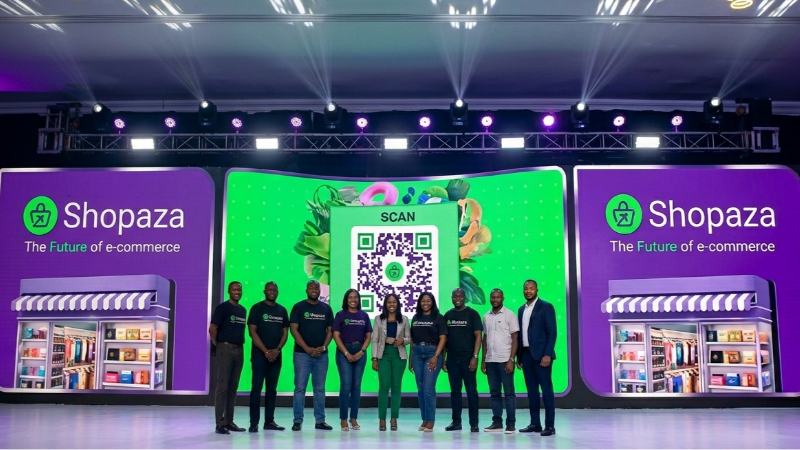
Africa’s e-commerce story has often been told as one of untapped opportunity. Yet for many merchants attempting to build online businesses across the continent, the reality has been less about opportunity and more about navigating fragmented payments, unreliable fulfilment systems and disconnected retail tools. That disconnect formed the backdrop to the official launch of Shopaza in Lagos on Thursday, June 18, 2026, a new e-commerce platform owned by Payaza Africa and positioned as an attempt to simplify how merchants build and scale digital commerce operations.
The launch brought together operators, founders, technology executives, and retail stakeholders for conversations that extended beyond product features to a broader question: what will it actually take to make digital commerce work at scale across Africa?
Payaza’s answer is infrastructure.
Shopaza enters the market as a cloud-based commerce platform that enables businesses to create online shopfronts, process payments, manage inventory, and oversee operations from a single environment. Rather than positioning itself as another marketplace, the company framed the product as an operating layer intended to reduce the complexity merchants encounter when moving online.

For the new e-commerce platform, the timing appears deliberate. Africa’s digital commerce sector continues to attract attention as internet access expands and mobile adoption deepens. Yet despite growing demand, many merchants still struggle to convert digital interest into sustainable online businesses.
Why Payaza?
Opening the event, Onyinyechi Aderibigbe outlined the thinking behind the platform and the market gap it aims to address. According to her, while digital adoption has accelerated across African markets, many businesses continue to manage sales, payments, customer engagement and logistics across multiple disconnected platforms. Shopaza is being introduced as an attempt to bring those functions together.
That theme carried into the keynote session delivered by Payaza’s Head of Engineering, Kehinde Omotoso. Speaking on the future of commerce in Africa, Kehinde argued that growth in online transactions across the continent has not automatically translated into operational efficiency for merchants.
He pointed to persistent bottlenecks across payments, logistics coordination and platform fragmentation as barriers preventing many businesses from scaling sustainably. His argument was less about creating more digital stores and more about enabling merchants to operate with a stronger infrastructure underneath them. African commerce may already have consumer demand, but long-term growth will depend on whether businesses gain access to systems that reduce operational friction rather than increase it. Shopaza, according to Omotoso, was built with that challenge in mind.
“With Shopaza, we are here to solve for our African market, starting with our African market, and then expanding globally, like we currently do today. We have our integrated payment, which handles multiple currencies for you.”

Kehinde detailed how Shopaza integrates multi-currency payments and instant settlements, allowing merchants to seamlessly launch operations across 23 global markets and 54 African nations. He also highlighted the platform’s AI-native architecture. Rather than manually inputting competitive pricing and exhaustive product details, merchants can simply upload an image; the integrated AI automatically populates the necessary categorisation, pricing, and variant data.
If there was one idea that connected almost every discussion, from payments and logistics to customer retention, it was that African e-commerce’s biggest challenge may no longer be access but trust. This was emphasised throughout the panel discussion.
Moderated by Onyinyechi, the session, Building a Scalable E-Commerce Business Across Africa, brought together operators with experience across finance, logistics, retail and trade.
Participants included Chioma Ifeanyi-Eze, former Finance Manager at Jumia Nigeria and founder of AccountingHub and Chioma Business School; Seun Alley, CEO and Co-founder of Fez Delivery (represented by Bukola Adefule, Head of Marketing, Fez Delivery); Tracy Ajoku, Founder and CEO of Saint Tracys; Ola Daramola, CEO and Co-founder of Bluebulb; and Kelechi A. Ekugo, Senior Country Director of the US-Nigeria Council for Food Security, Trade and Investment.
Panellists shared their thoughts on the various friction points militating against the growth of e-commerce on the continent.
Chioma noted that cart abandonment is rarely a pricing issue. Instead, browsers fail to become buyers due to lingering questions about platform legitimacy, delivery reliability, and post-purchase support.
“If you spend time building trust, you will sell more than if you focus on trying to get the lowest possible price,” Chioma argued. She identified three critical conversion barriers: trust concerns, friction in the payment experience, and the uncertainty of better alternatives elsewhere.
And the second issue they have is, you know, being able to pay online. Too many clicks, too many buttons, navigating the platform. So the easier we make the platform, the more they will, you know, pay.
And the third thing they are thinking about is alternatives. This thing, is it cheaper elsewhere? Is this the right price? How can I compare? You know, so those are the three reasons.

These observations align directly with Shopaaza’s product philosophy, which centres on rigorous merchant verification, real-time order confirmation, and robust buyer protection mechanisms designed to eliminate transaction anxiety.
Logistics and payments as trust infrastructure
The logistics discussion revealed another layer of operational friction. Bukola dispelled the myth that e-commerce delivery is merely transportation. Instead, she framed fulfilment as a critical piece of “trust infrastructure” and a core component of the customer experience design.
Bukola urged businesses to move beyond treating delivery as a backend afterthought. Instead, they must forge deeper logistics partnerships supported by API integrations and real-time visibility tools that preserve consumer confidence long after checkout.
On the payments front, Ola pointed out that checkout failures are typically an issue of interoperability rather than pure infrastructure. He suggested that emerging payment rails, including stablecoins, could drastically reshape digital commerce by cutting transaction costs and accelerating settlement. Ultimately, modern consumers demand flexible payment options, whilst merchants require faster access to working capital.
Addressing cross-border scalability, Kelechi stressed the importance of global standardisation and compliance. He argued that African brands can successfully export their products and tap into diaspora markets if they secure the right capital, maintain high product quality, and align with international regulatory frameworks.
This continental and global ambition is deeply embedded in Shopaza’s DNA. By configuring multi-currency transactions and navigating cross-border trade systems like the AfCFTA, the platform prepares merchants for broader regional selling opportunities.
Inside the product launch
Following the panel, attention returned to the platform itself. The official unveiling was led by Opeyemi Disu before moving into a live demonstration conducted by Esther Afia.
The session offered a closer look at how Shopaza is intended to function in practice. The platform allows merchants to create mobile-optimised shopfronts, upload product catalogues, manage stock visibility and oversee customer orders through a central dashboard.
Features demonstrated during the launch included support for product variants, pricing controls, order management and performance analytics.
Because Shopaza sits within Payaza’s existing payment infrastructure, merchants are also expected to access multi-currency transaction capabilities aimed at supporting both local and international buyers.
The positioning was deliberate: to reduce the number of disconnected systems, businesses need to operate online. Beyond the product walkthrough, organisers introduced pilot merchants who had already tested the platform.

Their feedback centred on operational simplicity, particularly the value of managing payments, shopfront administration and customer activity within a single environment rather than across multiple tools.
The testimonials added practical context to what could otherwise have remained a theoretical product pitch.
The event closed with remarks from Taiwo Adeeko, Payaza’s global head of operations, saying, “Today, we did not just witness a launch. What you witnessed is the validated need for a whole stack. Shopaza has officially been deployed to production and is live across Africa.”
In a final demonstration designed to reinforce the platform’s accessibility, attendees participated in a live store creation challenge, building shopfronts in real time. Three participants completed the exercise fastest and received prizes.
The exercise served less as entertainment and more as a practical statement about the company’s value proposition: reducing the time and complexity required to launch e-commerce operations.
As conversations continued into the networking session, one message remained consistent. Shopaza represents Payaza’s broader ambition to extend beyond payments and position itself deeper within the infrastructure layer of African commerce.
