




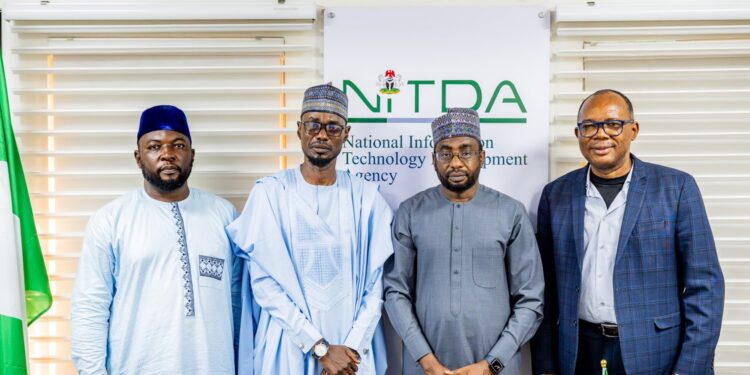
The National Information Technology Development Agency (NITDA) and the Jigawa State Government have partnered to enhance digital competence among Almajiri and out-of-school children. The new project was launched at a meeting held at the University of Lagos (UNILAG) Design Studio where NITDA Director-General Kashifu Inuwa hosted Abubakar Maje Hamisu, Executive Secretary of the Jigawa State Tsangaya Education Board.
Hamisu explained that the state plans to build three mega schools where digital literacy training will be fused with traditional education. Each of these schools will have the capacity to take in 4,000 students.
“The initiative aims to bridge the digital divide, empowering Almajiri children with knowledge that will enhance their future opportunities and improve their socioeconomic conditions,” Hamisu said.
He explained that by automating the conventional Almajiri school system, the new schools would teach both the Quran and technology to allow students to fit into a changing world. The Director-General, Inuwa explained that the program would be a pilot which can be scaled up across the country.
This development is among the government’s efforts to revitalize the Almajiri system, a system of Islamic education in the north of Nigeria. Historically, the Almajiri schools provided Quranic education of a highly basic nature, but many of these have not done well due to repeated underfunding and insufficient facilities.
In 2023, President Muhammadu Buhari signed a bill to establish the National Commission for Almajiri Education and Out-of-School Children. The law was intended to implement programs that integrate literacy, skills acquisition, and entrepreneurship training for the alleviation of poverty as well as a better future life for these out-of-school children and Almajiris.
Sponsored by Balarabe Shehu Kakale and 18 others, the bill aims to create an education system that goes beyond basic literacy. It supported a model that mixes reading and writing with practical skills training and entrepreneurship programs. The goal is to help reduce youth poverty and keep young people away from crime.
The newly formed Commission under this bill will manage these programs for children and teenagers, making sure they have better access to quality education and opportunities.
Infrastructural and resource challenges in Tsangaya Schools for Almajiris
Although the digital skills initiative is a step in the right direction, most Tsangaya schools continue to be plagued by serious infrastructural and resource challenges. The Tsangaya system, one of Nigeria’s dominant Islamic educational paradigms, has been plagued by fiscal problems for decades. Most of these schools lack decent buildings, a constant power supply, and even basic internet services, all of which are required for digital schooling.
Other areas of school life have been affected by poor infrastructure, from inadequate hostels for students to a deficiency of proper emergency facilities. This scarcity of resources has made Tsangaya schools unsuitable not only to potential students but also to instructors and guardians.
In addition to the physical limitations, unqualified staff and poor management also dominate, further undermining the quality of education. Inadequate funding has led to poor provision of food and medical facilities, reducing the overall welfare and academic performance of the students. Researchers have identified that these chronic issues are mirrored in even broader social issues, including high youth unemployment and increased vulnerability to exploitation.

The new program by NITDA and the Government of Jigawa is timely because of the need to revolutionize the Almajiri system. While as much as the intended mega schools will integrate digital literacy into the traditional curriculum, they too will need to eliminate the chronic infrastructure shortages which have long plagued the Tsangaya model of schooling.
This initiative and the passed bill work hand in hand with the digital skills project in Jigawa. Both efforts are designed to give vulnerable children the tools they need to build a better future. While the digital project focuses on equipping Almajiri children with modern technology skills, the bill-backed education model adds practical training and business skills to the mix. Together, these projects mark a significant step towards transforming education in Nigeria, addressing poverty, and creating a more supportive learning environment for young people.
