



The Digital Economy sector has contributed N7 trillion to the Nigerian real Gross Domestic Product (GDP) during the first quarter of 2025, representing a 14.19% input to the total N49.34 trillion. This is contained in a report released by the National Bureau of Statistics (NBS), which also revealed that total real GDP grew by 3.13% during the quarter compared to the 3.76% in Q4 2024.
The Digital Economy sector, which comprises the Information and Communication (I&C) sector and the Finance Institutions (FI) sector, saw a real GDP contribution of 10.59% and 3.60% respectively during the first quarter of 2025.
Notably, the sectors were among the top 10 performing sectors for the quarter with I&C coming fourth behind Trade, Crop Production and Real Estate, while the FI sector stood as the eighth best-performing sector on the nation’s GDP. For a while, the Digital Economy Sector has remained a top contributing arm to the Nigerian economy, driven by telcos and the financial industry.
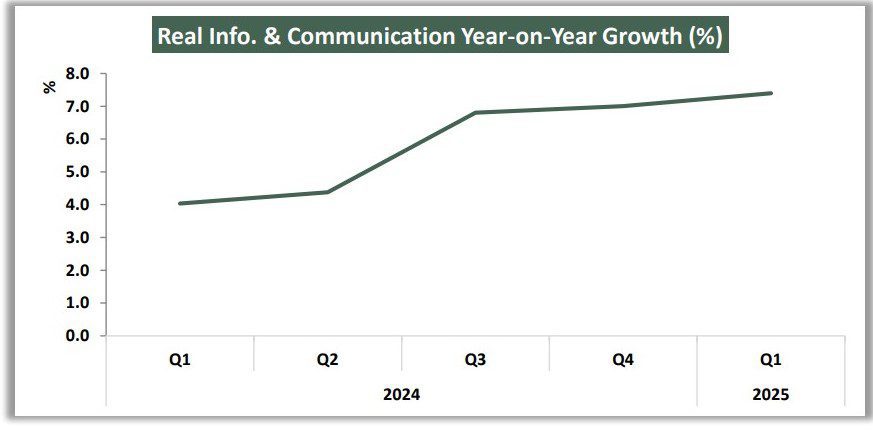
Explicitly, the I&C sector, during the quarter, recorded a Y0Y growth rate of 7.40% in real terms, but a growth rate of -8.86% on a quarter-on-quarter basis. In terms of its contribution to total real GDP during Q1 2025, the sector contributed 10.59%, higher than in the same quarter of the previous year, in which it contributed 10.17%.
Also, the Financial Institution sector, which comprises Financial Institutions and Insurance, recorded a 3.60% contribution to Nigeria’s total real GDP in Q1 2025, representing a 3.23% YoY growth rate by 0.37% points. Of this, Financial institutions such as banks and fintechs saw a 90.74% input while the insurance industry could only contribute 9.26%.
According to the NBS, growth in this sector in real terms totalled 15.03%, higher by 13.57% points from the rate recorded in Q1 2024, while quarter-on-quarter growth in real terms stood at 17.50%.

In monetary terms, the Digital Economy Sector contributed a total of N7 trillion naira to the nation’s real GDP, where the I&C recorded N5.2 trillion and the FI saw N1.8 trillion during the first quarter of 2025.
The larger share of the I&C sector (N4.2 trillion) is attributed to the telecommunications industry, representing an 80% share, with the other 20% to the likes of broadcasting, publishing, sound and music production. For the FI, the financial institution industry recorded N1.6 trillion, while the insurance industry saw almost N200 billion for the period in review.
Also Read: Nigeria’s digital economy contributed $191m to foreign direct investment in Q1’24.
In a broader view, Nigeria saw a YoY real GDP growth rate of 3.31%, higher than the 2.27% recorded in the first quarter of 2024 but lower than the 3.76 recorded in Q4 2024. In terms of share of the GDP, the services and industry sectors contributed more to the real GDP in Q1 2025.
The NBS also released the rebased GDP figures, using a base year of 2019. Real GDP growth in 2020 stood at -6.96% and improved to 0.95% in 2021. Higher growth rates were recorded in 2022 and 2023, at 4.32% and 3.04%, respectively. While 2024 recorded a real GDP growth rate of 3.38%.

Digital Economy: Q1’25 vs Q4’24
During the fourth quarter of 2024, the digital economy sector contributed 11.8% to Nigeria’s real GDP, raking in N7.2 trillion of N61.4 trillion. During the quarter, I&C recorded a 9.34% (N5.7 trillion) input while FI saw 2.46% (N1.5 trillion) of the total real GDP.
This means that the digital economy’s contribution to Nigeria’s real GDP dropped by 2.8% from N7.2 trillion in Q4’24 to N7 trillion in Q1’25. This is not far-fetched as the nation’s real GDP dropped from N61.4 trillion in the previous quarter to N49.34 trillion in Q1’25 while the growth rate dropped from 3.76% to 3.13%.
While the digital economy sector continues to show an important presence in the Nigerian economy, its impact on foreign trade remains significant.
In May, the Federal Government revealed that the digital economy sector attracted $191 million in foreign direct investment during Q1 2024, representing a 900% rise from the $22 million in Q1 2023.

The Minister of Communications, Innovation, and Digital Economy, Dr. Bosun Tijani, explained that the sector’s significant drive, pushed by major initiatives such as the 3 Million Technical Talent (3MTT) programme, has been instrumental in refining the Nigerian economy for digital transformation.
While the sector saw a ninefold increase in foreign direct investment from $22 million in Q1 2023 to $191 million in Q1 2024, the trend continued in Q2 2024, which also increased by 356 per cent to $114 million from $25 million YoY.
As Nigeria has witnessed the rise of unicorn companies such as Flutterwave, Jumia, Andela, Moniepoint, and Interswitch, the digital economy holds prospects to generate $18.3 billion by 2026, according to the Minister.
