




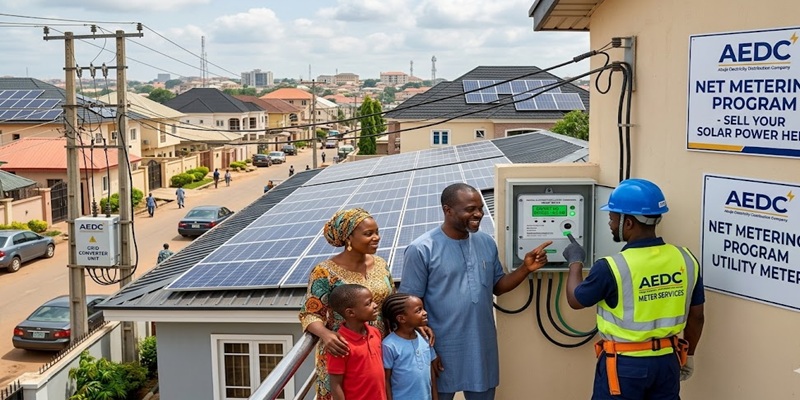
For years, Nigerians who invested in solar panels did so for one reason: survival. With DisCos delivering unreliable electricity and charging increasingly steep tariffs, businesses and households that could afford solar installations simply took themselves off the grid. The excess power those panels generated, and there is always excess, just went to waste.
That has now changed. The Nigerian Electricity Regulatory Commission (NERC) has commenced the implementation of its Net Billing Regulations 2026. This, for the first time, creates a legal and operational framework for eligible users to generate electricity for their own consumption and sell whatever they do not use back to distribution companies.
The timing matters. Nigeria recorded 141% year-on-year growth in new solar installations in 2025, making it Africa’s second-largest solar installer after South Africa. The country imported over four million panels in 2023 alone, valued at $200 million, with imports reflecting growing demand across rural and urban areas.
By early 2025, Nigeria’s domestic solar manufacturing capacity had grown from 110 megawatts to 600 megawatts, with a new 100-megawatt plant in Lagos fully operational. Solar is no longer a niche product in Nigeria. It is infrastructure.
The frustration that drove this adoption is well understood. Distribution companies in Nigeria have consistently been criticised for billing customers for power never delivered, applying band tariffs that push electricity costs higher while availability remains abysmal.
As recently as 2024, grid-connected solar operators contributed only approximately 0.2% of total electricity generation in Nigeria, a figure that tells you just how little of the country’s solar capacity was connected to and benefiting the wider grid. The new regulations are designed to change that relationship fundamentally, turning solar owners from passive consumers into active contributors and earners.
The new regulation introduces a term for these contributors: prosumers. A prosumer is simply someone who both produces and consumes electricity. You install solar, you use what you need, and when your panels produce more than your home or business requires, instead of that energy disappearing, it flows into the DisCo network, and you receive credit for it at an export tariff approved by NERC.
Who qualifies and how to start selling Solar power
The scheme is not open to every rooftop solar user. NERC has set clear thresholds. Your solar installation must have a minimum capacity of 50 kilowatts peak (kWp) and a maximum of 1.5 megawatts peak (MWp). In practical terms, a 50kWp system is commercial or industrial scale, significantly larger than the typical 5kW to 10kW home system.
This places the initial beneficiaries firmly in the commercial and industrial customer segment: factories, office complexes, large retail outlets, hotels, hospitals, and other high-consumption facilities that have invested in serious solar infrastructure.
The process to participate involves several steps. First, you apply to your Distribution Company for a technical feasibility assessment. The DisCo evaluates whether your installation meets the required technical standards and whether the local network can accommodate your exports. If approved, you then sign a net billing agreement with the DisCo and register formally with NERC.

Once registered, you will be fitted with a bidirectional meter, a special device that measures both the electricity you draw from the grid and the electricity you send back into it. The credit you receive for exported energy is calculated based on an export tariff that NERC will set and approve.
Commercial and industrial solar users in Nigeria are already achieving savings of 20 to 30% compared to diesel self-generation, and with net billing now in place, those economics improve further. The excess power that previously generated nothing now generates income, and in a country where electricity costs are rising while supply remains unreliable, that income is not trivial.
Also read: China solar panel exports to Africa jump by 83% as demand for clean energy surges
The bigger picture here is a shift in how Nigeria thinks about energy. The grid has historically flowed one way, from generators through transmission and distribution companies to consumers. Net billing turns some of those consumers into contributors, distributed generation becomes part of the national energy mix, and the burden of powering Nigeria becomes slightly less concentrated.

Nigeria’s renewable energy market is projected to grow to 14.07 gigawatts by 2031, supported by a 25.58% compound annual growth rate. The Net Billing Regulations are a policy signal that the country intends to capture that growth and share the benefit with Nigerians already investing in it.
