


El Salvador President Nayib Bukele has said that his government won’t stop buying Bitcoin for its strategic reserve’s enrichment. This follows a request from the International Monetary Fund (IMF) that the country should stop accumulating Bitcoin.
On March 3, the IMF issued a new request for an extended arrangement under its $1.4 billion fund facility to El Salvador. The arrangement included a clause that the country’s public sector should halt its voluntary accumulation of Bitcoin.
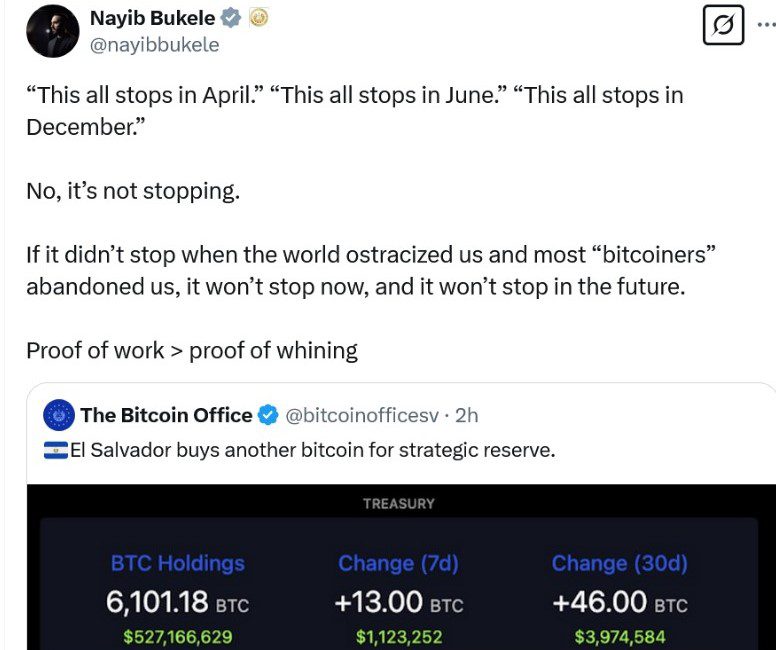
“No, it’s not stopping. If it didn’t stop when the world ostracized us and most ‘bitcoiners’ abandoned us, it won’t stop now, and it won’t stop in the future,” Bukele said in a March 4 X post, confirming El Salvador wouldn’t comply with the IMF’s request.
The memorandum also requested El Salvador to stop Bitcoin mining activities and restrict public sector issuance of “any type of debt or tokenized instrument that is indexed to or denominated in Bitcoin and implies a liability to the public sector.”
As against the request, the country continued its purchase of at least one Bitcoin per day on March 4 as part of the Central American country’s treasury initiative. Data from The National Bitcoin Office of El Salvador shows that El Salvador currently holds 6,101 Bitcoin worth $534.5 million.
The country, which started purchasing Bitcoin in September 2021, has the sixth-largest Bitcoin stash of any nation-state, trailing only the U.S., China, the U.K., Ukraine and Bhutan. El Salvador was also the first country to adopt Bitcoin as a legal tender.
El Salvador has witnessed a significant turnaround in its debt reduction since its adoption of Bitcoin as a strategic reserve currency. The Latin American country’s investment in digital assets had seen the cryptocurrency more than double in value. Rooted in his goal was to limit the risk of El Salvador’s finances by reducing its dependence on the US dollar.
Meanwhile, the digital assets’ strength as legal tender was narrowed in January when the country passed a law to make bitcoin acceptance optional for private sector merchants.
Also Read: South African politician warns against use of Bitcoin for strategic reserve.
What you should know about the IMF $1.4 billion deal to El Salvador
In December 2024, El Salvador secured a $1.4 billion funding deal from the IMF in exchange for scaling back its Bitcoin-related initiatives, among other things. Some of these include making Bitcoin payments voluntarily and tax payments in U.S. dollars.
The IMF noted that the deal aims to address the potential risks of El Salvador’s Bitcoin project in line with the fund policies and with fund advice to the authorities.
“Going forward, program commitments will confine government engagement in Bitcoin-related economic activities, as well as government transactions in and purchases of Bitcoin,” it added.
The IMF also emphasized that the deal would make El Salvador enhance regulation and supervision of digital assets in line with evolving international best practices. This move marks another step in the IMF’s ongoing efforts to curb El Salvador’s Bitcoin adoption.

In his own stance, Méndez Bertolo, the fund’s executive director for El Salvador said on Feb 26 that the IMF’s extended fund facility for El Salvador aims to provide several improvements in governance, transparency, and resilience to boost confidence and the country’s growth potential.
He pointed out that the funding deal will minimize Bitcoin-related risks saying:
“The authorities enacted amendments to the Bitcoin Law that clarify the legal nature of Bitcoin and remove from the law the essential features of legal tender. Acceptance of Bitcoin will be voluntary, tax payments will be made in US dollars, and the role of the public sector in the Bitcoin project will be confined,” he added.
The director also mentioned that the IMF program is expected to attract substantial additional financial support from international organizations such as the World Bank, the Inter-American Development Bank, and other regional development banks.
