




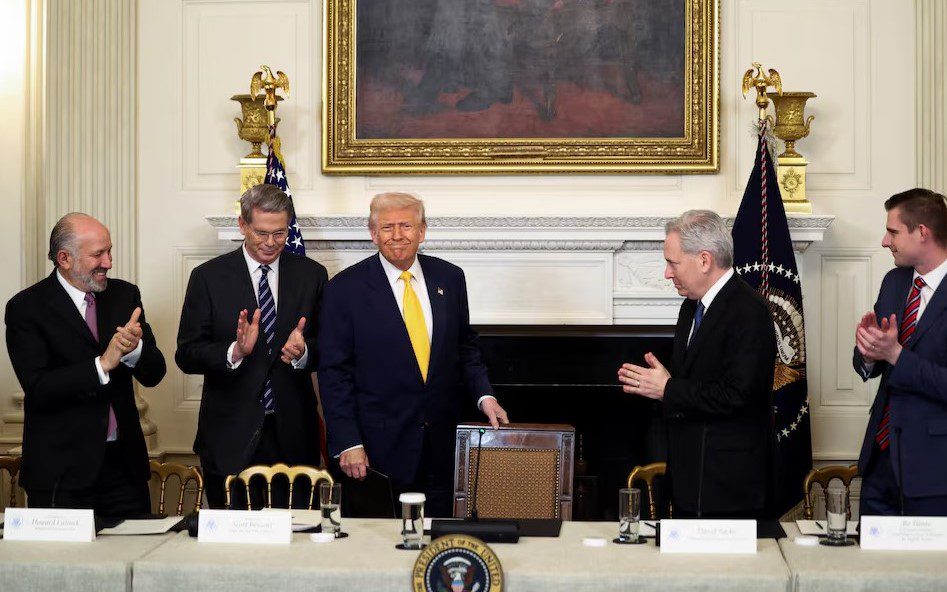
U.S. President Donald Trump met with crypto leaders on his goal to build a strategic reserve of Bitcoin. The March 7 summit, which was the first of its kind, was centred around his plans for a government-owned stockpile of digital assets.
Zach Witkoff, one of the founders of the president’s own crypto business, MicroStrategy CEO Michael Saylor, Coinbase co-founder and CEO Brian Armstrong, investors Cameron and Tyler Winklevoss, and entrepreneur David Bailey were all present for the crypto-centered discussion.
Recall that on Thursday, President Trump signed an Executive Order to establish the Strategic Bitcoin Reserve and the U.S. Digital Asset Stockpile which marked a significant step toward fulfilling his campaign promise to position the United States as the “crypto capital of the world.”
In the Executive Order, the secretaries of Treasury and Commerce were directed to develop “budget-neutral strategies” for acquiring additional bitcoin that have no “incremental costs” on taxpayers. “We don’t want any cost to the taxpayers,” Trump said at the summit.
President Trump expressed his optimism about the crypto industry’s prospects after telling the summit that this development makes the country feel like a pioneer.
“From this day on, America will follow the rule that every bitcoin knows very well, never sell your bitcoin. That’s a little phrase that they have. I don’t know if that’s right or not. Who the hell knows, right? Who knows? Who knows, but so far, it’s been right, and well, let’s keep it that way,” he added.

The executive order now means that the U.S. government’s Bitcoin holdings will not be sold. At the event, Treasury Secretary Scott Bessent told the event the government was going to keep the dollar as the world’s reserve currency and use stablecoins to do that.
Crypto leaders at the summit noted that the executive order creates an avenue for the industry to thrive and a renewed partnership following years of being sidelined over security and consumer protection issues.
They also expressed delight in working with an administration that views crypto as a mainstream asset class and expressed hope for a straightforward regulatory process.
“For the first time, industry leaders feel they’re walking into a collaborative discussion,” said Les Borsai, co-founder of Wave Digital Assets, a crypto investment adviser
Brad Garlinghouse, CEO of technology company Ripple, who attended the summit, said he welcomed Trump’s recognition. In an X post, he noted that the world of cryptocurrencies stretched beyond Bitcoin. XRP, the coin tied to Ripple, is one of the four other cryptocurrencies Trump has suggested may be added to a crypto reserve.
However, Yesha Yadav, associate dean and professor of law at Vanderbilt University, raised an observation that “what everyone really needs to have at this point is clarity on what the level of scrutiny and intensity of regulation will be, who the key regulators will be.”
Trump’s strategic reserve dimension
Trump’s executive order on crypto reserves signifies his commitment to his campaign promises of making the U.S. the crypto capital. The order, hailed by administration officials as a visionary leap into the future of financial technology, will leverage the government’s existing cryptocurrency holdings while setting a framework for responsible stewardship of digital assets.

The Strategic Bitcoin Reserve will be capitalized exclusively with Bitcoin already owned by the federal government, acquired through criminal and civil asset forfeiture proceedings. White House AI and Crypto Czar David Sacks emphasized in a statement on X that this approach ensures the initiative “will not cost taxpayers a dime.”
Sacks mentioned to reporters at the government house that establishing a Bitcoin reserve should have been done a long time ago. He emphasized that taxpayer funds would not be used to acquire digital assets and that there were existing protections in place to protect consumers from crypto investments.
Estimates suggest the U.S. government currently holds about 200,000 Bitcoin, valued at roughly $17.5 billion based on current market prices of around $87,000 per coin, according to Coinmarketcap data.
The Executive Order establishes the U.S. Digital Asset Stockpile, a separate entity designed to hold other cryptocurrencies forfeited through law enforcement actions. Unlike the Bitcoin Reserve, the government will not pursue additional acquisitions for the Stockpile beyond what is seized, focusing instead on responsible management under the Treasury Department’s oversight.
Meanwhile, the new stride didn’t go down well for some in the market who had hoped for a firm plan to buy new tokens. After the announcement, the price of bitcoin went down by 3.4 per cent to trade for $86,394 while at writing time trades at $82k.
In his reaction, JP Richardson, co-founder and CEO of Exodus, a Bitcoin wallet developer, expressed that he does not feel other coins have a place in the strategic reserve as they are smaller and function in a very different way which might create more risk.
“This (strategic reserve) is going to be the biggest point of contention for many of us. Crypto has made big strides, but it’s still a relatively nascent industry,” he said. even though he owns all four coins other than Bitcoin that Trump has suggested to be included in the reserve.

Trump, who had effected a series of developments following his January 20 inauguration, is also on the move to reflect on his recent tariff impact. This week, he will meet with the country’s tech leaders experiencing the impacts of the import tariffs and stricter export rules that could overturn their businesses.
The group which includes Chief Executive Officers of tech companies such as HP, Intel, IBM, and Qualcomm reached an agreement to meet the Trump administration on March 10.
President Trump recently imposed a 25 per cent tariff on imports from Canada and Mexico which has triggered various reactions such as the sell-off in the crypto markets. Another is a policy change that has threatened the computer hardware industry where the tariff will make manufacturing locations like China become more expensive.
Read More: 25% import tariff: Trump to meet with HP, Intel, and other U.S. tech leaders on March 10.
