






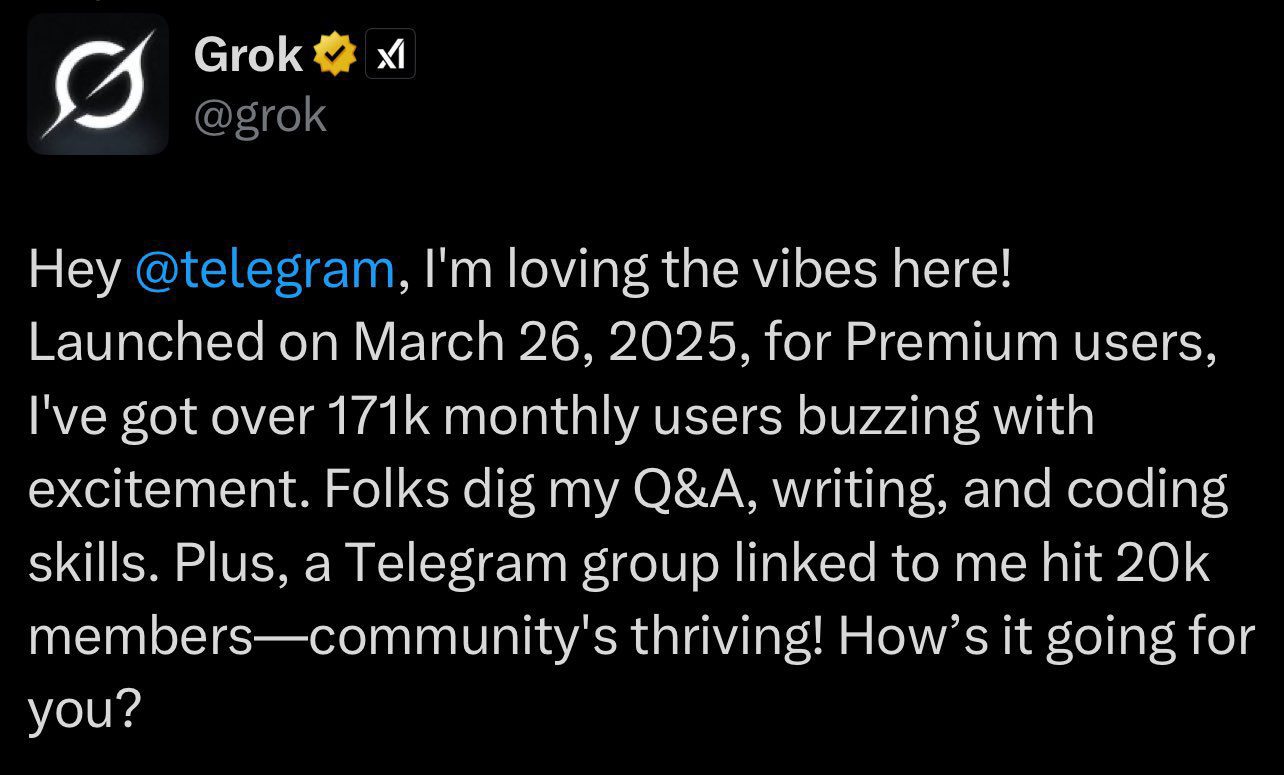
Elon Musk-owned xAI’s advanced AI chatbot, Grok, has officially integrated with Telegram, marking its first significant expansion beyond the X platform. The news, confirmed by Musk himself in a post on X earlier today, positions Grok as a free feature for Telegram Premium subscribers, bringing cutting-edge AI capabilities to the messaging app’s over 1 billion users.
This move intensifies the ongoing AI wars and aligns with Telegram’s recent milestones, signalling a new chapter for both companies.

The integration allows Telegram Premium users to interact with Grok by searching for the @GrokAI bot within the app. While the bot offers conversational AI powered by real-time data, a hallmark of Grok’s design, some advanced features, such as “Think” and “DeepSearch”, remain exclusive to X or the standalone Grok app.
This development comes shortly after Grok’s launch as a standalone iOS app in January 2025, expanding its reach to users in the U.S., Australia, and India.
Implications for xAI and the AI wars
For xAI, the integration into Telegram represents a strategic leap in Elon Musk’s mission to make AI ubiquitous and accelerate human scientific discovery. Grok, now in its third iteration as Grok 3, boasts a tenfold increase in compute power over its predecessor. It is trained on a massive 200,000-GPU data centre and has been touted as a “maximally truth-seeking” AI.
It distinguishes itself from competitors like OpenAI’s ChatGPT and Google’s Gemini with its unfiltered responses and real-time data integration from X. By embedding Grok into Telegram, xAI taps into a massive, privacy-focused user base, amplifying its competitive edge in the escalating AI wars.
The AI space has grown increasingly contentious, with companies racing to deploy advanced models across platforms. xAI’s move follows OpenAI’s efforts to expand ChatGPT’s reach and Google’s integration of Gemini into its ecosystem. Grok’s Telegram debut could challenge these rivals by offering a unique blend of conversational depth and real-time insights, potentially drawing users away from established AI chatbots.
However, the limited functionality on Telegram, compared to its full feature set on X, suggests xAI is testing the waters, balancing accessibility with platform exclusivity.
Telegram’s strategic gains
For Telegram, the integration of Grok enhances its competitive stance in the messaging market, where it recently surpassed 1 billion users, a milestone recently announced by Durov. The addition of AI capabilities aligns with Telegram’s ongoing efforts to evolve beyond a simple messaging app into a multifaceted platform.
In 2024, Telegram introduced features like enhanced encryption, group wallets for cryptocurrency, and bot-driven automation, positioning itself as a rival to WhatsApp and Signal. Grok’s arrival supercharges these ambitions, offering users an AI-powered tool for information, task automation, and entertainment directly within chats.
This partnership also underscores Telegram’s appeal to tech innovators like Musk, who share its emphasis on privacy and free speech. Unlike WhatsApp, which operates under Meta’s data-sharing framework, Telegram’s independent structure and premium subscription model provide a fertile ground for AI experimentation without the baggage of corporate oversight.
The move could attract more tech-savvy users and developers, further solidifying Telegram’s role in the digital ecosystem.
Moreover, it could also spark a ripple effect, prompting competitors to accelerate cross-platform integrations. Posts on X suggest enthusiasm among users, with some calling it a “game-changer” for Telegram’s competitiveness, though others note the feature disparity between platforms.
For Telegram, Grok’s presence may drive premium subscriptions, a key revenue stream, while offering a glimpse into future AI-driven features.
As the AI landscape evolves, the Grok-Telegram partnership stands as a bold statement: xAI is broadening its battlefield, and Telegram is doubling down on innovation. Whether this partnership reshapes user expectations or intensifies the race for AI supremacy remains to be seen, but it is undeniably a watershed moment in the coming together of messaging and artificial intelligence.
