


OpenAI’s Sam Altman has announced that it will introduce limits on the ChatGPT image-generation Ghibli-style feature it introduced earlier this week, noting that its widespread usage is overworking the company’s servers.
In a Thursday post on X, Altman said that the company will temporarily limit the feature’s usage as it works to make it more efficient.
“It’s super fun seeing people love images in ChatGPT. But our GPUs are melting. We are going to temporarily introduce some rate limits while we work on making it more efficient. Hopefully, won’t be long!” he expressed.
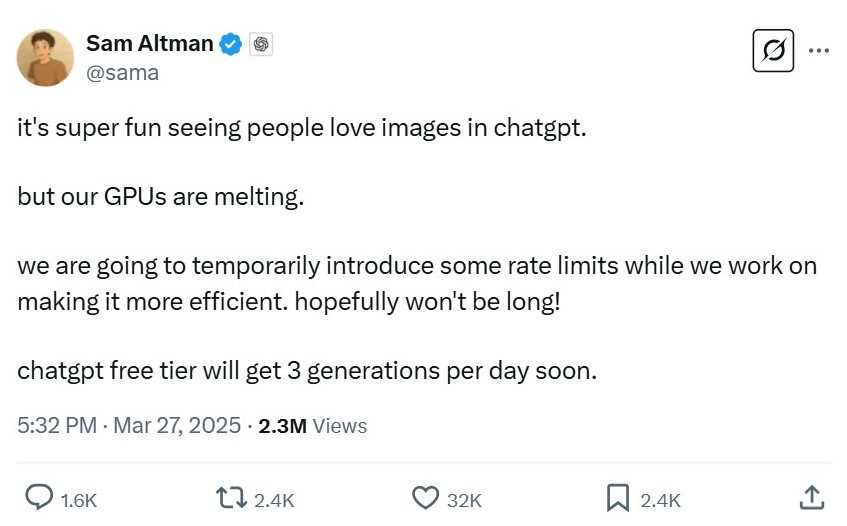
While paying users may still have some flexibility, OpenAI is taking steps to ensure the service remains stable for all. The OpenAI boss pointed out that while the system was mistakenly rejecting some appropriate image requests, he assured users that OpenAI is working on a fix and that the ChatGPT free tier would be getting a 3 generations per day limit soon.
“Also, we are refusing some generations that should be allowed; we are fixing these as fast we can,” he added.
See Also: Gemini 2.5: Google unveils “most intelligent AI model” to rival DeepSeek, ChatGPT.
The introduction of limits comes amid OpenAI’s debut of native image generation within ChatGPT on Tuesday. The company launched the “high-quality” image-generation tool as a way to produce everything from diagrams, infographics, and logos to business cards and stock photos. In addition, the feature can use an image as a starting point for art, such as a custom painting of a pet or editing a professional headshot.
The image-generation feature began rolling out to ChatGPT PLUS, Pro, and Team users on Tuesday. Free-tier users also gained access to the feature when they use OpenAI’s model, while ChatGPT Enterprise and Edu users will receive access next week, the company said.
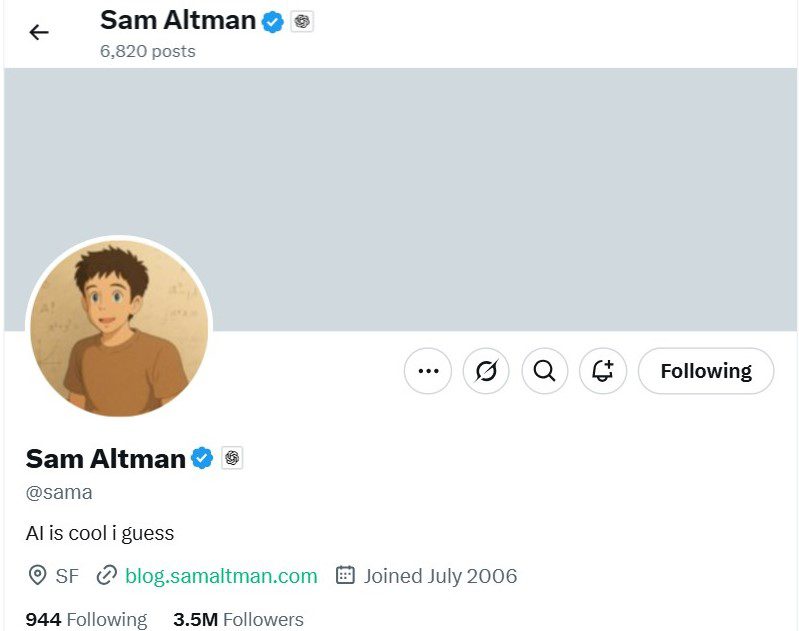
Following the introduction, images of anime-style renderings of users’ uploaded photos have been going viral on X (formerly Twitter) and other social media platforms. For instance, Altman changed his X profile photo to an image generated by the new feature.
The new feature is the first major upgrade to ChatGPT’s image-generation capabilities in over a year. To power the new image feature, OpenAI said it trained GPT-4o on “publicly available data,” as well as proprietary data from its partnerships with companies like Shutterstock.
“We’re respecting of the artists’ rights in terms of how we do the output, and we have policies in place that prevent us from generating images that directly mimic any living artists’ work,” said Brad Lightcap, OpenAI’s chief operating officer.
Rising concerns about ChatGPT’s image-generation feature
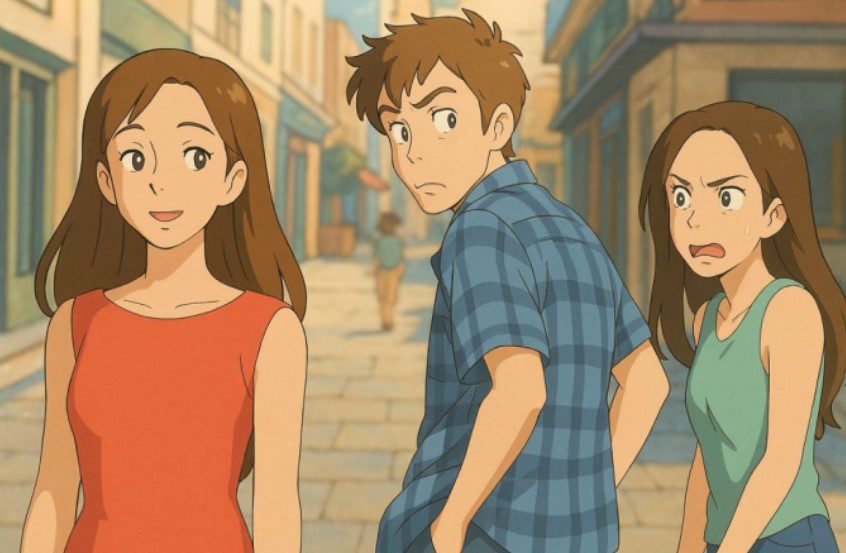
After the unveiling of the image filter in ChatGPT, users have flooded social media with Ghibli-inspired (anime-style) versions of famous moments. The trend has surged from the iconic Dilwale Dulhania Le Jayenge train scene to Donald Trump’s post-assassination attempt photo.
Studio Ghibli is a legendary Japanese animation studio known for its beautifully crafted and emotionally rich films. Founded in 1985 by Hayao Miyazaki and Isao Takahata, Studio Ghibli has produced masterpieces like Spirited Away, My Neighbor Totoro, and Princess Mononoke.
Based on this, the OpenAI model allows users to transform any image into this signature anime aesthetic, blending soft watercolor textures with expressive character designs.
Hayao Miyazaki, the co-founder of Studio Ghibli, has previously expressed strong disapproval of AI-generated animation. In a 2016 meeting where he was shown an AI animation demo, Miyazaki said:
“I am utterly disgusted. If you really want to make creepy stuff, you can go ahead and do it. I would never wish to incorporate this technology into my work at all.” He also said, “I strongly feel that this is an insult to life itself.”
Also, Hollywood actors and other creatives have voiced concerns about efforts by OpenAI and other artificial intelligence companies to “weaken or eliminate” intellectual property protections on copyrighted works for training AI systems.
A statement by the company explained that it looked forward to making it clear that it built its AI models using publicly available data, which is, in a manner, grounded in fair use and supportive of innovation.
In another turnout on Thursday, a federal judge ruled that the New York Times, along with other newspaper groups, are allowed to proceed with a copyright lawsuit against OpenAI and Microsoft in which they seek to force the AI companies to stop using their content to train chatbots like ChatGPT.
While users praised the tool’s versatility, some raised concerns about its ability to replicate distinct artistic styles. Altman acknowledged the issue, stating: “We’re working to refine our tools to better align with ethical standards and creative integrity.”
