


The Tanzanian government has shut down popular social media platform X (formerly Twitter) following a high-profile cyber attack, where the official Tanzania Police Force (TANPOL) X account was hacked to circulate false reports claiming that President Samia Suluhu Hassan had died. The new blackout comes just weeks after the previous blackout.
According to a Tuesday night tweet by NetBlocks, a real-time network data analyser that confirmed the shutdown, X became unreachable across major Tanzanian internet providers. The ban also follows similar government action in August 2024, when authorities also took X offline after the arrest of opposition leader Tundu Lissu.
“Live metrics show X (formerly Twitter) has become unreachable on major internet providers in #Tanzania; the incident comes as a compromised police account posts claims the President has died, angering the country’s leadership,” NetBlocks said in a post.
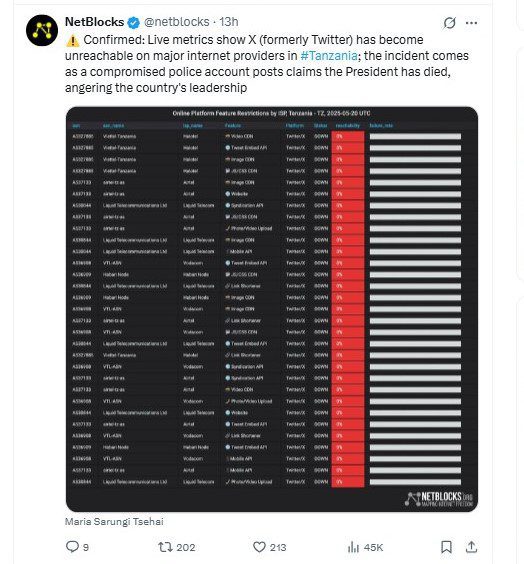
This comes amid a hack on the official TANPOL X account, which reportedly angered the country’s leadership, prompting President Suluhu to instruct police to “protect social media” earlier this week. There, she stressed the importance of safeguarding national interests in the digital sphere.
Before the attack, Tanzania had been under political struggles and a tense atmosphere. Tundu Lissu, a major opposition figure who survived an assassination attempt in 2017, has been arrested again and charged with treason. Also, his political party, Chadema, has been barred from participating in the upcoming October 2025 presidential election.
The situation became more tense when Kenyan activist Boniface Mwangi and Ugandan attorney Agather Atuhaire were detained by Tanzanian authorities. While a journalist confirmed speaking to Mwangi’s wife, who stated her husband had not yet been deported, their whereabouts have remained unknown. According to reports, both individuals were in the country on what appears to be civil society work.
Also Read: South Sudan shuts down Facebook, Tiktok for 30 days amidst violent riots.
A flip of social media suppression in Tanzania
The social media platforms’ shutdown has further raised familiar concerns over the ongoing trend of increased government censorship and tighter control over online expression and censorship in Tanzania.
Earlier this month, Tanzania shut down over 80,000 websites, social media accounts, blogs, and online platforms in the country’s most extensive digital content washout. The government explained that the move was meant to protect children’s mental health. Providing more explanation, Hamis Mwijuma, the deputy minister for information, culture, arts, and sports, told parliament that the Tanzania Communications Regulatory Authority (TCRA) had identified 80,171 platforms “publishing unethical content that poses a risk to children’s mental health.”
However, experts believe that the Tanzanian government is using child protection as a mask for a wider crackdown on dissent. Also, the government failed to make public information on how platforms are flagged, whether takedowns can be appealed, or if affected creators were given notice.
The social media wash raised concerns over an increasingly authoritarian digital policy landscape in Tanzania. In October 2023, the TCRA imposed a ban on Virtual Private Network (VPN) usage without government-issued permits. Citizens found using VPNs without prior approval risk were fined up to $2,000 or a minimum of 12 months in prison.
The law, anchored in the Electronic and Postal Communications (Online Content) Regulations, was ostensibly introduced to block access to illegal content. But in practice, it has criminalised digital privacy and censored opposition voices, especially during politically sensitive periods.

In 2017, Tanzania enacted the electronic and postal communications regulations, which were further amended in 2020. These laws stipulated that persons found making content deemed indecent, obscene, hateful, or having the potential to disrupt public peace would face risks of up to 12 months in jail, fines of TSH 5 million (approximately $1,900), or both. The regulations granted TCRA extensive authority to monitor and control social media platforms, including blogs and private user accounts.
While the social media suppression in Tanzania raises serious concerns, the growing trend in the East African region is alarming. Kenya faced scrutiny in 2023 and again in 2024 for suspected Telegram blackouts during the KCSE national exams, which were staged without official acknowledgement and were only partially addressed by the government or telecom providers.
Uganda has a long history of shutting down social media during the election period, with the latest in January 2021 during its presidential polls. Ethiopia has also frequently restricted access to the internet during civil unrest, while access to social media in Sudan has been tightly controlled during protests.
The situation again underscores the growing trend of government authorities’ suppression amid the glorification of ironic protection while orchestrating human rights abuses.
