




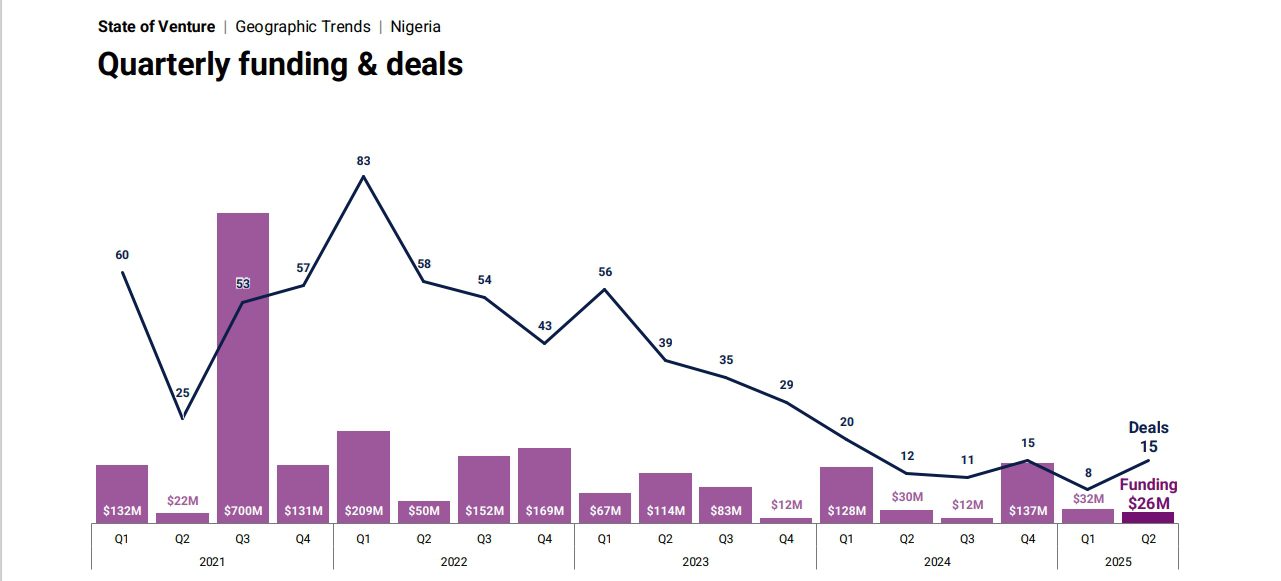
The year 2025 is not looking too good for the Nigerian startup ecosystem, especially regarding venture funding, as only $26 million in equity funding was raised by startups in the country in the second quarter of 2025. This was disclosed in the State of Venture report by global tech analytics and insights company, CB Insights.
Nigeria’s contribution represents a paltry 8.7 per cent of the total $300 million equity funding raised by African startups in the quarter. In terms of equity funding, the second quarter is the slowest in Nigeria over the last three quarters, aligning with a continental shift from equity to debt funding.
On a quarter-to-quarter basis, while the Q2 total equity funding represents an 18.75 per cent drop from the $32 million raised in Q1, compared to the fourth quarter of 2024 when startups raised $137 million, the drop was a monumental 81 per cent decline.
Nigerian solar energy startup, Arnergy contributed a majority of the Q2 funding with its $18 million Series B raise back in April. $15 million of it came in the form of equity, making it the highest equity-funded Nigerian startup in the quarter. Carrot, a Nigeria-based accounting and finance startup, came a distant second with its $4 million seed raise powered by MaC Venture Capital, Authentic Ventures and Partech.
CutStruct, an e-commerce platform that focuses on the sale of construction materials, raised $2 million in a seed funding round back in May. The investment was powered by CRE Venture Capital, Zedcrest Capital, E3 Capital and Techstars. Also raising $2 million was PaidHR, a human resource and workforce management startup. The raise was a seed round back in June and powered by Accion Venture Lab, Zedcrest Capital, Zrosk and Chui Ventures.
Also on $2 million is Yikodeen, a consumer products and services startup which focuses on footwear and allied accessories. Yikodeen’s raise, back in May, was powered by Aruwa Capital Management. Platos, a healthtech startup, raised $1 million pre-seed funding powered by Google for Startups and Invest International.

Fintechs, Hizo and So So Care, and a clean energy startup, PowerLabs, also raised undisclosed funding during the round.
South Africa leads Q2 equity funding in Africa
The South African startup ecosystem appears to be rebounding from its 2024 abysmal showing in the venture funding side of things, as startups around the country raised $96 million in equity funding. This is a 60 per cent increase from the $60 million raised in the previous quarter and a colossal 700 per cent increase from $12 million raised in the fourth quarter of 2024.
Indeed, South African startups have raised more in equity funding this quarter than Nigerian startups have raised all year. In light of the continental total, South Africa contributed 32 per cent of the $300 million raised around the continent.
Leading the pack is Stitch, a fintech that raised $55 million in Series B funding back in April. The funding was powered by Flourish Ventures, Glynn Capital Management, Norrsken22, QED Investors and Firstminute Capital. Next is e-commerce startup, Aura, which raised $15 million in Series B back in May. The round was funded by Cathay Innovation, Partech, Buffet Investments, KLT Holdings and MultiChoice Group.
Nile, another e-commerce startup, raised $11 million in Series A funding back in June. The round was funded by Cathay Innovation, Platform Investment Partners and FMO. Others are MyNextCar, which raised $10 million, Locstat, which raised $3 million, Open Access Energy with $2 million, and PsyLabs with a $1 million seed round in June.

Egypt also recorded some success in equity funding as startups in that ecosystem raised $78 million in the second quarter of the year. This represents a 13 per cent increase from the $69 million recorded in the first quarter and an impressive 110 per cent from the fourth quarter of 2024. It also means South African startups contributed 26 per cent of the $300 million continental total.
The overall equity investment outlook paints a grim picture for the Nigerian startup space. This is buttressed by the number of deals recorded within the quarter. Nigeria and South Africa recorded 15 deals, while Egypt recorded 16. Thus, while 15 Nigerian startups had to share $26 million, the same number of startups had $96 million in South Africa. In Egypt, it was 16 startups for $78 million.
The Nigerian startup ecosystem was for long the most-preferred funding destination in Africa. It has, however, lost that to Kenya over the last two years, and now it appears to be sliding even further.
See also: What is the cost of going cashless? How transaction charges affect Nigeria’s informal sector
