






e-Hailing drivers operating on the Bolt platform have condemned the company’s claim that top drivers on its platform earn as much as N1.6 million, insisting that such a notion is misleading in various aspects.
Recall that the company released a statement declaring that the top 50 drivers on its platform earn an average of N1.6 million monthly and ₦9.6 million over six months.
Explaining how the ₦9.6 million average over six months was arrived at, the company said it calculated based on gross trip earnings. These include bonuses and incentives available to drivers who consistently maintain high ratings, accept ride requests, and complete a large volume of trips.

Some drivers who spoke with Technext said that the claim does not reflect the true average earnings of drivers on the platform. First, drivers do not generally earn up to that amount
“Maybe they are referring to our colleagues abroad because I have never come close to that sum,” one driver said.
See also: Bolt says top drivers earn N1.6 million monthly amid calls for improved welfare
In his remark, the founding secretary of the Amalgamated Union of App-based Transporters of Nigeria (AUATON), Comrade Ayoade Ibrahim, challenged Bolt to show a breakdown of expenses. He went on to describe the claims as a “professional blunder and market misrepresentation” that has made drivers targets of robberies.
“The claims about driver earnings are a professional blunder and market misrepresentation. The data presented by Bolt doesn’t account for operational expenses, leading to a misconception that drivers pocket the entire amount. This misinformation poses a security risk to drivers, potentially making them targets for robbery,” he said.
Do Bolt drivers really ‘earn’ that much?
Analysing a screenshot which shows a top-performing Bolt driver’s gross income in June 2025, Comrade Ayoade pointed out that the “average monthly earnings” for Bolt drivers are being misrepresented, even though it clearly shows a total of ₦1,066,431.
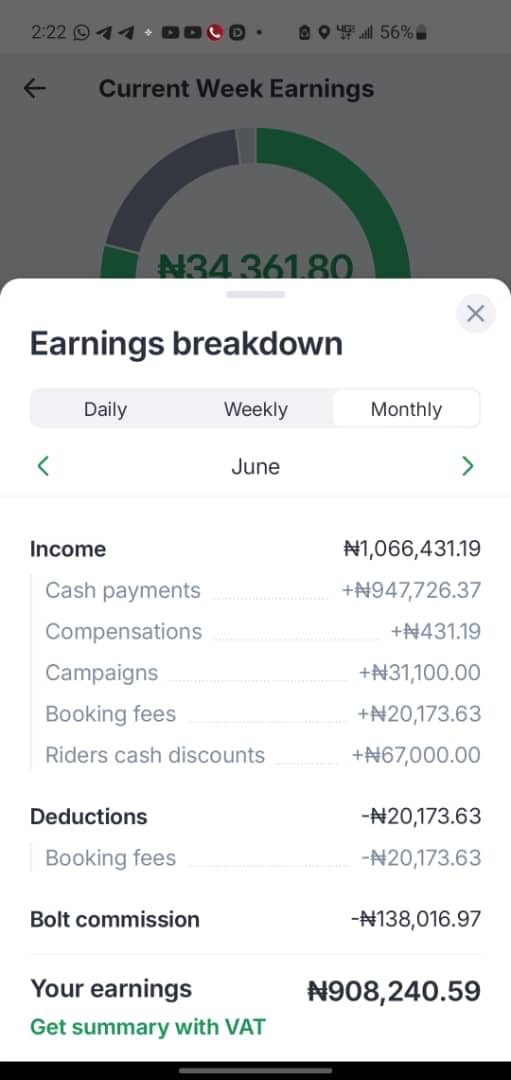
According to him, of that sum, Bolt would first extract a commission of ₦138,016.97. This will be followed by a booking fee of N20,173. This will leave the actual gross earnings at about N908,240.
He added that drivers typically travel between 3 and 5 kilometres before picking up a rider, thus incurring other costs outside of the ride earnings. This, however, is not reflected in Bolt’s earnings calculation, which starts only when the rider is in the vehicle and the trip has started.
He also enumerated other drivers’ operational costs not captured by the company. First, they work daily for over 10 hours, which exceeds the 8-hour labour law limit. He believes that the least a driver’s monthly take-home should be N1 million.
He justifies his expectation thus:
A 10-hour working day translates to a fuel consumption of ₦700,000 monthly. Data used for work is about ₦10,000 a month. Vehicle maintenance gulps up to ₦80,000 monthly. This includes a change of engine oil, brake pads, car washing, fixing tyres and other care expenses.
In addition, vehicle cost for hire purchase or rental is ₦120,000 monthly. Others include the cost of food for the driver and other smaller expenses.
Comrade Ayoade noted that after all these expenses, the driver is left with almost nothing. He then challenged Bolt to consider these operational costs and make public the actual earnings of drivers on its platform.
“We request that Bolt consider the actual operational costs incurred by drivers, which are not reflected in their analysis. We urge them to consider these operational costs and provide a more accurate representation of driver earnings,” he said.

He also expressed support for the Lagos State House Assembly’s investigation into the e-hailing industry in the state, noting that it’s crucial they consult experts who understand the intricacies of the industry.
He noted that since the 2020 regulations, the industry has yet to see any benefits from the ₦40 per trip road development levy.
