



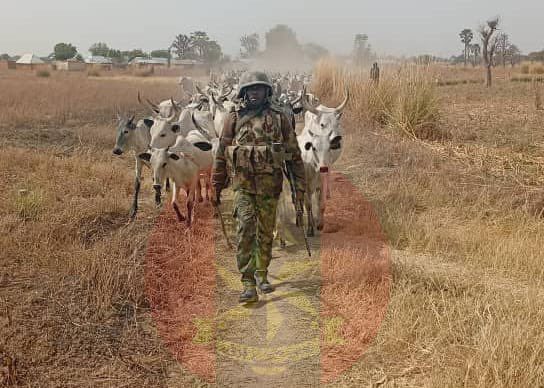
On the night of August 6, 2024, a 16-year-old boy named Ismail Mohammed was buried in Samaru, Zaria, according to Islamic rites. Senior military officers attended. The Nigerian Army’s official X account posted a statement the same morning, describing his death as the tragic consequence of a “warning shot” fired to disperse hoodlums who had attacked troops enforcing a curfew.
The post has had 801,900 views. Below it, a Community Note citing eyewitness accounts and local media reports that said something different. Ismail was not attacking anyone. He was shot in cold blood.
The Army later arrested the soldier, and the family received ₦300,000. No statement was amended.
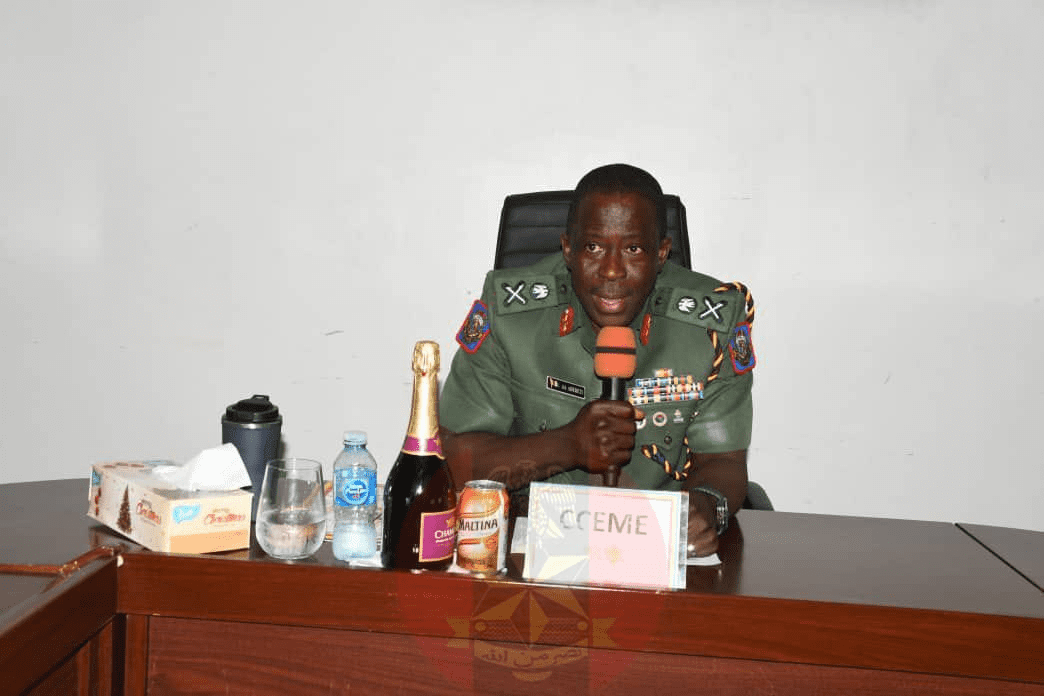
Lieutenant
Acting Deputy Director Army Public Relations
Headquarters Nigerian Army Electrical and Mechanical Engineers
That gap between the official version and the contested one is not unique to Zaria. Between August 2024 and April 2026, Nigerian government institutions posted on X at least seven times in ways that drew Community Notes, the platform’s crowdsourced fact-checking mechanism, where independent contributors add context or corrections beneath posts they find misleading. Of those seven, five involved security agencies. Four involved the Nigerian Army alone.
That concentration is the story.
Read also: Nigerian army raises alarm as terrorists increase the use of armed drones in the northeast
Investigative journalist Fisayo Soyombo had been undercover for weeks when soldiers from the 6 Division Nigerian Army arrested him in November 2024 at an illegal oil bunkering site in Port Harcourt.
The Army’s press release, signed by a Lieutenant Colonel, described his arrest as part of anti-pipeline vandalism operations. It listed him among suspects found at an illegal site. What the statement did not say was that Soyombo had shared his movement plans with Army contacts in advance, only to arrive at the site and find troops already there.
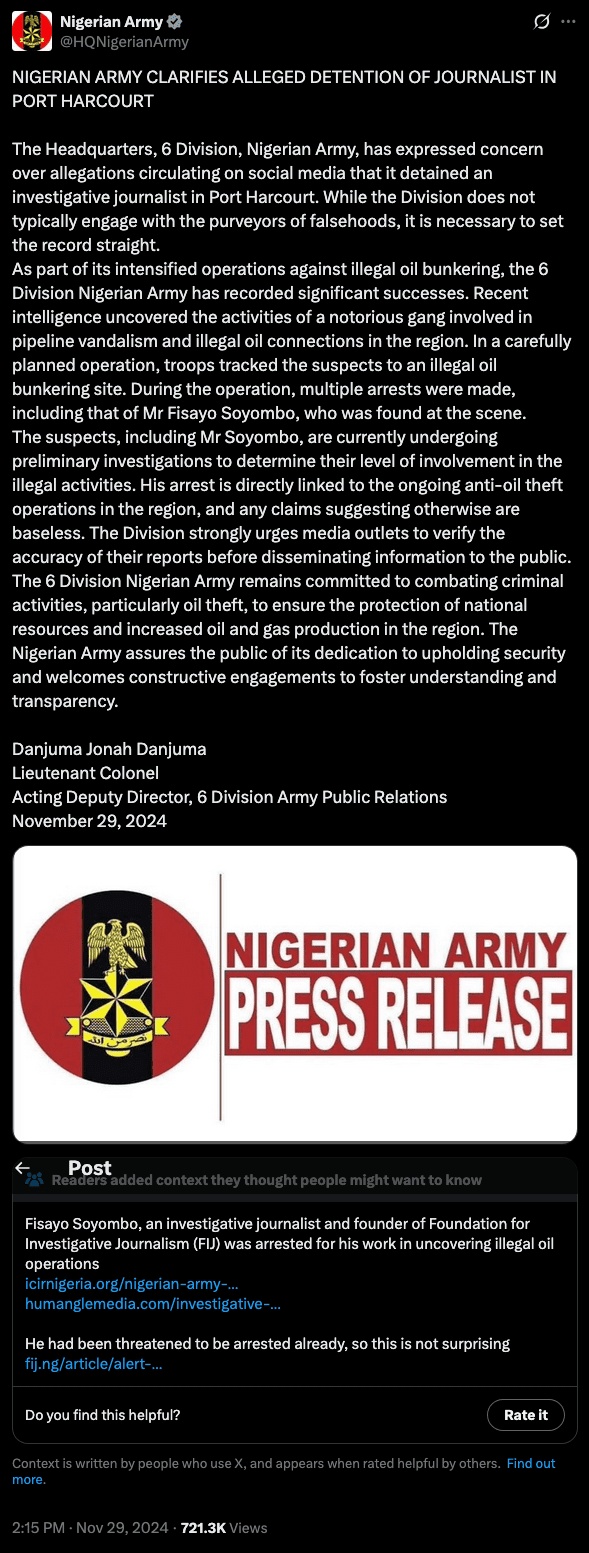
He spent three days in incommunicado detention. The Community Note beneath the Army’s post was direct: he was arrested for journalism, not crime, and had been threatened with arrest beforehand.
Two cases involving two institutions, and both involving the loss of something irreversible, including a boy’s life and a journalist’s freedom. Both were framed officially in ways that crowdsourced correction found incomplete at best.
The deeper question is not whether these institutions lied. Some cases are more ambiguous than that.
In January 2026, President Bola Tinubu’s verified account posted a photo of his private lunch with Rwandan President Paul Kagame in Paris. The meeting happened. The Community Note flagged that the image carried a GrokAI watermark, indicating AI enhancement.
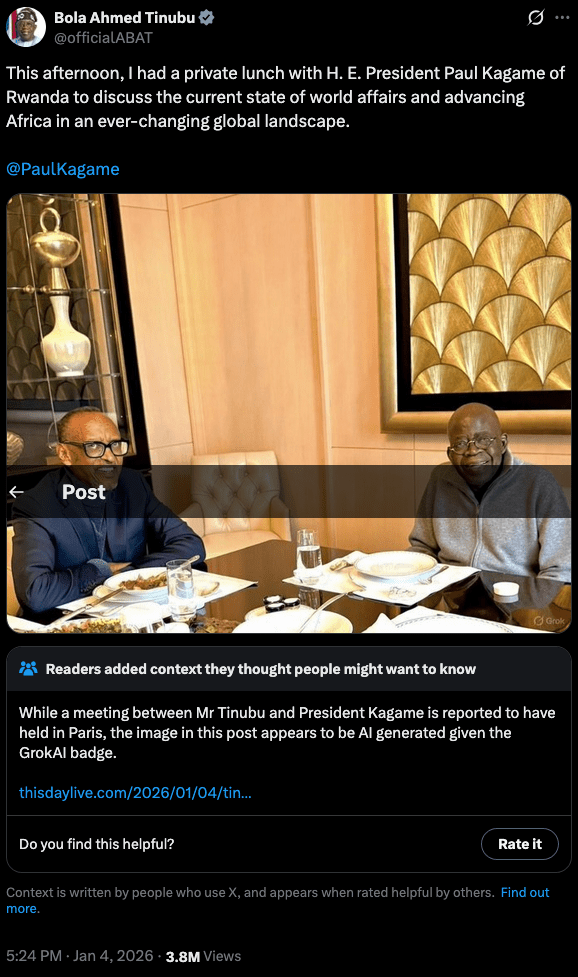
The Presidency did not dispute the meeting, only the image became the problem.
In another case, the Nigeria Police Force (NPF) announced the extradition of Matthew Chukwuemeka Adebiyi, a name that initially drew questions around ethnic framing. Passport records later confirmed the name. The note was answerable.
These lighter cases matter precisely because they sit on the same list as Zaria and Soyombo. They reveal that the problem is not always intent. Sometimes it is carelessness. A presidency that lets an AI-enhanced image go out without flagging it, a police announcement that does not anticipate how a name will land…these are institutional communication failures that in a high-trust environment would be minor embarrassments. In Nigeria in 2026, they feed a much larger fire.
Nigeria does not have a misinformation problem the way that phrase is usually deployed, as though false information arrives from outside and institutions are its victims. The documented pattern here runs the other direction. The institutions with the most power to shape public understanding of security, protest, journalism and elections are also the institutions whose public communications have most consistently required external correction.
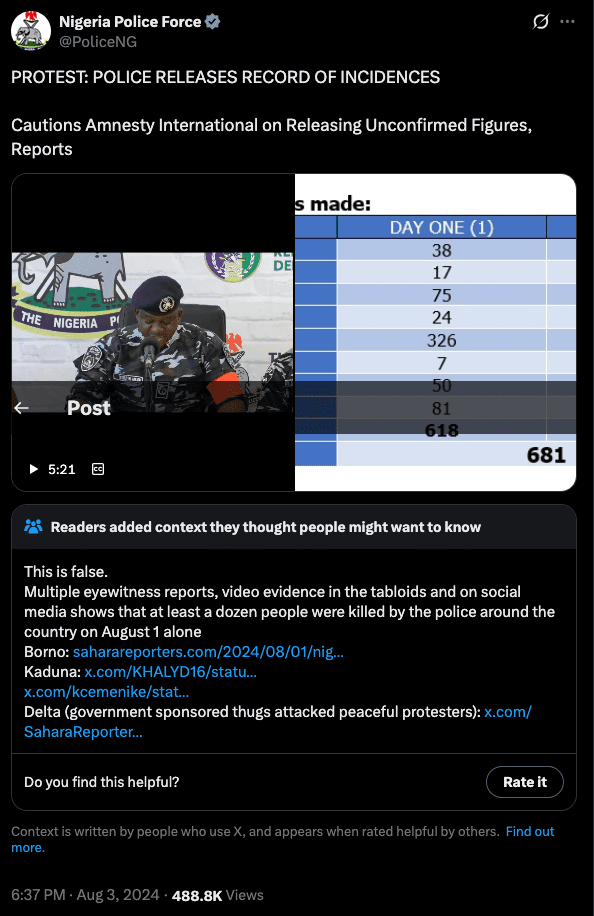
The Nigeria Police Force’s August 2024 post releasing its “official record” of protest incidents was met with a Community Note that called it false, citing video evidence and regional reports of civilians killed by security forces on August 1 alone.
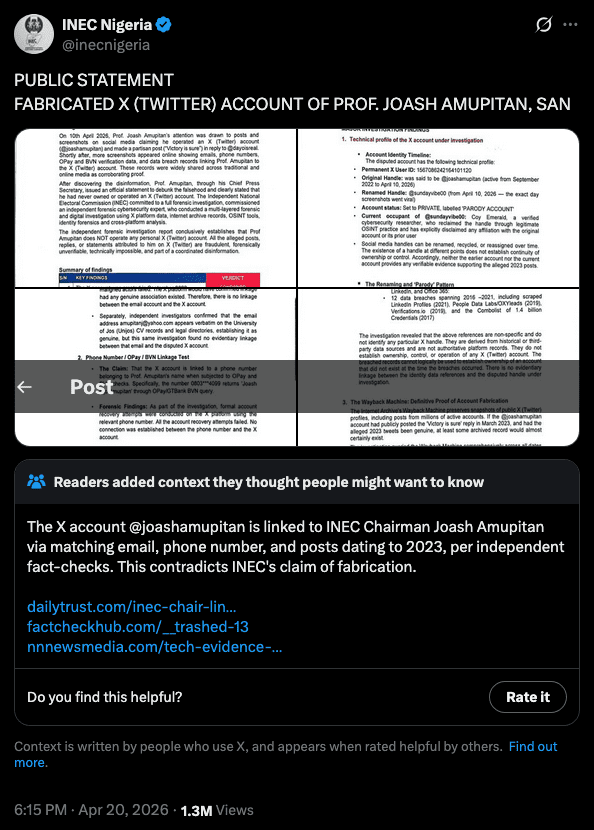
INEC’s April 2026 claim of a “forensically fabricated” account for its own chairman was directly contradicted by independent fact-checkers who traced the account to matching email addresses, phone numbers and posts dating to 2023.
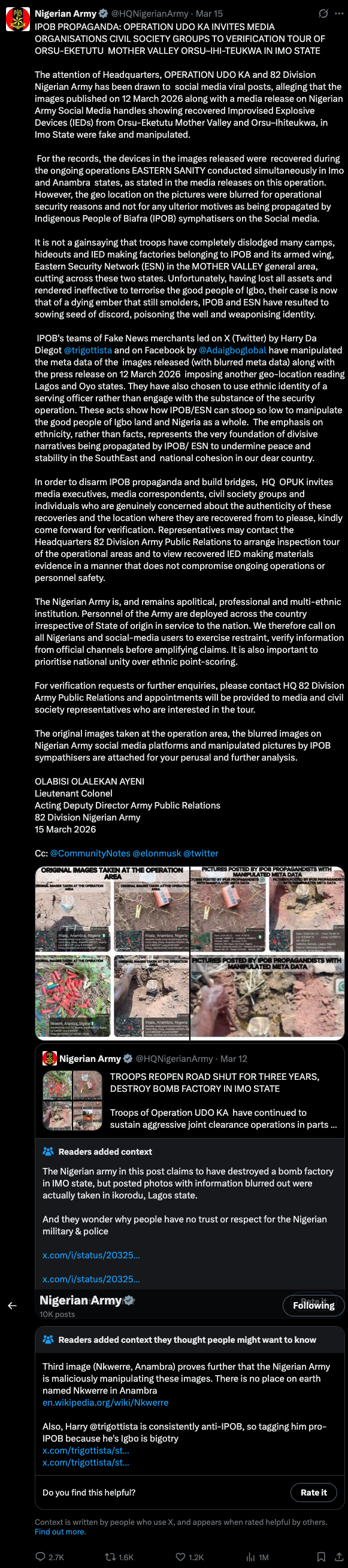
The Army’s Southeast operations posts in November 2025 and April 2026 drew notes questioning whether the visuals matched the claims, in a region already living under the dual anxiety of criminal violence and military presence.
What Community Notes cannot do is restore what bad communication costs. Malam Mohammed’s family in Zaria received ₦300,000 and a delegation of senior officers. They did not receive a corrected statement. Fisayo Soyombo walked free and wrote about what happened to him. The Army’s post remains as originally published.
The record of these seven cases does not prove that Nigerian institutions are uniquely dishonest. It proves something quieter and more consequential:
In the age of instant citizen verification, the cost of sloppy, incomplete or self-serving communication is no longer just reputational. It is structural.
Every uncorrected post is a small withdrawal from the account of public trust that security, elections and governance all depend on.
The consequences are not abstract. In communities where the Army operates, residents who distrust official narratives stop reporting suspicious activity, because cooperation feels like exposure. Journalists who watch a colleague get arrested and framed in a press release calculate the personal cost of undercover work differently after that. Voters who see INEC unable to defend the integrity of its own chairman’s social media account carry that doubt into the next election cycle.
None of this shows up in a Community Note. It shows up in weakened intelligence networks, chilled investigative journalism, and an electorate whose default posture toward institutions is suspicion rather than engagement. That account, across these seven cases, is running low.
Community Notes is a feature on X that allows approved contributors to add contextual information or corrections beneath posts they consider misleading. Notes become publicly visible when enough contributors with differing perspectives rate them helpful. The feature is independent of X’s editorial team and is not moderated by the platform.
TABLE: 7 (4 – Nigerian Army) cases, 4 institutions
| # | Institution | Date | Post Summary | Community Note | Outcome |
|---|---|---|---|---|---|
| 1 | Nigerian Army | Aug 6, 2024 | Described Ismail Mohammed’s death as a “warning shot” gone wrong during hoodlum attack | Eyewitness accounts and local media said he was shot in cold blood, not during any assault | Soldier arrested, family paid N300,000, original post never amended |
| 2 | Nigeria Police Force | Aug 3, 2024 | Released “official record” of protest incidents, cautioning Amnesty International on unconfirmed figures | Called outright false, with video evidence and regional reports showing at least a dozen civilians killed on August 1 alone | No correction issued |
| 3 | Nigerian Army | Nov 29, 2024 | Described Fisayo Soyombo’s arrest as part of anti-pipeline vandalism operations, listing him among suspects | Noted he was arrested for investigative journalism, had been threatened with arrest beforehand, and spent three days in incommunicado detention | Soyombo released, wrote account of detention, Army post unchanged |
| 4 | Nigerian Army | Nov 2025 / Mar 2026 | Posts on Southeast raids, recovered IEDs, destroyed bomb factory, framed as IPOB/ESN operations | Notes questioned whether visuals matched claims, with one noting photos were taken in Lagos not operation area | No corrections issued |
| 5 | Nigerian Army | Apr 2026 | Claimed arrest of kidnap suspect and recovery of ransom funds linked to IPOB/ESN network | Note pointed out the arrest featured in photos matched a civilian-led operation with no IPOB/ESN link mentioned in original reporting | No correction issued |
| 6 | Presidency | Jan 4, 2026 | Posted photo of Tinubu-Kagame private lunch in Paris | Note flagged GrokAI watermark indicating AI-enhanced image | Presidency confirmed meeting happened, image enhancement not disputed |
| 7 | INEC | Apr 20, 2026 | Claimed forensic investigation proved INEC chairman’s X account was fabricated | Independent fact-checks linked account to chairman via matching email, phone number and posts from 2023 | No correction, contradicted by multiple fact-checking outlets |
| 8 | Nigeria Police Force | Apr 2026 | Announced extradition of Matthew Chukwuemeka Adebiyi, drawing ethnic framing questions | Name confusion raised questions around Igbo-Yoruba identity framing | Passport records later confirmed the name, note resolved |
