





Nigerian telecom stakeholders have urged the industry to adopt a Dig-Once policy to protect against fibre cuts, enhance network reliability, and boost service quality.
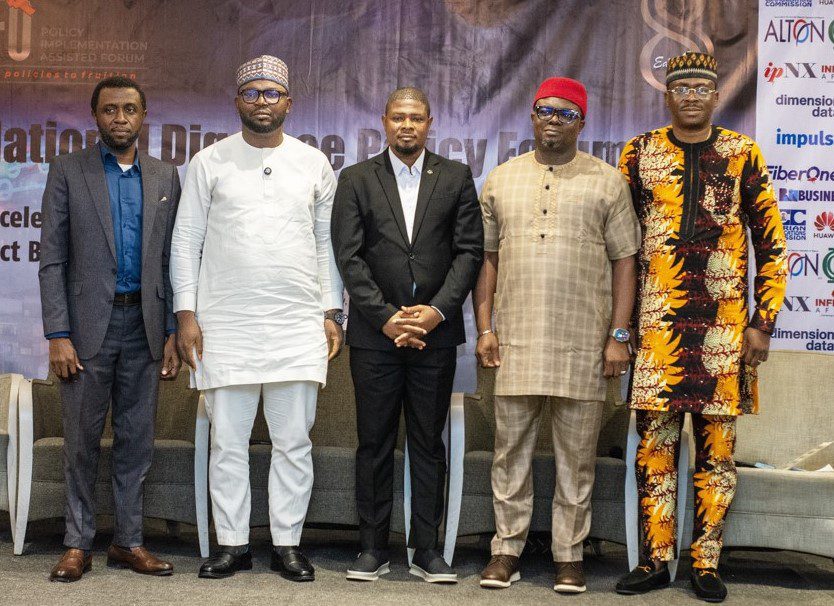
At the National Dig-Once Policy Forum in Lagos, which marked the 8th Policy Implementation Assisted Forum (PIAFo), stakeholders called on the federal government to adopt a unified framework for fibre deployment alongside road construction.
In the forum titled “Accelerating Nigeria’s Digital Backbone: Dig-Once Policy, Project BRIDGE and Strategies for Effective Fibre Deployment,” they also agreed that the Dig-Once policy holds the key to achieving the 90,000km nationwide fibre deployment target.
The Dig-Once policy aims to install fibre ducts alongside road and rail line construction or rehabilitation, and other public infrastructure. It also involves a collaboration by telcos to deploy cables through shared ducts, which in turn reduces repeated digging along a particular line.
Project BRIDGE is Nigeria’s most ambitious connectivity project, aiming to lay 90,000km of fibre optic cable across cities, towns, and rural communities. The $2 billion federal government initiative, backed by $500 million in World Bank funding, recently secured $100 million in funding from the European Bank for Reconstruction and Development.
Issues relating to policy implementation
Most times, Nigeria’s deepest issues are not about policy formulation but hinge on policy implementation. And the President of the Association of Telecommunication Companies of Nigeria (ATCON), Tony Emoekpere, aligned with this.
“We have so many policies we don’t execute well. What Dig-Once offers is an opportunity to correct this,” he noted, pointing out that operators frequently damage one another’s cables during repeated digging, causing network disruptions and major outages.

Fibre cuts are a leading cause of network outages, mostly caused by avoidable incidents. Data made available by the Chief Executive Officer of Dimension Data Limited, Gbenga Olabiyi, revealed that road construction accounts for 60% of network outages caused by fibre cuts.
The data further showed that about 35,000km of fibre is in the ground, yet only 16% of Nigerians are connected. Also, broadband penetration stands at 45%, with Lagos alone having a penetration rate of over 70%.
Mr Olabiyi noted that the gap to address the missing fibre link over the years has led to connectivity gaps in both urban and rural areas, leaving people with internet-enabled phones unconnected.
Also Read: New NCC, CBN partnership targets telecom-linked fraud and financial risks.
Technology initiative to solve fibre cuts
At the forum, Huawei shared a fibre sensing technology that detects and locates cable damage in real time.
The Director of Strategies, Huawei Technology Nigeria Limited, Eric Chen, said the initiative combines a sensing device attached to a live fibre with an artificial intelligence unit that runs a 32-dimensional algorithm to analyse the signals collected.
He noted that Huawei began building the technology two years ago after backbone transmission customers raised repeated complaints about the time lost searching for cut locations manually.

At a time when repeated excavation of the road leads to frequent fibre disruption, telcos suffer increasing operating costs. Participants quoted NCC data, noting that of 50,000 fibre cut incidents recorded in a year, about 60% occurred during road construction and rehabilitation.
Although the National Security and Civil Defence Corps (NSCDC) is working with the Office of the National Security Adviser (NSA) and the National Security and Emergency Management Agency (NEMA) to protect telecom infrastructure from vandalism, experts believe the efforts are insufficient.
They charged both the government, stakeholders and operators to implement a more coordinated effort to solve the industry’s greatest threat.
