


Over the past few months, MTN Nigeria’s share price has reacted strongly to the company’s milestones, signifying a glimmer of investor confidence and how it shifts alongside the positives.
However, some commentators have argued that investors or share buyers are undervaluing the company (share price remains around ₦790 – ₦800), considering its worth and leadership position in the Nigerian telecoms industry. Often, the focus is on short-term factors such as profits, acquisitions, and other developments when calculating share value.
Compared to its loss in 2024, the company rebounded to ₦1.11 trillion profit after tax (PAT) in 2025, with over 95 million subscribers (51% of the country’s total subscribers). And, it paid out dividends of ₦419.91 billion at the rate of ₦20.00 per share in 2025.
In its recent earnings disclosure in Q1 2026, its PAT more than doubled year-on-year to ₦355.5 billion, driven by data revenue and expansion of fintech services.
Yet, the valuation and share price do not fully reflect these trends.

Ownership of 51% of total telecom users means the operator controls a substantial percentage of Nigeria’s digital economy, daily connectivity and business activities.
With increasing smartphone penetration and data usage, the revenue potential is bigger; if you consider that, despite the January 2025 tariff hike, data usage has continued to spike quarter on quarter.
The major argument is that the share value price hasn’t experienced a commensurate growth trajectory.
How MTN Nigeria’s share price traded recently
MTN Nigeria’s share price on the Nigerian Exchange (NGX) shifted from the ₦200 range into the ₦700 and ₦800 range between late 2025 and early 2026.
The share price previously traded around the ₦200 – ₦300 zone due to broader foreign exchange (FX) and macroeconomic challenges. By early 2026, it frequently traded in the ₦700 range following the ease in economic rigidities.
Following the deal announcement in February, set to be finalised through 2026, MTN Nigeria’s share price started trading around the ₦730 to ₦755 range. It would later increase to trade in the ₦780 to ₦790 range after the operator’s historic announcement of ₦1.11 trillion PAT in 2025.
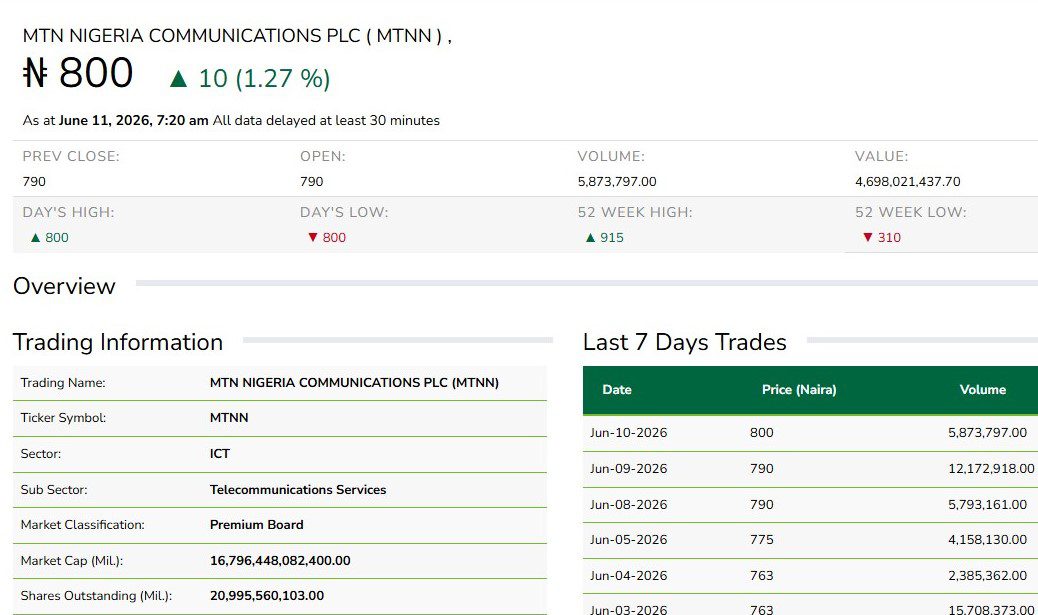
The company later hit an all-time high of ₦915 in the first week of May 2026. This followed strong Q1 earnings that triggered a bullish run on the NGX. As of Wednesday, June 10, the MTN share price was ₦800.
These shifts showed a more relatable pattern in how investors rely on short-term cycles and the economy to inform their trading decisions. But for a company as big as MTN, should investors still rely only on short-term fluctuations?
Consider that we are in an era where tech giants are also valued for potential and economic relevance.
Also Read: MTN Nigeria CEO, Karl Toriola links absence of unlimited plans on mobile to need for survival.
Investors’ minds, scepticism, and the MTN share price
Here is something to consider:
When the share price was trading below ₦200 in 2024 and early 2025, the performance wasn’t only due to FX and broader market conditions. The operator’s financial position was weak, with a ₦400.44 billion loss after tax in 2024.
Then came the 50% tariff increase, which brought a drastic financial gain for telcos, marking the rest of the history of the current situation. While operating costs kept rising, the subscriber base also jumped, showing massive growth.
Similarly, data has significantly overtaken voice as its leading revenue driver over the past two to three years. The operator’s data revenue surged 74.5% to ₦2.78 trillion in 2025, accounting for over half of its total revenue.
These illustrate a still uncertain trend that is significantly hinged on the government’s policies and users’ habits. Some argue that MTN’s sudden growth is driven by tariff hikes and not intrinsic value.
It is safe to ask: what would have happened to the telco if the tariff adjustment had not happened?

After all, it may be that MTN’s share price reflects the market’s attempt to balance observed growth with the realities of an unpredictable market and inoculate their hopes.
What the future might look like
The next massive shock, be it economic or industry-wise, will significantly test MTN’s share price and valuation. It will reveal where its real strength lies.
But there are positives for investors to admire. The operator has long-term growth potential as more Nigerians are using smartphones, internet consumption keeps increasing, which guarantees data revenue and the growing demand for digital services to uplift its fintech business.
It’s also rising fast above competitors such as Airtel Nigeria, Globacom and T2mobile (formerly 9mobile). By acquiring IHS, it will buy back its own towers and control the core of its business drive. But beyond these are market forces which are beyond MTN’s control. FX, inflation, and interest rates play key roles.
MTN Nigeria might be big in what it controls. Yet investors look beyond big, seeking the guarantee of long-term stability.
