


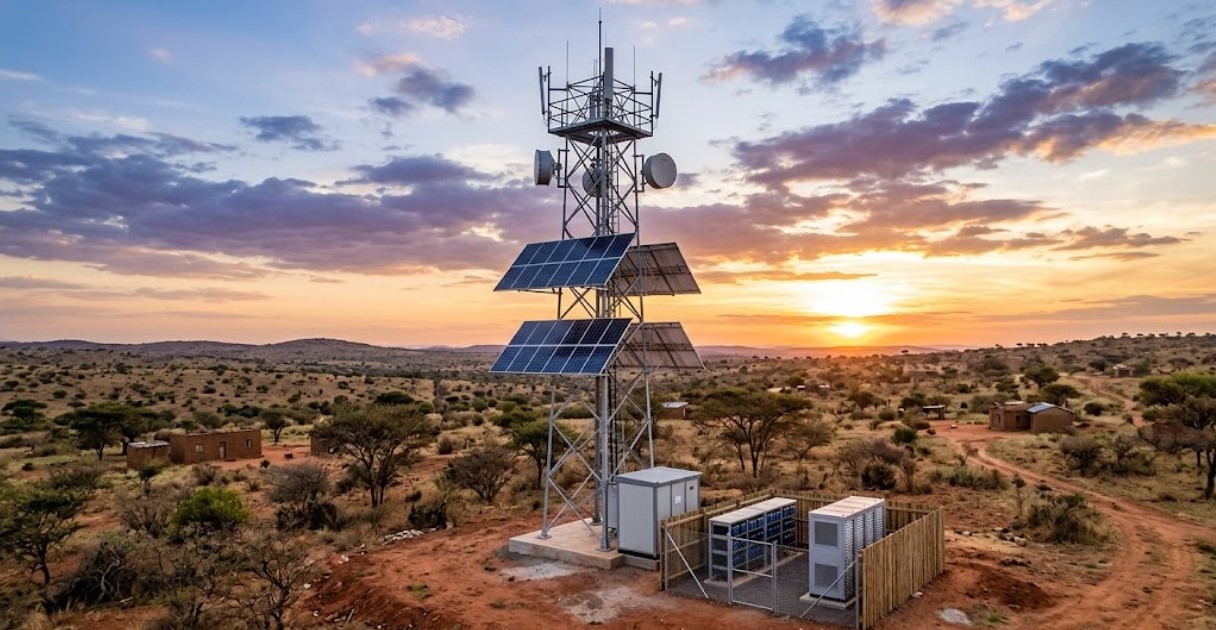
The federal government has set a six-month target to secure funding for community co-owned telecom towers and rural networks powered by renewable energy (solar-powered) in zero-connectivity communities. This forms part of a broader push to expand sustainable infrastructure to underserved areas.
According to a resolution during the Nigerian Communications Commission’s Nigeria Digital Connectivity Investment Forum, in partnership with Swedfund and Ookla, the funding for the rural-owned towers will be accessed through partnerships with the Universal Service Provision Fund (USPF), State governments and the Rural Electrification Agency (REA).
While the federal government still targets device affordability, it wants to keep expanding coverage across rural Nigeria. Recall that the 3,700 tower rollout in underserved communities is set to commence in October, with the ambition to deploy 200 by December 2026.

Also read: These 5 FG projects are set to roll out in October; here’s how they’ll affect the $1tn digital economy.
The funding will see contributions from different parties. The USPF funds the telecoms side, such as towers, base stations, small cells, backhaul, and core for zero-connectivity communities, while the REA funds the energy components like solar mini-grids, batteries, and solar panels to power the tower. State governments then provide land, security, and Right of Way.
Under the plan, the facilities will be community-owned, meaning that instead of an MNO or government owning it 100%, the community forms a cooperative that maintains it, shares revenue, and keeps it sustainable. REA often does this with its Rural Electricity Users Cooperative.
In fact, the NCC and REA signed an MoU in 2025/2026 specifically to map their projects together for rural connectivity initiatives. Experts tipped that the USPF should get regulatory backing as the primary source for underserved-area projects, supported by blended public and multilateral funding.
Meanwhile, the federal government still needs to deal with the usage gap in rural Nigeria. According to the NCC, mobile broadband already covers about 90% of Nigerians, yet smartphone ownership stands at about 27% and broadband penetration at 57.4% against a 70% target. Device affordability, digital skills and gender segregation are leading constraints.
Despite the presence of connectivity expansion initiatives such as shared rural networks, satellite services delivered to unmodified handsets, micro-cabling, solar-powered rural sites and local device and SIM manufacturing to reduce the cost of reaching rural communities, none removes the need for affordable devices in users’ hands.
Calls for telecom towers and Project Bridge’s acceleration
In the digital infrastructure investment forum, stakeholders have asked the federal government to accelerate the delivery of Project BRIDGE, the 90,000 km national fibre backbone, as a strategic response to the middle-mile connectivity gap.
Recall that the federal government, through the Minister of Communications, Innovation and Digital Economy, Dr Bosun Tijani, revealed that it will commence deployment of Project BRIDGE by October, an initiative expected to be rolled out in phases over 5 years (2026 – 2030).
In addition, the forum encouraged respective government agencies to advance complementary measures in improving the availability and reliability of power for digital infrastructure, sustain policy consistency, and support financing structures that reduce the cost of capital for the sector.

The forum also highlighted the need for long-term financing that matches the lifespan of digital infrastructure, because it has an asset life of twenty to thirty years and cannot be financed on five-year bank tenors. This comes as infrastructure financing in Nigeria has grown from under ₦70 billion in 2004 to ₦19.4 trillion in 2025.
Telecom operators, infrastructure and technology companies are also encouraged to pursue shared-infrastructure and neutral-host models that lower the cost of rural and indoor coverage. This includes pairing every coverage investment with measures that put affordable devices in users’ hands, including locally manufactured devices and SIMs.
