



It’s been decades of power struggles in Nigeria, and somehow, the national grid still manages to surprise us with new plot twists every time. One minute you have light, the next minute is darkness.
At this point, it almost feels like we have all adjusted our lives around inconsistency and owning a powerbank has become our coping mechanism.
“POV: You rent power banks in Nigeria” was the caption of a viral video I saw on Instagram and TikTok. “Who is renting power banks?” I thought. Then I found Increase and his team.
In response, Increase Eromosele Isesele, an Edo State-born tech innovator, founded Padiplug. His idea is to create a system where people can rent solar-powered power banks whenever they need them on campuses, at events, at NYSC camps or in any controlled spaces.
Increase’s journey is rooted in his background and lived experiences. With a degree in International Business Management from Russia, he has spent years in countries where stable electricity is the norm.
What makes his story even more interesting is how personal it is.
He didn’t just wake up and decide to build a tech solution; he has actually lived the problem. Before travelling abroad, he studied law in Nigeria, so he understands what it means to navigate school, life, and hustle with unstable electricity.
“I have lived the problem and lived the solution. So I understand the bridge that needs to be built for us to enjoy stable electricity. I know what it takes for an average Nigerian student to survive. So it's important to build that bridge that puts people in that type of position too,” he said in an interview with Technext.
Through research, he discovered that powerbank rental systems were already widely adopted in countries like China.
However, adapting this model to Nigeria required more than replication; it required designing for local realities, where affordability, accessibility, and energy sources like solar power play a critical role.

How Padiplug works
Padiplug operates as an app-enabled service.
Users are required to download the application, which serves as the primary interface for locating and accessing power bank stations. Through the app, users can identify nearby stations across different locations, supported by an integrated mapping system that allows for seamless navigation.
The pricing model is similarly flexible and context-dependent. For example, at NYSC camps, users may be required to top up a minimum wallet balance of ₦1,500, with rental costs structured at approximately ₦300 per hour.
Unused balances remain in the user’s wallet, allowing for continued access without repeated onboarding. However, pricing varies across different locations, reflecting differences in demand, audience, and operational considerations.
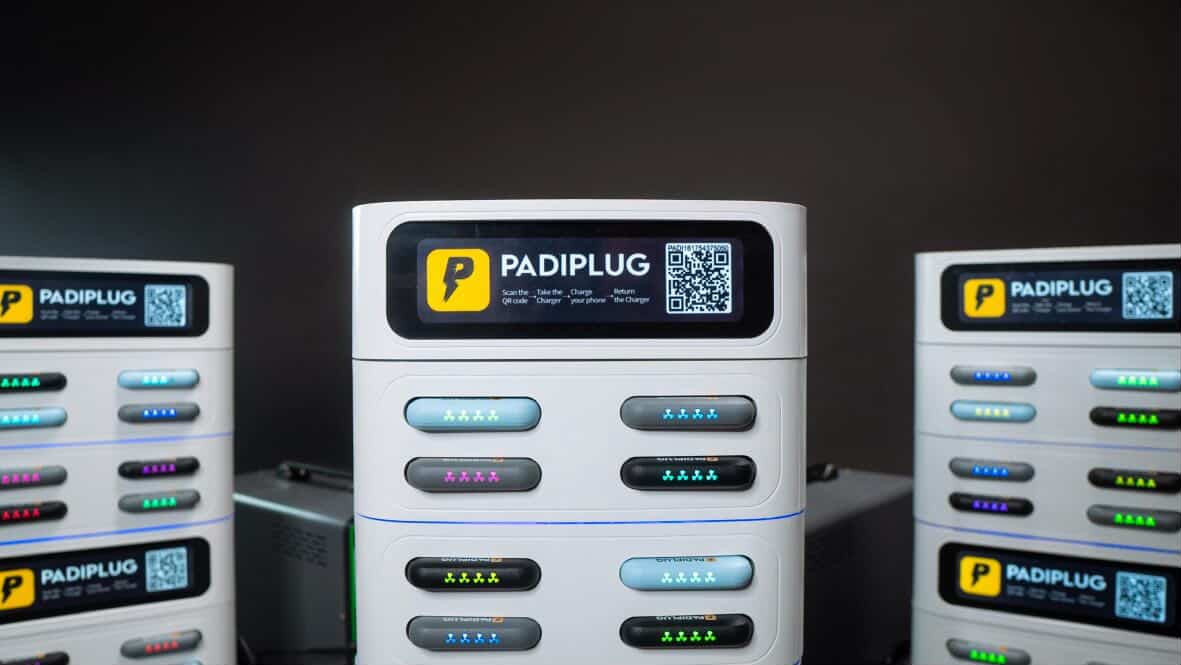
A key component of the platform’s design is its emphasis on trust and accountability.
Recognising the challenges of operating in a low-trust environment, the system incorporates a Know Your Customer (KYC) process tailored to specific user groups.
For instance, university students provide matriculation numbers, while National Youth Service Corps members are identified with their state codes or call-up numbers. At organised events or corporate settings, identification may be linked to staff credentials.
This layered verification system is intended to balance accessibility with security, ensuring responsible usage without creating unnecessary barriers.
How Padiplug got here
Increase says that Padiplug is built to create convenience.
The goal is to provide an accessible, on-demand solution for moments when power is unavailable, particularly in social and high-mobility settings such as events, campuses, and public gatherings, where access to electricity is often limited.
Like ride-hailing platforms that thrive despite widespread car ownership, the service does not attempt to replace Nigeria’s electricity system but complements it.
According to him, the team began work in December 2024 and officially launched in January 2026. The process of product development, partnership building, and market testing lasted for 13 months.
He emphasised that the platform is the result of a collaborative effort involving a co-founder and a broader team working to refine both the technology and its deployment strategy.

Today, the product is not available everywhere; only in controlled areas in Lagos. This rollout strategy reflects a deliberate focus on high-demand environments.
Rather than pursuing immediate nationwide expansion, the company is concentrating on locations with dense populations and predictable usage patterns, including university campuses, NYSC camps, and event venues.
These controlled environments allow for more effective monitoring, user education, and adoption, while also addressing some of the most immediate use cases for portable power access.
Looking ahead
From a usability standpoint, the service is designed to be straightforward. The power banks are equipped with built-in charging cables compatible with multiple device types, eliminating the need for additional accessories.
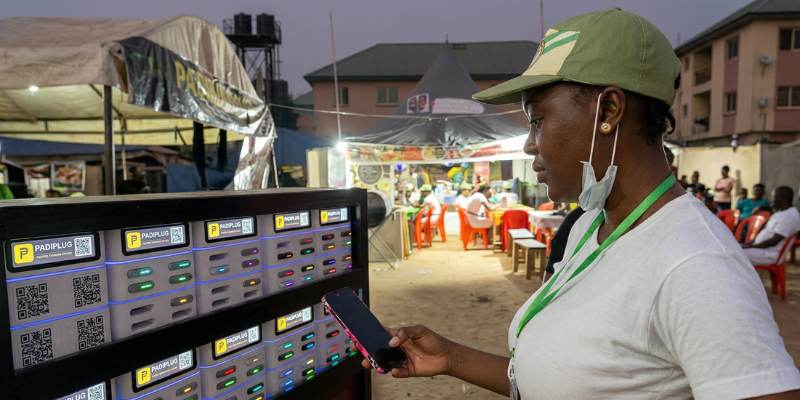
Once rented, devices can be returned to any available Padiplug station, removing the constraint of returning to the original pickup point. The self-service model is intentionally simple, mirroring familiar systems such as automated teller machines.
Interestingly, this trend is not isolated. Just recently, a similar idea surfaced online, showing a store at Olabisi Onabanjo University renting out power banks to students for a fee over several days.
The video sparked conversations across social media, with many people sharing their thoughts. This suggests that this model is not just a single innovation but part of a growing pattern in which individuals and small businesses are stepping in to solve everyday problems in practical ways.
Read also: Preventing the Next Blackout: The Silent Revolution in Power Grid Intelligence
