


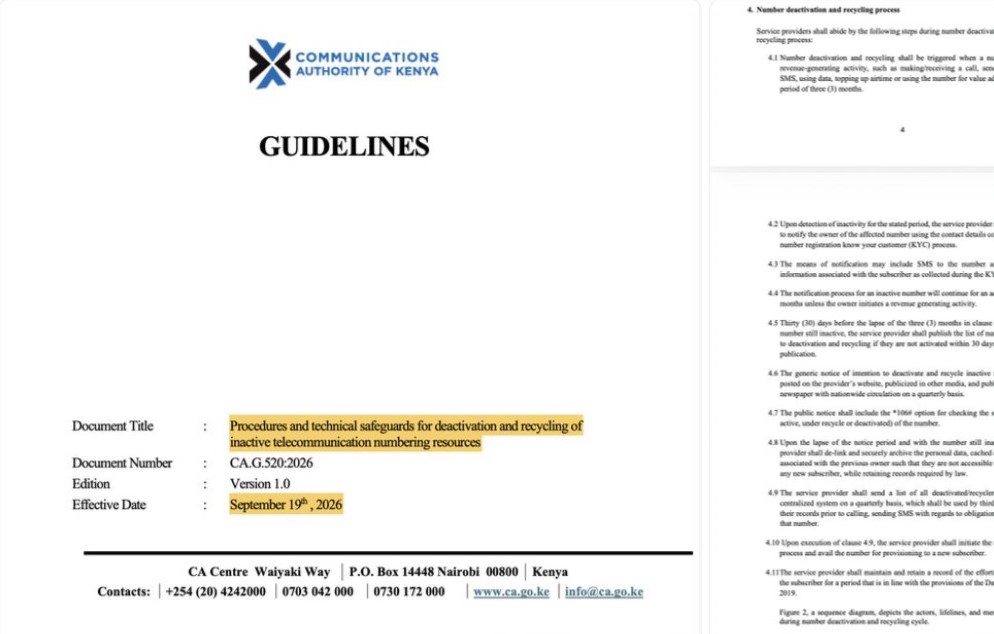
Kenyan authorities have announced that a cell phone number will be deactivated and recycled if it has no record of activity for three (3) months. The development will take effect from September 19, 2026.
The rule is contained in a published document by the Communications Authority of Kenya (CAK) titled “The Procedure & Technical Safeguards for Deactivation & Recycling of Inactive Telecommunications Numbering Resources”, expected to guide the churning and reactivation of phone lines.
Once a number has been inactive for three months, it becomes eligible for churning and recycling by Kenyan telecom operators such as Safaricom, Airtel and Telkom.
In its definition, a phone line becomes inactive when it has no record of revenue-generating activity for three months. This includes activities such as making and receiving calls, sending and receiving SMS, using data, topping up airtime or using the number for value-added services such as airtime lending and mobile money transactions.
The guideline follows the March 19th High Court determination that a registered cell phone number constitutes a digital identifier linking personal data & qualified for protection under Article 31(c) & (d) of the Constitution.
It also follows the landmark judgment in which the Kenya High Court barred telecom operators from deactivating or recycling a phone number without the owner’s consent. It noted that a registered mobile phone number constitutes personal data protected under Kenyan law.
Before the deactivation of lines, telecom operators are expected to follow due process.
Once an operator detects a period of inactivity for a certain period, it’s expected to notify the owner via call or SMS using alternative contact details collected during the number registration. Such notification is expected to continue for an additional 3 months unless the owner initiates a revenue-generating activity.
According to the document, operators must publish a list of numbers susceptible to deactivation and recycling 30 days before the end of the three-month notification period.
To make the notification of line deactivation more generic, the Kenyan authority said telecom operators are to publish a list of inactive numbers on their respective websites and across national newspapers quarterly.
“The public notice shall include the *106# option for checking the status (suspended, active, under recycle or deactivated) of the number,” it added.
How Kenyan telcos will handle data protection
A leading concern about SIM recycling is how telecom operators may fail to completely remove records linking a SIM card or phone number to its original owner. When a SIM is not properly purged, it leads to the exposure of sensitive data and financial loss.
According to its ruling in March, the High Court ruled that cell phone numbers should be reassigned only after the previous registered owner is informed and consents to the process. It also directed telcos to implement technical safeguards to prevent unauthorised exposure or transfer of personal data to the new user or another party.

The latest document made an effort to provide guidelines that cover the concerns and also ensure data protection.
Before deactivating and recycling any phone number, operators must delink the number from any previously opted-in business-to-customer (B2C) messages. As such, newly issued SIM cards are not expected to receive any marketing messages from either the number issuing service provider or third parties.
“For any business-to-customer (B2C) message, the subscriber MUST have explicitly dialled a USSD consenting to receiving messages from that specific business. The dialled USSD code shall be business-specific, and dialling a given USSD shall not imply consent to receiving all B2C messages,” part of the document reads.
Also read: Kenya introduces mandatory licence for phone and router importers to curb counterfeits.
While the deactivation and recycling process is both regulatory and economically backed for telcos, concerns arise from how SIM recycling processes are not properly cleaned, leading to identity and financial risk.
Recently, the Nigerian Communications Commission (NCC) ruled that telecom operators must inform customers through emails or alternative phone numbers before churning the lines after 360 days (12 months) of inactivity.
Exceptions to SIM deactivation
The document by the Kenyan regulator provided instances where the 90-day period of inactivity will not apply.
For persons, including caregivers of persons who may be indisposed and unable to use their numbers for a potential period of more than 6 months, such is expected to notify their respective service provider of the need to whitelist a subscriber’s number.
Also, for inmates, the Commissioner General of Prisons is expected to submit the person’s details (phone lines and NIN) to the respective service provider for whitelisting and notify the inmate. This must be done 3 months after a person is committed to a jail term of more than 6 months and has exhausted their appeal options.
However, the document did not make provision for customers who travel abroad and stay there longer than the stipulated 3 months. And because there are countries where telecom operators don’t offer roaming services.
