





Bitcoin is heading into October on a high after recovering from the US Senate’s failure to advance the CLARITY Act, with the cryptocurrency reaching $86,349 on September 21, its highest level since late January. The rebound has coincided with a sharp reversal in US spot Bitcoin exchange-traded fund (ETF) flows, even as markets brace for a possible Federal Reserve rate hike later in October.
The Senate’s September 15 vote was a procedural test rather than a final vote on the legislation. Senators voted 49 for and 50 against invoking cloture on the motion to proceed, falling short of the 60 votes needed to advance the bill.
Bitcoin fell below $76,000 around the vote before recovering above $80,000 and reaching $86,349 on September 21. Kester Ejikeme, founder and project lead of Bitcoin Anambra, says the sequence “shows that one legislative event doesn’t necessarily change the underlying demand for Bitcoin.”

That raises a more useful question than whether Bitcoin has an “Uptober” built into its calendar: Can the demand behind the September rebound continue into October?
October has earned its Bitcoin ‘Uptober’ reputation
According to RiskWhale’s historical price data, Bitcoin finished October higher than it began in nine of the last 11 years, with an average return of 19.1% across that period. October 2024 alone produced a 10.9% gain.
But the record is not automatic. Bitcoin rose about 5.4% in September 2025, then lost about 4% in October. The same sequence appears to be taking shape in 2026, with a strong September behind the market before October begins.
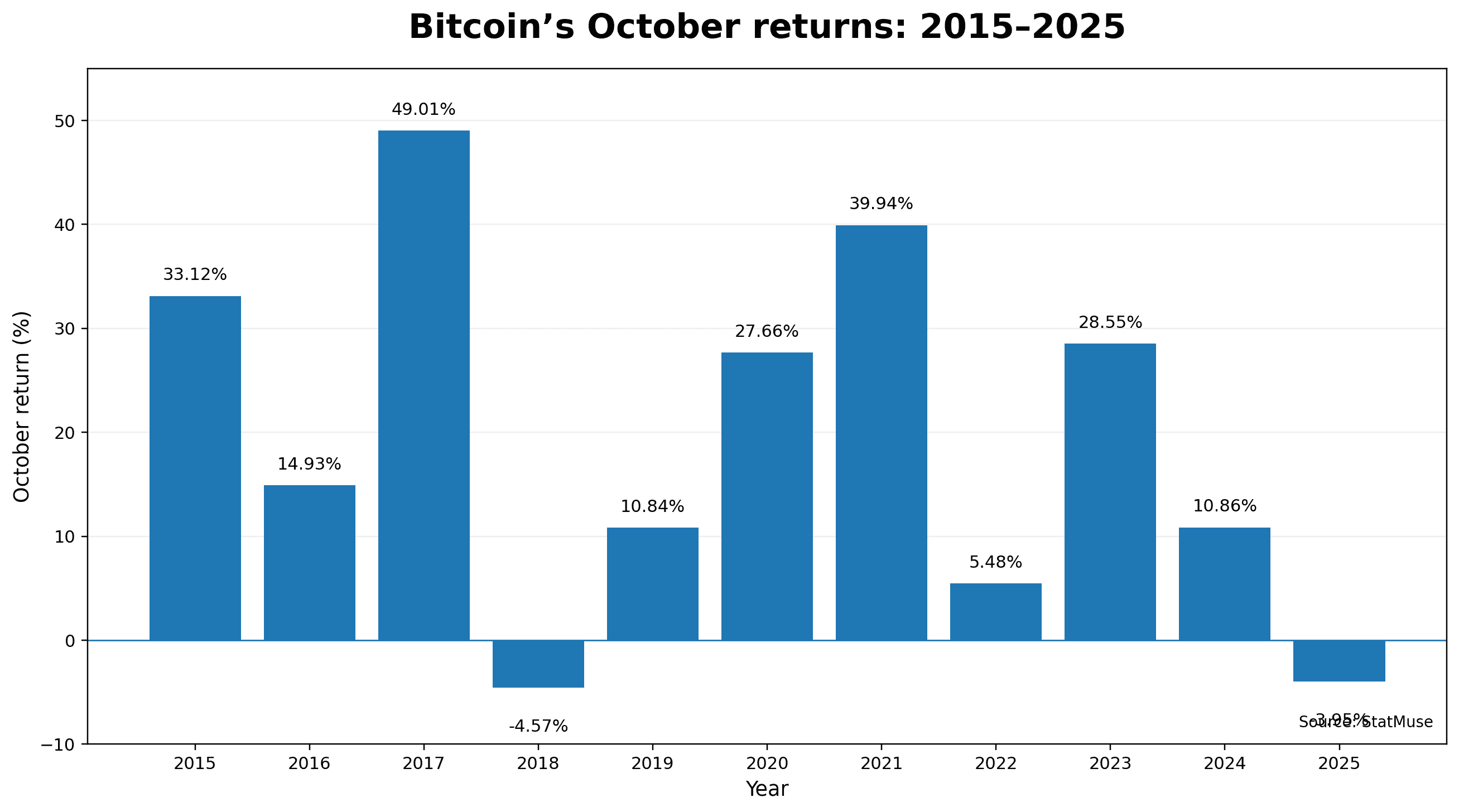
Ejikeme says he looks at broader market conditions first and treats the seasonal pattern as confirmation at most. “I pay attention to ‘Uptober’, but I wouldn’t use it on its own as a reason to buy or sell Bitcoin,” he said.
CLARITY failed, but regulators kept moving
Coinbase CEO Brian Armstrong said after the vote that the Securities and Exchange Commission (SEC) and the Commodity Futures Trading Commission (CFTC) could create clearer crypto rules under their existing authority.
Two days later, the SEC announced an “Innovation Exemption” granting temporary, conditional relief to certain venues to trade tokenised US stocks on-chain. The agency’s chairman, Paul Atkins, said the move sat within its statutory authority. The CFTC issued a no-action position for qualifying providers of passive software the same day.
The actions do not replace the CLARITY Act, but they show regulatory work continuing while Congress is stalled.
ETF flows reversed, but the rally was not just about ETFs
Spot Bitcoin ETFs in the US initially saw heavy withdrawals, which coincided with the CLARITY vote and the Fed meeting.
According to SoSoValue data, the funds recorded $450.3 million in net outflows on Sept 15 and $296 million on Sept 16. Inflows followed: $159.5 million on Sept 17, $433 million on Sept 18 and $999 million on Sept 21. Across the five sessions, net inflows came to about $845 million.
Ejikeme says ETF flows are the first thing he watches. “As much as I wouldn’t want to admit it, it increasingly looks like ETF flows are having a major influence on Bitcoin’s short-term price action,” he said.

The $999 million inflow on Sept 21 coincided with Bitcoin breaking above $86,000, but the timing does not show that ETF demand caused the move. DailyCoin reported that Bitcoin had already broken above its 50-week moving average, which had capped prices for 45 consecutive weeks. Crypto short liquidations also spiked, with CoinGlass data cited by Cointelegraph putting the 24-hour total across crypto above $600 million.
The rally came with renewed ETF demand and a short squeeze, not ETF flows alone.
The Fed adds another test for October
The Federal Open Market Committee voted 12-0 on September 16 to raise its target range by 25 basis points to 3.75% to 4%. The move was widely expected, with CME futures putting the probability of a hike at about 92% before the meeting.
The bigger issue is what comes next. Sixteen of the 18 officials who submitted projections expected at least one more hike this year. According to the CME Group’s FedWatch tool, the probability of a hike at the Oct 27-28 meeting stood at 73% on Sept 23, up from 49% right after the Sept 16 press conference.
Ejikeme lists interest rates among the three things he is watching in October, alongside ETF flows and on-chain metrics such as exchange balances and accumulation. He says “liquidity still matters, even for an asset that was designed to operate outside the traditional financial system.”
Last year’s September gain did not prevent October’s decline, and this year’s buyers face a tougher backdrop. Whether ETF inflows hold as those hike odds rise will show whether “Uptober” repeats.
