





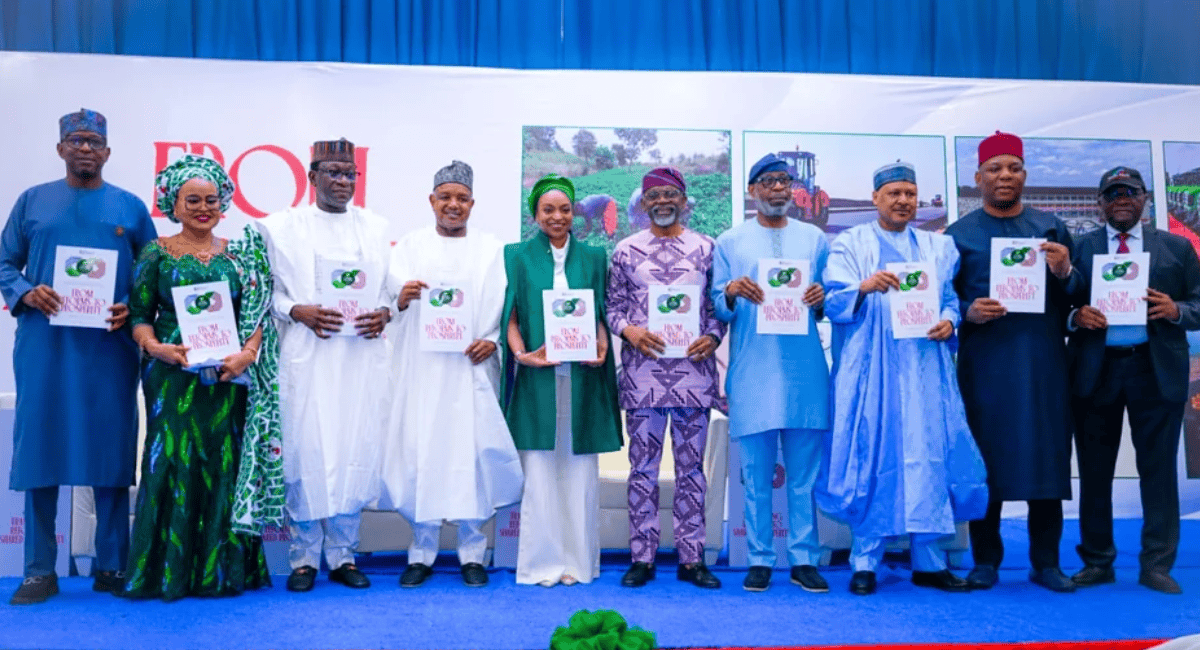
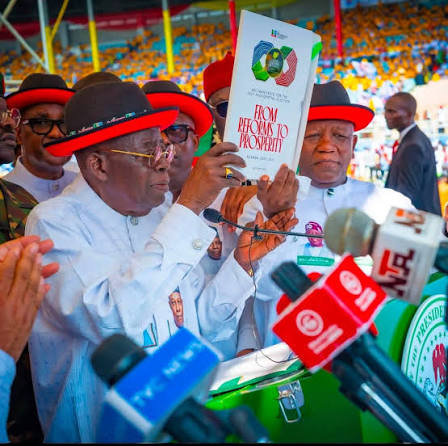
Selling a second-term vision on the back of painful macroeconomic therapy is the hardest pitch in politics. When the All Progressives Congress Presidential Campaign Council (APC-PCC) gathered in Abuja on Tuesday, 10 November 2026, to unveil President Bola Ahmed Tinubu’s 2027 re-election manifesto, the president himself was notably absent from the room. In his stead, Chief of Staff Femi Gbajabiamila, Campaign Council Spokesperson Dele Alake, and Budget and Economic Planning Minister Atiku Bagudu made a blunt admission that the removal of petrol subsidies and the unification of the foreign exchange windows since May 2023 have placed severe pressure on Nigerian households. Yet the ruling party insists the worst of the surgery is over.
That pitch is codified in the newly released 109-page manifesto, officially titled the Renewed Hope Agenda 2.0 and themed “Translating Reforms into Shared Prosperity” for the 2027 to 2031 term. To justify a second mandate, the document leans heavily on recent macroeconomic indicators like foreign reserves reaching $55.3 billion in September 2026, headline inflation moderating to 14.63 per cent that same month, Q2 2026 GDP growth hitting 4.43 per cent, and Federation Account Allocation Committee (FAAC) distributions jumping to ₦18.72 trillion in the first half of 2026 compared to ₦6.76 trillion in the first half of 2023. For Nigeria’s technology ecosystem, however, sovereign balance sheets do not automatically pay cloud invoices or power data centres.
Four pillars and 35 promises
Rather than introducing a fresh set of campaign slogans, the Renewed Hope Agenda 2.0 consolidates the administration’s original eight-point framework into four strategic pillars containing at least 35 distinct commitments.
- Secure and Resilient Nation: Focuses on intelligence-led kinetic security, deploying 50,000 newly recruited police officers toward a 1:400 officer-to-citizen ratio, completing e-surveillance across the remaining 31 of 190 mapped borders, and enrolling 95 per cent of citizens into the National Identity Database.
- Better Quality and More Affordable Life for Every Nigerian: Targets halving youth unemployment and out-of-school children by 2031, delivering 200,000 homes across all 774 local government areas, cutting out-of-pocket health spending below 50 per cent, and scaling technical and digital capabilities.
- Energy, Infrastructure and Economic Growth: Commits to scaling available grid electricity generation toward 10,000 megawatts, installing seven million additional electricity meters, establishing flagship industrial hubs in all six geopolitical zones, and accelerating annual GDP growth to 6 per cent.
- Effective and Accountable Governance: Pledges to digitise all court processes nationwide by 2029, transition federal ministries, departments, and agencies (MDAs) to end-to-end digital workflows, and subject every manifesto promise to an independently verified public delivery tracker.
Tinubu’s core promises to the tech community
To understand why this document matters to startup founders and stakeholders across the country, one only has to look at how technology is woven across all four pillars. The manifesto shifts digital policy away from isolated ministry programmes toward state-supported industrial infrastructure:
- One Million Export-Linked Jobs and Services Financing: Under Pillar 3, the administration pledges to more than double non-oil export earnings and create one million export-linked jobs for young Nigerians through talent and digital services exports by 2030. Rather than treating software like physical cargo, the blueprint promises bespoke export credit, factoring facilities, and working capital for B2B outsourcing and SaaS operators.
- Collateral-Free Capital and the Youth Bank Law: Under Pillar 2, the platform commits to enacting the proposed Youth Bank Law while expanding NEXTGEN Bank lending, YouthCred’s partner-bank network, and the rejuvenated Nigeria Youth Investment Fund. It also pledges to scale the Student Venture Capital Grant, Diaspora BRIDGE, and the BOI-NYSC entrepreneurship windows (which have funded 860 corps members with grants between ₦100,000 and ₦2 million to date) to provide equity and debt without traditional real estate collateral.
- Project BRIDGE and Digital Public Infrastructure (DPI): Recognising that edge innovation fails without bandwidth, the manifesto positions Project BRIDGE as the digital counterpart to physical trade corridors, deploying over 90,000 kilometres of open-access fibre-optic cable to expand Nigeria’s national backbone from 35,000 km to 125,000 km. On the software layer, Pillar 1 commits to integrating the remaining government databases (building on 11 of 20 databases and 44 of 50 MDAs already linked) into a central foundational biometric identity stack, alongside scaling the Digital Literacy for All programme from 748,988 trainees toward 30 million Nigerians and launching a Digital MSME Academy.
On paper, the manifesto addresses the exact friction points early-stage founders have decried for a decade. In practice, three operational realities require scrutiny.
First is the tension between tax relief and revenue collection pressures. Gbajabiamila highlighted recent tax reforms as a relief for lower-income earners and qualifying small companies. Yet tech startups continue to navigate a fragmented compliance environment marked by multi-agency enforcement and statutory levies. Rationalising corporate taxes through automation will only stimulate local startups if federal and state collection agencies halt overlapping assessments.
Second is the bureaucratic risk in state-backed venture lending. Collateral-free credit through a statutory Youth Bank sounds transformative, but public credit vehicles in Nigeria historically struggle with adverse selection and political patronage. Without private-sector venture debt mechanics or co-investment rules with vetted angel syndicates, state loan windows risk bypassing actual high-growth technology ventures.
Third is the execution timeline for hard infrastructure. Scaling grid generation to 10,000 megawatts and laying 90,000 kilometres of fibre require uniform right-of-way harmonisation across 36 state governors and ironclad security against cable vandalism. Until dedicated power reaches industrial clusters, startups and data centres will continue bleeding working capital on diesel and off-grid solar arrays.
Waiting on Obi and Atiku
A manifesto does not exist in a political vacuum. While minor contenders like Donald Duke of the Peoples Redemption Party (PRP) and Seyi Makinde of the Allied Peoples Movement (APM) have outlined broad developmental visions, Nigeria’s two principal opposition heavyweights, Peter Obi of the Nigeria Democratic Congress (NDC) and former Vice President Atiku Abubakar of the African Democratic Congress (ADC), have yet to publish their formal 2027 manifestos.
When their blueprints drop, the tech community will have a critical three-way comparison to make. Based on their established economic doctrines, the implicit divergences are already clear.

An Obi manifesto will likely anchor on fiscal austerity, slashing governance costs, and a “consumption-to-production” industrial mandate that removes discretionary waivers while enforcing strict tax transparency. Conversely, an Atiku blueprint will predictably champion aggressive market liberalisation, privatising state infrastructure rather than relying on government-led Special Purpose Vehicles (SPVs) like Project BRIDGE, and deploying broad corporate tax cuts to court foreign direct investment.
As opposition manifestos emerge, the Nigerian tech community must assess not just the breadth of political promises but also the mechanisms of implementation, regulatory restraint, and monetary predictability each contender brings to the table.
The APC document succinctly declared, “A manifesto is only as strong as the promises a citizen can check.” As 2027 approaches, the Nigerian tech community must hold the incumbent to its promised public delivery dashboards, demand equally granular blueprints from the opposition, and vote strictly on verifiable execution rather than campaign rhetoric.
