




Artificial intelligence-powered solutions have become entrenched in tech offerings. This explains the global funding boom for AI startups. However, this boom isn’t entirely global, as reports indicate that African startups only raised a fraction of the lot.
AI startups around the world raised a total of $47.3 billion between March and June (Q2, 2025). Of the total, $14 million was raised by African startups across 5 deals. This represents a paltry 0.02% of the total, effectively making Africa the least funded region in the world, by far.
By large contrast, the United States of America was by far the leading contributor to the global haul, with AI startups in the country raising $39.7 billion across 728 deals. This represents an overwhelming 83.9% of the total.
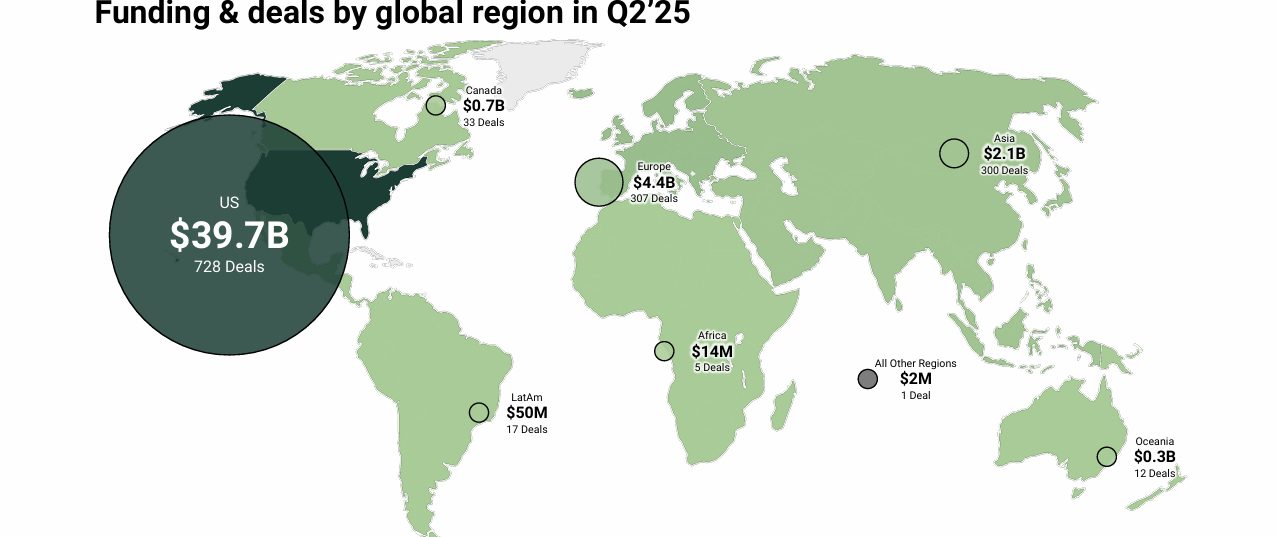
Europe came a distant second with startups on the continent raising $4.4 billion across 307 rounds. This represents 9.3% of the global total raised in the quarter. The Asian region comes next with $2.1 billion raised across 300 deals, representing 4.4 per cent of the total raised.
Canadian startups raised $700 million across 33 deals, 1.47% of the global quarterly total. Next is the Oceania region, where startups raised $300,000000 across 12 funding rounds and representing 0.6 per cent of the total funding.
The Latin American region saw startups raise $50 million across 17 deals. This represents 0.1% of the total. The African region is the least funded.
See also: 500 Nigerian languages will be dead in 50 years if they are not AI-compliant- linguistics prof
Q2 2025 was the second-highest funding quarter for AI startups
Innovations built around artificial intelligence have continued to enjoy tremendous funding globally. This was buttressed by an impressive $47.3 billion funding into AI startups across 1,403 deals recorded during the three months under review, making Q2 2025 the second most funded quarter ever.
According to CB Insights:
“AI startups raised $47.3 billion in the quarter, marking the second-highest funding total on record, thanks to massive deals like Meta’s $14.8 billion minority stake in Scale. Deal volume edged up 2.5 per cent from Q1’25. Investors are increasingly aggressive when deciding to invest. Median deal size reached $4.6 million in 2025 YTD — a 4-year high.”
Quarterly, however, the funding represented a decline from the $68.9 billion recorded in the first quarter of the year, representing a still 31.3 per cent drop.
Yet, funding into AI startups has crossed the $40 billion mark for the third straight quarter, indicating steady, strong interest in companies making artificial intelligence their backbone.
Put together, though, 2025 is already the most funded year for AI startups ever recorded, despite being just 6 months in. Globally, $116.1 billion has already been raised in 2025 so far. This represents roughly a 10 per cent increase from the $105.7 billion raised in the whole of 2024 and nearly double the sum raised in 2023 and 2022 combined.

Aside from funding, investors and major organisations are also expressing strong interest in the acquisition of AI startups, possibly to integrate them into their operations. At least 177 exits were recorded across the globe, an all-time high in quarterly exits, dwarfing the 100 recorded in the previous quarter and the 120 recorded in the quarter before that.
Indeed, the 177 acquisitions recorded in Q2 are double the quarterly average over the last five years of 89 exits. However, the United States alone was largely responsible for the exponential amounts of exits, with acquisitions of US-based AI startups nearly doubling quarter-over-quarter.
As artificial intelligence continues to permeate personal and professional life, investment in AI solutions continues to soar. However, while AI startups across the globe continue to carve huge chunks of this investment, investors do not seem very interested in African AI startups.
But as these African startups continue to develop solutions that solve local problems, hopefully, it is just a matter of time before they start getting the financial backing they require.
