




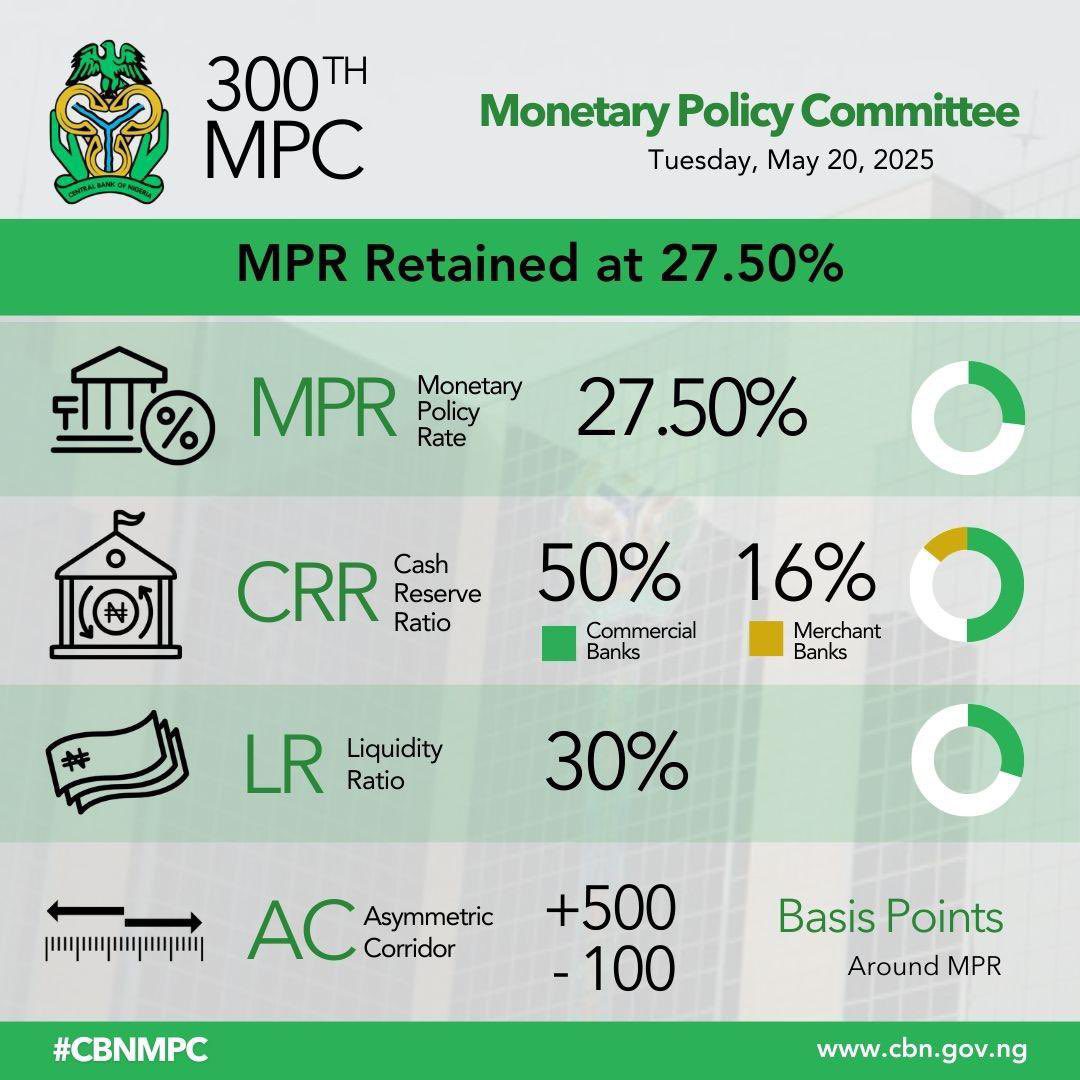
The Central Bank of Nigeria (CBN) announced today that its Monetary Policy Committee (MPC) has unanimously decided to maintain the Monetary Policy Rate (MPR) at 27.50% during its 300th meeting held on May 19-20, 2025, at the CBN headquarters in Abuja. The decision, disclosed by CBN Governor Olayemi Cardoso during a live press briefing on YouTube (YouTube.com/cenbank), reflects the committee’s cautious approach amid signs of easing inflation and ongoing economic challenges.
The MPC also retained the Cash Reserve Ratio (CRR) at 50% for Deposit Money Banks and 16% for Merchant Banks, the Liquidity Ratio (LR) at 30%, and the Asymmetric Corridor at +500/-100 basis points around the MPR.
The two-day meeting, a significant milestone for Nigeria’s apex monetary policy body, was closely watched by investors, analysts, and policymakers as it addressed critical economic issues, including persistent inflation, naira volatility, and global economic uncertainties.
The decision to hold the MPR steady follows a sharp decline in headline inflation to 23.71% in April 2025 from 24.23% in March, according to the National Bureau of Statistics (NBS). This drop, attributed partly to the rebasing of the Consumer Price Index (CPI) from 2009 to 2024, signals a potential stabilisation in price dynamics, though monthly price pressures remain a concern.

Governor Cardoso, speaking at the press briefing, emphasised the MPC’s commitment to sustaining recent macroeconomic gains while addressing structural challenges.
“The committee is encouraged by the downward trend in inflation and the stabilisation of the foreign exchange market,” Cardoso stated. “However, we remain vigilant as monthly price increases indicate that inflationary pressures are not fully subdued.”
He highlighted the role of recent reforms, including efforts to stabilise the naira and reduce the cost of Premium Motor Spirit (PMS), in fostering economic stability. Cardoso also called for stronger coordination between monetary and fiscal authorities to address structural bottlenecks and supply chain inefficiencies, which continue to drive inflation.
The MPC’s decision to maintain the MPR at 27.5% aligns with expectations from industry professionals, who anticipated a cautious stance given the complex economic environment. While a modest 25-basis-point hike was possible, the consensus leaned toward holding rates steady to assess the impact of prior tightening measures. The committee’s focus remains on anchoring inflation expectations, supporting the naira, and bolstering investor confidence.
CBN’s MPC stand signals optimism as the economy shows signs of recovery
The 300th MPC meeting comes at a time of cautious optimism for Nigeria’s economy. The NBS reported that food inflation eased to 21.26% in April 2025 from 21.79% in March, reflecting slight relief in household cost burdens. However, the headline inflation index rose from 117.34 in March to 119.52 in April, underscoring persistent monthly price growth. Analysts note that structural issues, such as supply chain inefficiencies and high energy costs, continue to challenge the CBN’s efforts to achieve price stability.
The committee also reviewed global economic conditions, noting the International Monetary Fund’s projection of 3.2% global growth for 2025 and Nigeria’s upwardly revised growth forecast of 3.3%. However, global inflationary pressures and geopolitical tensions pose risks to Nigeria’s economic outlook. The MPC emphasised the need for continued vigilance to ensure that inflation expectations remain well-anchored.
Recently, critics, including Gboyega Nasiru, chairman of the House Committee on National Planning and Economic Development, have warned of the unintended consequences of high interest rates, such as slowed economic growth and rising unemployment. Lending rates have surged from 28% in 2023 to 35.5% in 2024, discouraging business expansion and exacerbating unemployment. Nasiru urged the CBN to adopt a more accommodating stance to promote growth and job creation.
The MPC’s decision to retain all monetary policy parameters reflects a delicate balancing act between curbing inflation and fostering economic growth. Cardoso reiterated the CBN’s commitment to data-driven policies and ongoing reforms to strengthen the banking system’s stability. The committee commended recent recapitalisation initiatives and urged sustained regulatory oversight to ensure financial sector resilience.
As Nigeria braces for its path toward economic recovery, the outcomes of the 300th MPC meeting will likely shape market sentiment and policy expectations in the coming months. The next MPC meeting is scheduled for July 21-22, 2025, where the committee will reassess economic conditions and adjust policies as needed.
