




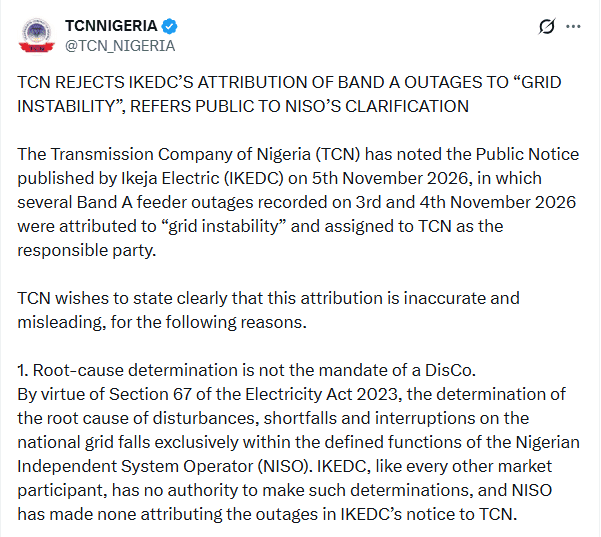
The Transmission Company of Nigeria (TCN) has pushed back against claims by Ikeja Electric Distribution Company about recent outages in parts of Lagos. The transmission company says that Ikeja Electric is misleading customers by blaming these outages on issues with the power grid.
In a statement, the transmission company clarified that Ikeja Electric’s announcement on November 5 falsely attributed the cause of power outages on November 3 and 4 to it. TCN explained that the actual reason for the reduced electricity supply is lower power generation, which has resulted in load shedding, rather than any issues with the transmission network itself.
This dispute comes after Ikeja Electric issued an apology to its customers for not meeting the minimum requirement of 20 hours of power supply on November 3 and 4. They had earlier noted that the reduced electricity supply was due to lower allocations from the national grid.

TCN says most feeder interruptions were caused by low generation
To back up its claims, the company shared records showing the outages that affected Ikeja Electric on November 1 and 2. They mentioned that 68% of these outages were due to load shedding triggered by low electricity generation.
About 26% were because Ikeja Electric did not follow the load allocations set by the National Control Centre or were related to issues with their distribution network, like faults and maintenance. The last 6% were due to TCN’s own planned maintenance or switching operations. Importantly, the transmission company stated that none of these outages was caused by equipment failures on their transmission network.
Read the backstory here: Persistent Lagos power outages: Ikeja Electric blames reduced grid allocation
They also reported on 46 outages related to the 33kV feeders that Ikeja Electric had mentioned. Out of these, 29 were due to load shedding linked to low generation, while 14 were the responsibility of Ikeja Electric. This included nine cases where they didn’t comply with load allocations and five instances of faults or trips in their network. The last three outages were due to scheduled maintenance by TCN on the Ogba–Alimosho line on November 1.
The transmission company pointed out a specific case involving the Rack Centre feeder, where a cable fault on Ikeja Electric’s network caused an outage on November 2, and the issue was fixed by Ikeja Electric’s own team. It’s worth noting that TCN’s figures only cover November 1 and 2, not the period of November 3 and 4, which is when Ikeja Electric issued its apology.
NISO points to gas shortages and lower hydropower output
TCN also recently referred to a statement made by the Nigerian Independent System Operator (NISO) on November 5. NISO pointed out that issues with gas supplies and lower water levels at hydroelectric plants are the main reasons for the drop in electricity generation.
Because of limited gas, some thermal power stations cannot run at their full capacity. Additionally, less water in reservoirs is impacting hydropower generation. This decline in electricity means there’s less power available for distribution companies, resulting in shorter supply hours and more frequent power cuts.
According to the Electricity Act 2023, NISO is tasked with important responsibilities related to managing electricity generation and transmission. The company emphasised that distribution companies should rely on accurate information from NISO when discussing power supply issues.
They urged companies like Ikeja Electric to stop making what they call baseless claims about the reasons for power shortages. The transmission company’s role is to transmit the electricity it receives, not to generate it.
For customers, this back-and-forth does not change the fact that some premium customers are still getting less than the 20 hours of electricity they were promised. The disagreement between the transmission company and distribution companies leaves consumers confused, as they hear different reasons for outages while ongoing generation problems continue to impact electricity supply.
Read also: Power shortages, broadband costs, funding gaps threaten Nigeria’s digital economy, experts say
