


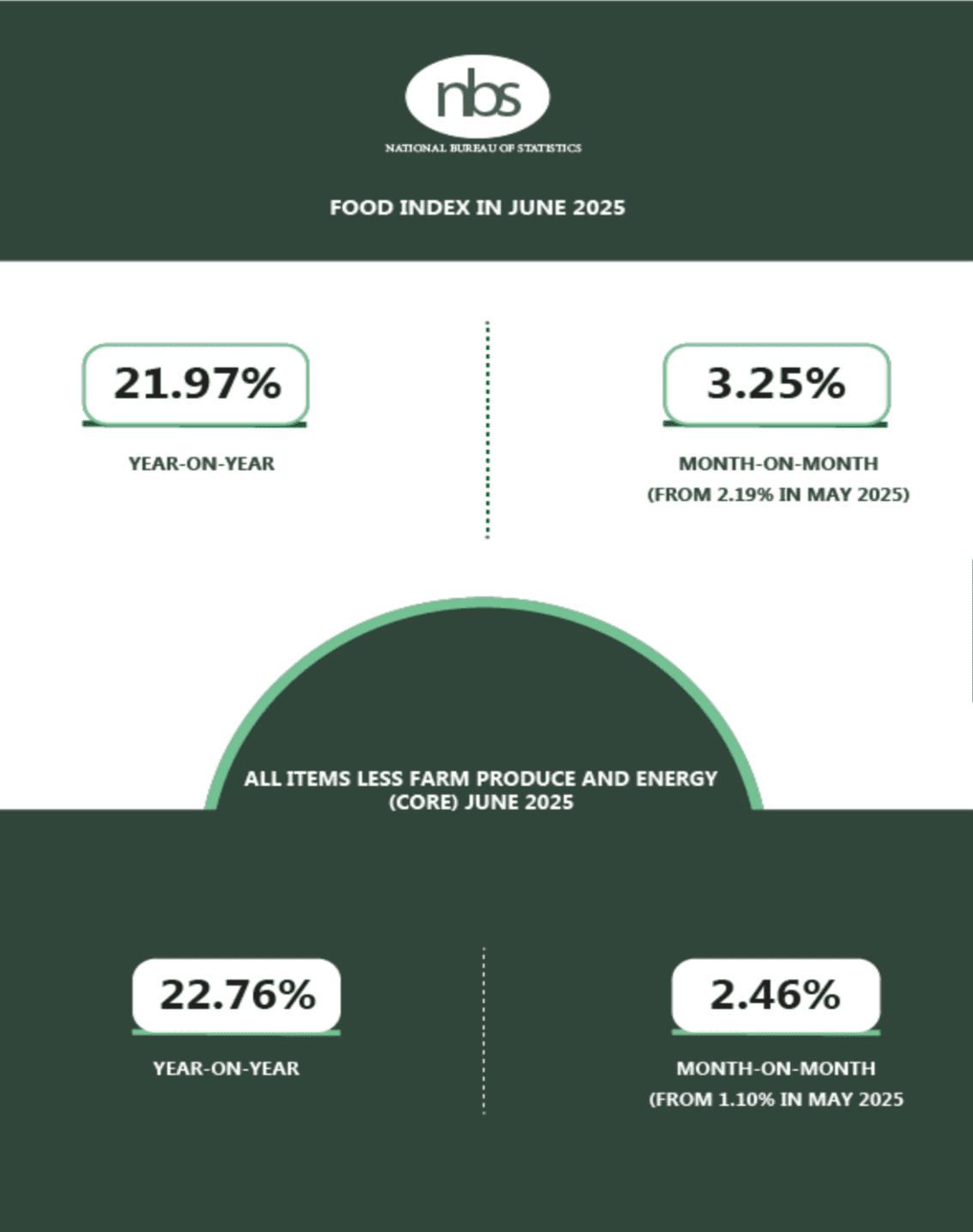
Inflation in the food index for June 2025 has been reported by the National Bureau of Statistics (NBS), revealing a rate of 21.97% year-on-year. This marks a notable rise compared to the previous month, with a month-on-month increase of 3.25% from 2.19% in May 2025.
The data, which excludes farm produce and energy, shows an even steeper year-on-year climb at 22.76%, with a month-on-month rise of 2.46% from 1.10% in May 2025. These figures paint a picture of growing economic pressure on households across Nigeria as food prices continue to escalate.
Breaking down the data further, the urban and rural index provides additional insight. Urban areas saw a year-on-year inflation rate of 22.72%, with a month-on-month increase of 2.11% from 1.40% in May 2025.
In contrast, rural regions experienced a slightly lower year-on-year rate of 20.85%, with a modest month-on-month rise of 0.63% from 1.83% in May 2025. This disparity highlights the varying impacts of inflation across different living environments, with urban dwellers facing a sharper increase in costs.
The headline Consumer Price Index (CPI) for June 2025 also reflects this upward trend, recording a year-on-year rate of 22.22% and a month-on-month increase of 1.68% from 1.53% in May 2025. Over the past 12 months, the CPI has fluctuated, peaking at 34.80% before settling at 22.22% in June. The shift from the old base year of 2009 to the new base year of 2024 offers a fresh perspective on these changes, showing a gradual decline from 23.18% in May to the current figure.
Read also: CBN survey indicates easing inflation in rural Nigeria, different tale for urban areas
Regional inflation
Regionally, the all-items inflation rate varies widely. On a year-on-year basis, Borno leads with the highest rise at 31.63%, followed by the Federal Capital Territory (FCT) at 26.79% and Benue at 25.91%. At the other end of the spectrum, Zamfara recorded the slowest rise at 9.90%, with Yobe at 13.51% and Sokoto at 15.78%.

For month-on-month changes, Ekiti topped the list with a 5.39% increase, closely followed by Delta and Lagos, both at 5.15% and 5.13% respectively. Meanwhile, Zamfara saw the slowest rise at 6.89%, with Niger at 5.35% and Plateau at 4.01%.
These figures underscore the uneven economic landscape across Nigeria, where some states grapple with significantly higher inflation rates than others. The sharp increases in states like Borno and Ekiti suggest localised factors driving up costs, possibly linked to supply chain disruptions or regional demand. Conversely, the slower rises in Zamfara and Plateau indicate a more stable price environment, though still above comfortable levels for many residents.
